Columbia, SC Rental Market: Rents, Vacancy and Demand in 2026
November 2, 2026
The Columbia rental market is steady, affordable by Sun Belt standards and in the middle of a supply wave. Depending on the data source, a typical Columbia unit asks between roughly $1,330 and $1,520 a month. One-bedrooms mostly sit near $1,000 to $1,300 and three-bedrooms near $1,700 to $1,850. Rent growth is flat to modest, and occupancy is softer than it was a few years ago because thousands of new apartments are being built. This guide lays out the numbers, explains why they differ, and shows what they mean if you own or plan to buy rental property in the Midlands.
TL;DR
- Median asking rent across Columbia ZIP codes is about $1,523 for all unit types, with one-bedrooms near $1,031 and three-bedrooms near $1,713 in one October 2026 dataset.
- Multifamily asking rents averaged $1,332 in Q1 2026, up 1.3% year over year, so growth is slow and stable rather than hot.
- About 1,897 units were under construction in Q1 2026, and multifamily occupancy was 89.5%. Owners who price and market well will keep the edge.
- Downtown is the priciest submarket and the center of new development. North Richland County is the growth corridor to watch.
- Renting saves only about $271 a month over owning in Columbia, one of the smallest gaps among large U.S. markets, which supports steady demand for single-family rentals.
Table of Contents
- What rents look like by bedroom count
- Where rents are heading
- Supply, demand and what is driving both
- Neighborhoods: where rents run highest and lowest
- Occupancy and vacancy: the investor signals
- Renting versus owning in Columbia
- Short-term rentals compared with long-term leases
- What this means if you own or plan to buy
- Our perspective on the Columbia market
- Get help turning market data into returns
- FAQ
- Sources
What rents look like by bedroom count
No single number describes Columbia rent, because every dataset samples different listings. Some count only large professionally managed apartment communities, some pull from online listings across all property types, and some cover only certain ZIP codes. Read them as a range.
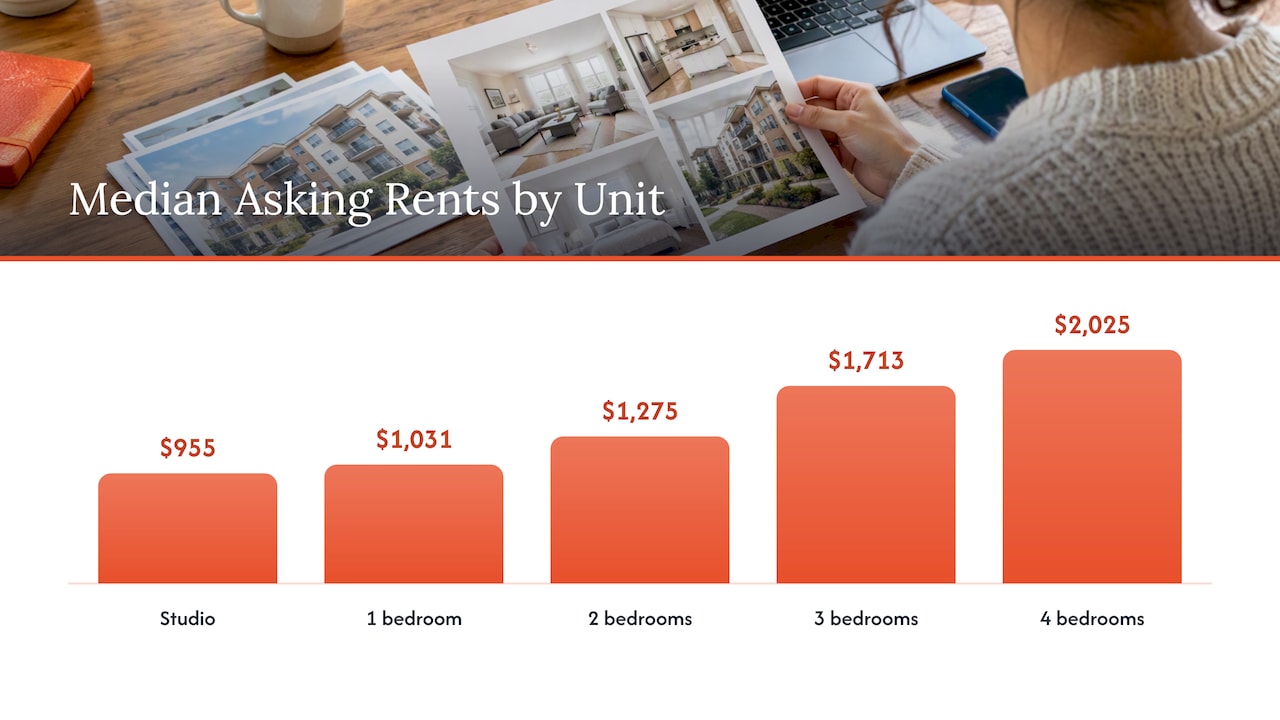
The most useful property-type breakdown comes from PropMetrics, updated October 2026, which reports median asking rents across Columbia ZIP codes:
| Unit size | Median asking rent |
|---|---|
| Studio | $955 |
| 1 bedroom | $1,031 |
| 2 bedrooms | $1,275 |
| 3 bedrooms | $1,713 |
| 4 bedrooms | $2,025 |
| All units | $1,523 |
The jump from two to three bedrooms is the number to notice. A three-bedroom house costs about $440 more than a two-bedroom unit, which is where the single-family rental segment starts to separate from the apartment market. Families, military households connected to Fort Jackson and graduate students sharing space tend to shop in that bracket.
For a second reference point on the apartment side, RentEst’s September 2026 report puts average apartment and condo rent at $1,268 for one-bedroom units across 107 properties and $1,196 for two-bedrooms across 59 properties. Samples that small move with a few new buildings, which is why one-bedroom averages can look higher than medians from broader data.
Why you will see different numbers online
An average is pulled up by luxury new construction, while a median is not. A figure for a single neighborhood near the University of South Carolina can run well above a metro-wide one. And asking rent is what landlords list, not necessarily what tenants sign for after concessions.
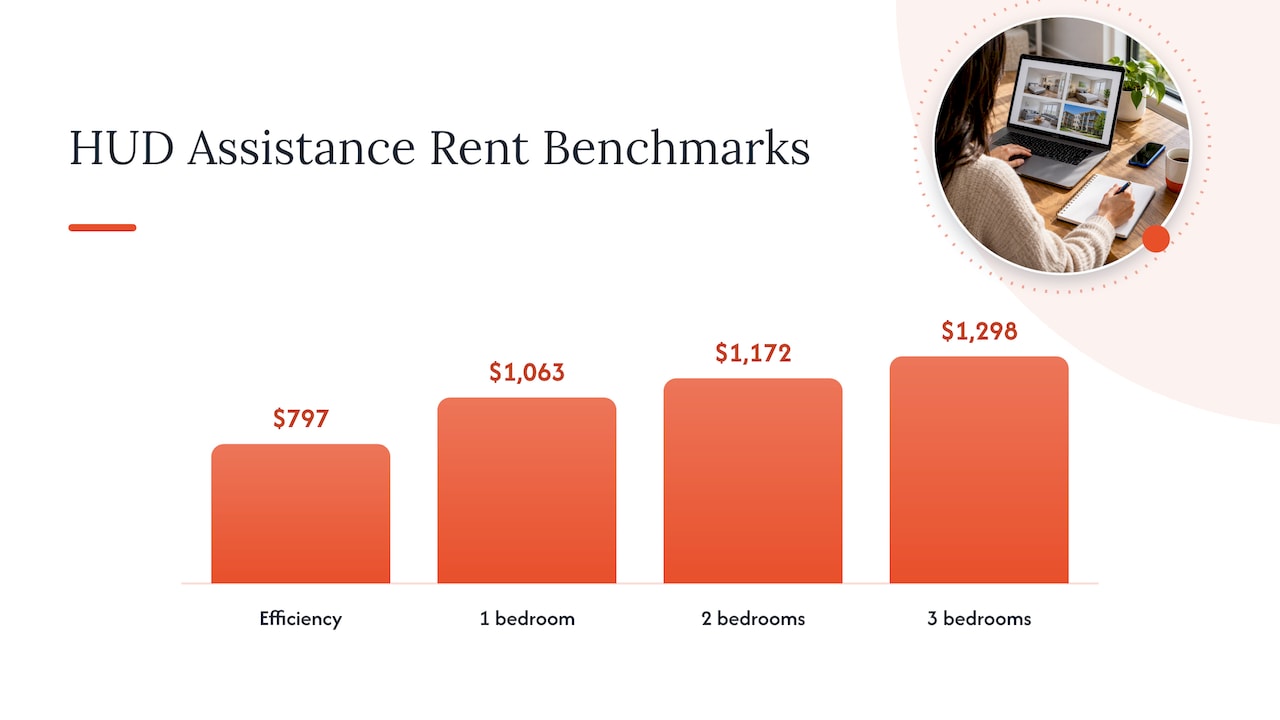
Government benchmarks add another layer. HUD’s HOME rent limits effective June 1, 2025 list Fair Market Rents for the Columbia metro area of $797 for an efficiency, $1,063 for one bedroom, $1,172 for two bedrooms and $1,298 for three bedrooms. These are program benchmarks. HUD explains that Fair Market Rents are estimates of 40th-percentile gross rents for standard-quality units, used for housing assistance. They matter if you plan to accept housing vouchers, but they are not a market average and should not be used to price a renovated listing.
Where rents are heading
The short version: slowly up, not spiking. Colliers reported that average multifamily asking rents in Columbia were $1,332 in Q1 2026, a 1.3% increase year over year. Earlier, Colliers said in its Q4 2025 Columbia report that consistent supply growth was stabilizing rents and maintaining affordability.
IRR’s mid-year 2025 viewpoint adds useful context. Columbia’s long-term rent growth has lagged larger peer metros, but recent growth has been stable and has avoided the negative trends seen in supply-heavy Sun Belt markets. For an owner, that profile means fewer windfalls and also fewer sharp drops. Returns here come from steady occupancy and controlled expenses more than from rent spikes.
Supply, demand and what is driving both
Demand: government, the university and a growing region
Columbia’s economy rests on stable anchors. IRR’s 2026 annual viewpoint names state government and the University of South Carolina as the stable drivers, and notes that population has grown about 5% since 2020, trailing Charleston and Charlotte. That is growth without the boom-and-bust pattern. Students, state employees and military-linked households keep a floor under demand year after year.
North of the city, the picture is more dynamic. Colliers counts 648 units under construction in the North Richland County submarket as of Q1 2026, supported by demand from the emerging Scout Motors hub.
Supply: downtown is the epicenter
The same Colliers report shows 1,114 units under construction downtown in Q1 2026, which it says will expand downtown inventory by roughly 25%. Across the metro, the Colliers Q1 2026 market report shows total multifamily inventory of 54,343 units after 777 new deliveries in the quarter.
If you are evaluating a new-build deal or an apartment purchase in this pipeline, run the numbers with realistic lease-up assumptions. Tools such as multifamily deal analysis tools can help you stress-test rents and occupancy before you commit.
Neighborhoods: where rents run highest and lowest
IRR’s 2026 annual report identifies Downtown as the most expensive submarket in Columbia. That fits what you see on the ground: new mid-rise and mixed-use buildings near Main Street and the Vista price above the metro average, and they compete mainly with each other.
Outside the core, rents step down. Single-family neighborhoods across the Northeast, Irmo, Lexington County and the areas near Fort Jackson draw families who want a yard, a garage and school access. Those households rent three- and four-bedroom homes in the $1,700 to $2,000 band, and they tend to stay longer than apartment tenants. Properties close to the university behave differently again. They lease on an academic calendar, often with pre-leasing months ahead, and they need active turnover management each summer.
Because published data on individual ZIP codes varies widely in quality, treat any ZIP-level number as a starting point and confirm it against recent signed leases for comparable homes on the same street.
Occupancy and vacancy: the investor signals
Occupancy is where the supply wave shows up. Colliers reports Columbia’s multifamily occupancy at 89.5% in Q1 2026, down from 90.3% the prior quarter, with net absorption of 204 units. Innago’s 2026 vacancy report puts the metro rental vacancy rate at 9.1% as of Q1 2026, and links South Carolina’s vacancy trends partly to heavy construction in metros like Columbia.
What this means in practice:
- Newer apartment communities will compete on concessions. A single-family home with a good renovation, a fenced yard and a fast response to maintenance requests competes on a different axis.
- Days on market matter more than the last dollar of rent. A vacant month costs more than a $25 rent bump earns back over a year.
- Retention is the cheapest source of income. Tenants who renew save you the turnover cost, cleaning, leasing fees and vacancy.
Renting versus owning in Columbia
Columbia is one of the markets where renting offers the least savings. A January 2026 LendingTree study, reported by the Post and Courier, found renters saved about $271 a month compared with homeowners, the third-smallest gap among the 100 largest U.S. markets. The assumptions behind that comparison include down payment, mortgage rate, insurance, taxes and maintenance, so your own household’s math may differ.
For landlords, a narrow gap has two effects. Some renters will decide to buy, so the tenant pool turns over. And well-located houses that rent for close to a mortgage payment give owners a clearer picture of cash flow, which is why single-family rentals remain a core strategy here.
Short-term rentals compared with long-term leases
Short-term rental income in Columbia is real but modest. AirDNA reported 96 active listings in September 2026, with average annual revenue of $29K, 60% average occupancy and an average daily rate of $144. A property earning $29K gross still has to cover cleaning, platform fees, utilities, furnishing and more active management. Compare that with a standard 12-month lease at the rents above, which brings predictable income with less operating work. Check city and HOA rules before listing any home short-term.
What this means if you own or plan to buy
- Price against your direct comparables. Use the bedroom-level medians as a frame, then adjust for condition, parking, pets and distance to downtown, the university or Fort Jackson.
- Underwrite conservatively on occupancy. With multifamily occupancy under 90%, assume some vacancy and concessions in the first year of any new purchase.
- Favor the segments with fewer new competitors. Renovated single-family and small multifamily properties are not the ones flooding the downtown pipeline.
- Plan maintenance before it is urgent. Turnover is where margins are won or lost. Reliable vendors and a preventive schedule protect rent.
- Watch the north. The Scout Motors corridor in North Richland County is where new demand is being planned for.
Our earlier posts on studying rental rates before investing and getting good deals on investment properties go deeper on the purchase side.
Our perspective on the Columbia market
We have managed 2,700 properties across 10 regional markets over more than 15 years, and Columbia behaves like the markets that reward patient owners. Rent growth is slow, demand is anchored by government, the university and the military, and new supply is arriving. That combination punishes owners who guess and rewards owners who manage.
Our approach is to treat a rental as an investment asset, not a chore. A pod-based team gives each owner a focused group of people who know their home. In-house maintenance and transparent vendor selection keep repair costs and response times under control. Proactive resident retention matters most in a market with rising supply, because a renewed lease avoids the vacancy and leasing cost that supply pressure makes more expensive.
If you own in Columbia, the question is rarely whether the market is good enough. It is whether your property is priced, presented and maintained so that it stays full. That is the work we do, so owners can earn reliable returns with minimal hands-on involvement.
MediaBeast
Get help turning market data into returns
Reading the numbers is the easy part. Pricing a specific house, placing the right tenant and keeping maintenance on schedule is where owners lose time. Our property management team handles leasing, tenant placement, rent collection, maintenance and renovation oversight for single-family, multifamily and build-to-rent properties. If you are still deciding what to buy, our brokerage services and asset management teams can help you evaluate acquisitions against the market conditions above. Pricing is not published, so contact us for a quote based on your property.

If you are looking for a place to rent rather than an investment, browse our current Columbia homes for rent.
FAQ
What is the average rent in Columbia, SC?
It depends on the dataset. PropMetrics shows a median asking rent of $1,523 across all unit types, while Colliers reports average multifamily asking rent of $1,332 for Q1 2026. Apartments skew lower and houses higher, so check the bedroom count and property type before comparing.
Are Columbia rents going up?
Slowly. Colliers measured a 1.3% year-over-year increase in average multifamily asking rent in Q1 2026. With nearly 1,900 units under construction, large jumps are unlikely in the near term, though well-run single-family rentals can hold their pricing.
Is Columbia a good market for rental investors?
It suits investors who value stability over speculation. Demand is supported by state government, the University of South Carolina and nearby growth around North Richland County, while renting is only slightly cheaper than owning. Occupancy is softer in new apartment buildings, so underwrite conservatively and plan for strong management.
Which part of Columbia is most expensive to rent in?
IRR identifies Downtown as the most expensive submarket. It is also where the largest share of new apartment construction is concentrated, so competition among new buildings is likely to increase.
Do HUD Fair Market Rents tell me what to charge?
No. HUD sets them as benchmarks for housing assistance programs, based on 40th-percentile rents for standard-quality units. Use them if you accept vouchers, and use current local listings to set your market rent.
Sources
- HUD HOME rent limits for South Carolina, effective June 1, 2025
- HUD Fair Market Rents by state, county and metro area
- PropMetrics: Columbia, SC rents
- RentEst: Average rent in Columbia, SC
- Colliers Columbia multifamily report, Q1 2026 (summary)
- Colliers Columbia multifamily report, Q1 2026 (PDF)
- Colliers Columbia multifamily report, Q4 2025
- IRR 2025 mid-year viewpoint, Columbia multifamily
- IRR 2026 annual viewpoint, Columbia multifamily
- Innago rental vacancy rates by state
- Post and Courier: renting versus owning in Columbia
- AirDNA: Columbia, SC short-term rental data
- Multifamily deal analysis tools