Skip to content

Six Step Tenant Screening That Meets HUD and FCRA Rules for Landlords

Tenant screening is the systematic, documented process landlords use to verify identity, income, credit, criminal history, and eviction records before handing over keys. The core steps run in order: pre-screen, collect a signed application with FCRA consent, verify identity, pull credit and background reports, confirm income, check references, then decide. Two rules govern every step: get written authorization before pulling any consumer report, and apply your written criteria the same way to every applicant.


TL;DR:

  • Most tenant screening processes, including credit, criminal, and eviction checks, are completed within two to five business days if conducted simultaneously.
  • Using a documented six-step screening process significantly reduces risks like eviction and unpaid rent, as it covers application, identity, credit, criminal, eviction, and income verification.
  • Applying consistent, written screening criteria before listing a property protects against legal claims and ensures fair treatment of all applicants.
  • Red flags such as eviction judgments and prior landlord debt are strong indicators of non-payment risk, but ambiguous records should be verified before denial.
  • Turning screening over to a professional property management service, like Auben Realty, streamlines the process, ensuring legal compliance and saving landlords time and effort.

Aubenrealty
Make Tenant Screening Easier
Auben Realty provides property management, tenant placement, and local market expertise for owners seeking less hands-on involvement.

Explore Auben Realty

Table of Contents

Why Tenant Screening Matters for Your Bottom Line

A bad placement costs far more than a screening fee. Once you factor in lost rent during an eviction filing, court costs, unit turnover, and possible property damage, a single failed tenancy can wipe out months of cash flow on that unit. Screening fees typically cost a moderate amount per applicant. That gap between screening costs and eviction costs is the entire business case for doing this consistently rather than skipping it when you’re desperate to fill a vacancy.

A documented six-step process, covering application, identity verification, credit, criminal history, eviction records, and income verification, reduces placement risk more than any single check performed alone. Landlords who only run a credit check, for example, miss prior landlord debt sitting in an eviction database that a credit bureau never touches.

Screening also functions as legal insurance. When you apply the same written criteria to every applicant, you build a paper trail that protects you if a denied applicant ever claims discrimination. When you skip that consistency, even a single subjective exception, approving one friend-of-a-friend without running the full process, can undermine your defense in a Fair Housing complaint later.

Here’s what a consistent process actually reduces:

  • Eviction filings and the legal fees that come with them
  • Chargebacks from unpaid rent and damage beyond the deposit
  • Vacancy days spent re-marketing after a failed tenancy
  • Fair Housing complaints tied to inconsistent or undocumented decisions
  • Turnover costs from cleaning, repainting, and re-listing a unit

Screening Snapshot: A comprehensive six-step screening process, covering application, identity, credit, criminal, eviction, and income verification, is considered industry best practice specifically because it closes the gaps that any single check leaves open.

Setting Written Tenant Screening Criteria Before You List

Write your criteria before your first showing, not while you’re staring at three competing applications. A written policy applied consistently is the single strongest defense you have if a denial is ever challenged, and it also speeds up your own decision making because you’re not reinventing standards for every applicant.

Income. Most landlords set a household income requirement between 2.5 and 3 times monthly rent, but decide upfront whether you’re evaluating household income or individual applicant income, since roommates and co-applicants change the math. Be careful with source-of-income rules: many jurisdictions have state-level protections for voucher holders and non-wage income, so a blanket “no vouchers” policy can create legal exposure depending on where your property sits.

Credit. Set a minimum score band, but don’t stop at the number. Look at the underlying report for collections, prior evictions reported to credit bureaus, and recent delinquencies, since two applicants with the same score can have very different risk profiles.

Rental history. Decide in writing how you’ll treat a past eviction filing versus an actual eviction judgment, and how you’ll treat prior landlord debt showing up in a screening report. A filing that was later dismissed is a different fact pattern than a judgment for unpaid rent.

Criminal history. Build your policy around HUD’s individualized assessment approach rather than a blanket “no felonies” rule, which HUD guidance flags as a likely source of disparate impact.

  • Set an income multiplier and specify household vs. individual calculation
  • Define your minimum credit score and what report details override a borderline score
  • Write out how eviction filings vs. judgments get treated differently
  • Build a case-by-case criminal history review instead of automatic exclusions
  • Publish the criteria so every applicant sees the same standard before applying

Pro Tip: Give every applicant the same one-page criteria sheet before they pay an application fee. It cuts down on unqualified applications and gives you a clean record showing the standard was public and consistent.

How Do You Run a Tenant Screening Process Step by Step?

Once your written criteria exist, the workflow itself is mechanical, which is exactly what you want. Here’s the order that keeps you compliant and efficient.

1. Pre-screen before you accept an application. A short phone or online questionnaire, asking move-in timeline, household size, income range, and pets, filters out obvious mismatches before anyone pays a fee. Sample questions: “What’s your gross monthly household income?” “Have you been evicted in the past five years?” “When do you need to move in?”

2. Collect a full application with FCRA consent. Your application should capture full legal name, date of birth, current and past addresses, employer information, income sources, and emergency contacts. Include explicit written authorization language for pulling a consumer report. The FCRA requires permissible purpose and written consent before you request any credit, criminal, or eviction report, and skipping this step exposes you to liability regardless of what the report shows.

3. Verify identity before you verify anything else. Match the applicant’s government ID to the Social Security number and name on the application. Fraud schemes involving stolen or borrowed identities are common enough that Auben Realty has written about the scam patterns property managers run into, and a mismatched name or a photo that doesn’t match the ID holder is your first red flag.

4. Pull and read the full credit report, not just the score. A tenant screening report typically bundles credit, eviction records, criminal history, and identity verification into one document. The score tells you relative risk; the report tells you why. Look for recent collections, high credit utilization, and whether debts are trending toward or away from resolution.

5. Run criminal and eviction searches, then evaluate them individually. A criminal record search shows convictions by jurisdiction, and an eviction search shows filings and judgments across the counties an applicant has lived in. Neither should trigger an automatic denial. HUD’s guidance instructs housing providers to weigh the nature, severity, and recency of a criminal record rather than apply a blanket exclusion, and the same logic applies to an old eviction filing that never became a judgment.

6. Verify income with real documents, not a stated number. For wage earners, request two to three recent pay stubs plus a prior year’s W-2. For self-employed applicants, request the two most recent tax returns and two to three months of bank statements showing consistent deposits. Acceptable documents generally include:

  • Recent pay stubs (two to three most recent)
  • W-2 forms or federal tax returns for the prior year
  • Bank statements showing deposit history
  • An offer letter for new employment
  • 1099 forms for contract or gig income

7. Call references, and use a consistent script. Ask the current landlord: “Did the tenant pay on time?” “Was proper notice given before move-out?” “Would you rent to them again?” A hesitant or vague answer to that last question is worth following up on directly.

8. Make and document your decision. Your options aren’t limited to approve or deny. A borderline applicant might qualify with a guarantor, a larger security deposit, or a shorter initial lease term. Whatever you decide, write down the specific reason tied to your published criteria.

Two federal frameworks govern almost every screening decision you make: the Fair Credit Reporting Act and the Fair Housing Act, with HUD guidance shaping how the latter applies to criminal history specifically.

FCRA obligations start before you pull a report and don’t end until after you decide. You need written authorization for permissible purpose before requesting any consumer report. If that report contributes to a denial, a higher deposit requirement, or any other unfavorable decision, you must send an adverse action notice that identifies the reporting agency, states the applicant’s right to a free copy of the report, and explains their right to dispute inaccurate information.

HUD’s guidance on criminal history is the piece landlords most often get wrong. The HUD framework instructs housing providers to run an individualized, three-factor assessment rather than a blanket policy against renting to anyone with a criminal record. The three factors are the nature and severity of the offense, the time that has passed since it occurred, and evidence of rehabilitation or changed circumstances. A blanket exclusion policy, common as it still is among small landlords, is precisely the kind of practice that creates disparate impact liability under the Fair Housing Act.

  • Get written FCRA authorization before pulling any consumer report
  • Weigh recency, severity, and relevance for any criminal record instead of applying an automatic bar
  • Apply the same income, credit, and history standards to every applicant regardless of protected class
  • Send a complete adverse action notice whenever a report contributes to a denial
  • Keep a dispute and correction process available so applicants can challenge inaccurate records

HUD’s guidance specifically flags ambiguous records, like an eviction filing with no judgment attached, as records that should carry less weight than a confirmed judgment. Treating every filing as equivalent to a judgment is one of the most common ways landlords accidentally create disparate impact without meaning to.

The practical workflow is simple even if the law behind it isn’t: review the full file against your written criteria, issue whatever notice is legally required, and keep a record of exactly what you reviewed and why you decided what you decided.

Documenting Decisions and Managing Adverse Action Notices

Every applicant file should contain the same set of documents regardless of outcome: the signed application, the FCRA consent form, the full screening report, income verification documents, reference notes, and a written record of your final decision with the specific reason. Keep these files for at least three years, longer if your state’s landlord tenant statute of limitations runs longer, since a Fair Housing complaint can surface well after the tenancy decision was made.

An adverse action notice isn’t optional paperwork; it’s a legal requirement whenever a consumer report contributes to a denial, a higher deposit, or a co-signer requirement. The notice must include the name and contact information of the screening company that produced the report, a statement that the company didn’t make the rental decision, and a clear statement of the applicant’s right to dispute the report’s accuracy and request a free copy within 60 days. HUD guidance also expects landlords to maintain a process for applicants to correct inaccurate records and to carry those corrections forward into future screenings rather than treating each application as a blank slate.

Illustrated adverse action notice process

Send every notice in writing, whether by email or mail, and keep proof of delivery. A template you reuse for every denial, with fields for the specific reason and the reporting agency’s contact information, keeps you consistent and saves you from drafting language under pressure.

Before you consider a file closed, run this checklist:

  • Signed application and FCRA consent are on file
  • Full screening report is saved, not just the summary score
  • Income verification documents match what was claimed on the application
  • Adverse action notice was sent and delivery is documented, if applicable
  • Decision reason is written down and tied directly to your published criteria

How Long Does Tenant Screening Take and What Does It Cost?

Most landlords can complete a full screening cycle within two to five business days if checks run in parallel rather than one after another. Credit reports usually come back fastest, criminal and eviction searches take longer depending on jurisdiction, and income verification speed depends entirely on how quickly the applicant supplies documents.

Check Type Typical Turnaround Notes
Credit report About 24 hours Fastest of the standard checks
Criminal history 1 to 3 days Varies by number of jurisdictions searched
Eviction search 2 to 5 days Depends on county record availability
Income verification Same day to several days Depends on applicant document turnaround

Screening fees generally run $25 to $75 per applicant, often passed through as an application fee, though several states cap what you can charge or require it to reflect actual cost. Run credit, criminal, and eviction checks simultaneously rather than sequentially, and require documents at application time rather than after approval, to keep your total timeline closer to two days than five.

Red Flags That Deserve Context, Not an Automatic Denial

Not every red flag carries the same weight, and treating them all the same is how landlords end up denying qualified applicants or missing genuinely risky ones. Prior landlord debt and a recent eviction judgment tend to be the strongest predictors of future non-payment, more predictive than a low credit score alone, since they show a documented pattern with a previous landlord specifically.

An eviction filing that never resulted in a judgment deserves far less weight than a judgment itself, since filings get dismissed, settled, or thrown out for procedural reasons unrelated to whether rent was actually owed. Bankruptcy discharges can also look scarier than they are; a Chapter 7 discharge often means the applicant is now debt-free rather than currently unstable.

Name-matching errors are more common than most landlords assume, especially with common names or generational suffixes (Jr., Sr., II, III) getting confused across county databases.

  • Verify any criminal or eviction record against a second identifier, like date of birth, before treating it as confirmed
  • Weight recency heavily: a five-year-old misdemeanor matters less than a filing from last year
  • Accept mitigating documentation, like proof of a settled debt or a letter from a prior landlord, and record it in the file
  • Apply the same tolerance for ambiguous records across every applicant, not just ones you already like

Pro Tip: When a record looks ambiguous, ask the applicant directly before denying. A short written explanation from them, kept in the file alongside your notes, gives you real documentation instead of a guess.

How a Professional Manager Runs Screening at Scale

Running screening consistently across a handful of units is manageable with a checklist. Running it consistently across hundreds of units, with different local laws and different vendor relationships in each market, is a different problem entirely, and it’s the one Auben Realty solves for owners every day.

At scale, the fix isn’t more effort; it’s more structure. That means one written criteria policy applied the same way in every regional market, centralized vendor oversight so every report comes from the same verified source instead of whatever tool a local manager happens to prefer, and pod-based teams that keep the same people accountable for a property from application through move-in rather than handing files off between departments.

What that structure looks like in practice:

  • One documented screening policy applied identically across every managed market
  • Centralized report ordering so credit, criminal, and eviction data come from consistent, vetted sources
  • Dedicated pods responsible for an applicant file end to end, reducing handoff errors
  • Standardized adverse action templates so notices go out correctly and on time every time

The tradeoff owners feel most is the one that never shows up in a screening report: the hours spent chasing pay stubs, calling references, and drafting notices correctly under FCRA. Handing that workflow to a manager who runs it daily is often the difference between screening as a chore and screening as a system that actually protects the asset.

Your Tenant Screening Checklist: What to Do Today

Screening only works if you do it before you have an applicant sitting in front of you asking for an answer. Here’s where to start:

  1. Write your income, credit, rental history, and criminal-history criteria and put them in one document
  2. Update your rental application to include full FCRA consent language
  3. Train anyone who touches an application on your criteria and on adverse action notice requirements
  4. Choose a screening vendor that pulls credit, criminal, and eviction data in one report
  5. Draft your adverse action notice template now, before you need it under time pressure
  6. Run one full applicant through the entire workflow as a test before your next real vacancy

Get these six in place and you’ll cut both your vacancy exposure and your legal exposure at the same time, which is rare: most fixes trade one risk for the other.

Screening Isn’t Paperwork. It’s How You Protect the Asset.

Consistent screening is the single biggest lever a landlord has over long-term tenancy outcomes, and it’s the one most small landlords underinvest in because it feels like friction between them and a signed lease. We see it differently. Every stable, on-time tenancy starts with the same boring, repeatable process applied the same way every time, and that consistency is what actually protects the property’s value over a ten-year hold, not the rent number on day one.

With over 15 years managing rental properties and roughly 2,700 properties served across our regional markets, we’ve watched what a documented, consistent screening policy does to a portfolio’s default rate over time. It’s not dramatic. It’s just fewer bad surprises, month after month.

If you’d rather have that consistency running in the background than build it yourself, we’re glad to talk.

— MediaBeast

How Auben Realty Handles Screening So You Don’t Have To

If you’re weighing whether to run this process yourself or hand it to someone who does it daily, the honest tradeoff is time versus control. Auben Realty’s Property Management service runs the full screening workflow, application intake, FCRA-compliant consent, credit and background checks, income verification, and adverse action handling, as a standard part of tenant placement, so you’re not the one chasing pay stubs or drafting a notice correctly at 9pm.

Aubenrealty

A consultation starts with a look at your current criteria, if you have any, and your property’s specific market. From there, we walk through what a consistent, documented process would look like for your portfolio specifically, whether that’s one unit or fifty. Owners who want a broader view of their holdings, not just placement, often pair this with Asset Management for portfolio-level oversight, including screening policy design across multiple properties.

The value isn’t just fewer bad tenants. It’s fewer hours spent on paperwork you didn’t sign up to become an expert in. Reach out to start a conversation about your property, and we’ll walk you through exactly how screening runs under our management from application to move-in.

The compliance guidance in this article draws from primary regulatory sources rather than secondhand summaries. The HUD 2024 guidance on applying the Fair Housing Act to applicant screening is the current federal framework for individualized criminal-history review. The FTC’s guidance on consumer reports covers landlord obligations under the FCRA, including adverse action notices. The CFPB’s explainer on tenant screening reports breaks down what’s actually inside a standard report. For timing benchmarks, Checkr’s turnaround data reflects typical processing windows across credit, criminal, and eviction checks.

This article is general information, not a substitute for advice from a qualified lawyer. Consult a qualified legal professional about your own circumstances before acting on anything here.

Sources

FAQ

What Is Tenant Screening?

Tenant screening is the process landlords use to verify an applicant’s identity, income, credit history, criminal record, and eviction history before approving a lease. A full screening report typically bundles credit data, eviction records, criminal history, and identity verification into a single document landlords review against written criteria.

What Counts as a Red Flag When Screening a Tenant?

The strongest red flags are a confirmed eviction judgment and prior unpaid landlord debt, both of which show a documented pattern of non-payment rather than a one-time issue. An eviction filing without a judgment, an old misdemeanor, or a discharged bankruptcy deserve individual context rather than an automatic denial, per HUD’s individualized assessment guidance.

How Long Does the Tenant Screening Process Take?

Most screenings finish within two to five business days when checks run in parallel. Credit reports often return within about 24 hours, criminal checks take 1 to 3 days, and eviction searches take 2 to 5 days depending on the jurisdiction.

Is a Tenant Credit Check a Hard Inquiry?

It depends on the screening vendor, but many tenant credit checks are structured as soft inquiries that don’t affect the applicant’s credit score. Vendors like TransUnion SmartMove specifically design their tenant screening products to pull data without a hard inquiry, though landlords should confirm this with whichever service they use.

Does Auben Realty Handle the Full Screening Process for Owners?

Yes. Auben Realty’s Property Management service manages the full workflow, from application intake through FCRA-compliant consent, credit and background checks, income verification, and adverse action notices, as part of tenant placement. Pricing details are available directly through a consultation.
Section 8 Property Management: Owner Playbook to Secure HAP

Yes, Section 8 can provide steady, government-backed rent payments for landlords who meet local Public Housing Authority requirements and keep units inspection-ready. Expect paperwork, a formal inspection before move-in, and a rent reasonableness review before your first payment lands. Landlords who treat the PHA as a working partner, rather than a bureaucratic hurdle, see fewer delays and fewer surprises once the lease is active.


TL;DR:

  • Local PHAs require thorough paperwork, inspections, and rent reasonableness reviews, which can extend the process to six weeks or more.
  • Landlords must continue screening voucher applicants equally and document policies clearly to defend against potential legal challenges.
  • Failing to self-inspect units before inspections risks delays and increased repair costs, as unresolved issues can suspend or delay payments.
  • Building a strong relationship with your PHA caseworker improves approval speed, reduces errors, and facilitates smoother renewals and payments.
  • Regular organization of records, including lease agreements, inspection reports, and communication logs, shortens dispute resolution and contract renewal timelines.

Aubenrealty
Simplify Your Property Management
Auben Realty combines property management, renovation, and tenant placement with local expertise for owners seeking less hands-on involvement.

Explore Auben Realty

Table of Contents

What Section 8 Property Management Actually Involves

Section 8, formally the Housing Choice Voucher program, is federally funded through HUD but run locally by roughly 2,200 Public Housing Authorities across the country. You never sign a contract with HUD directly. You sign a Housing Assistance Payments contract with your local PHA, and that agency becomes your point of contact for everything from rent approval to inspections.

Payment splits into two pieces: the PHA covers the Housing Assistance Payment (HAP) portion, and the tenant covers the remainder, usually a portion of their adjusted household income. Once the lease starts, the PHA pays its share directly to you, which is what makes the program attractive to owners tired of chasing rent.

Your obligations under the HAP contract include:

  • Maintaining the unit to Housing Quality Standards or NSPIRE inspection criteria for the full lease term
  • Submitting required paperwork accurately, including the lease and any addenda the PHA requests
  • Notifying the PHA of any change in tenancy, rent, or unit condition
  • Never charging the tenant more than the PHA-approved rent amount

Why Landlords Accept Vouchers, and What They Get Wrong

The biggest draw is payment certainty. A guaranteed HAP portion each month reduces the risk of a tenant paying nothing at all, since the subsidized share is not tied to whether the tenant’s job situation changes. Voucher holders also tend to stay put longer than market-rate renters, since moving means reapplying and possibly waiting months for a new inspection. Lower turnover means fewer vacancy gaps and fewer re-leasing costs.

The misconception that trips up new landlords is treating a voucher as a substitute for screening. It is not. A voucher confirms income assistance, nothing about a person’s rental history or reliability as a tenant. Smart practice looks like this:

  • Run the same credit, background, and rental history checks you would for any applicant
  • Apply identical income and screening thresholds across voucher and non-voucher applicants
  • Check state and local source-of-income protection laws before rejecting an applicant based on voucher status
  • Verify the voucher amount and bedroom size match your unit before scheduling a walkthrough

Pro Tip: Keep your screening criteria in writing and apply them the same way every time. If a rejected voucher applicant challenges the decision, a documented, consistent policy is your best defense.

Passing Inspection: From HQS to NSPIRE

HUD is in the process of replacing the old Housing Quality Standards inspection with a new system called NSPIRE, which stands for National Standards for the Physical Inspection of Real Estate. Instead of a simple pass or fail, NSPIRE scores deficiencies by severity, meaning a cracked outlet cover and an exposed wiring hazard no longer get treated the same way.

The items that trip up landlords most often:

  1. Missing or non-functioning smoke and carbon monoxide detectors
  2. Cracked or missing outlet and switch covers
  3. Active plumbing leaks under sinks or around water heaters
  4. Missing GFCI protection near water sources in kitchens and bathrooms
  5. Peeling paint in units built before 1978, which triggers lead-based paint scrutiny

Self-inspecting against the HUD landlord checklist before the official visit catches most of these issues in an afternoon. A failed inspection does not just delay your first payment. Repeated failures can suspend HAP disbursement entirely until the unit is corrected and reinspected, so a $15 outlet cover and a working smoke detector can be the difference between a payment landing on time and a payment landing weeks late.

Working With Your Local PHA: RFTA and Timeline

Your local PHA is not a passive approval office. It is the entity you will call when something goes wrong, so building a working relationship early pays off. Most PHAs have a landlord portal or listing service where you can advertise available units directly to voucher holders.

Once you have a prospective tenant, you submit a Request for Tenancy Approval (RFTA), which includes the proposed lease terms, rent amount, and unit details. The PHA then evaluates whether your rent is reasonable compared to similar unassisted units in the area, so pulling two or three comparable listings and recent lease data before you submit strengthens your case.

Expect a typical timeline of two to six weeks from RFTA submission to your first HAP payment. Common causes of delay include:

  • A failed initial inspection that requires repairs and a second visit
  • An incomplete RFTA missing signatures or lease details
  • Contract renewal backlogs at PHAs processing high volumes of existing vouchers
  • Rent reasonableness disputes when the proposed rent sits well above comparable units

Landlords who attend PHA landlord briefings and keep templates ready for RFTA submissions and inspection responses tend to move through this process faster than those handling it for the first time.

Screening, Leases, and Evictions Under Section 8

Consistency is the rule that protects you legally and operationally. Screen every applicant, voucher or not, against the same credit, criminal history, and prior landlord reference standards. The Philadelphia Housing Authority’s landlord guidance makes clear that participation is voluntary, but once you sign a lease, you cannot collect payments from the tenant above the PHA-approved amount.

Your lease must include the HUD tenancy addendum, which spells out the tenant’s and PHA’s rights and obligations alongside your standard lease terms. Document the unit’s move-in condition thoroughly with photos and a signed checklist. This record becomes critical if a dispute over damages or deposit deductions comes up later.

Eviction works under your state’s normal landlord-tenant law. A voucher does not create special protection against eviction for cause, whether that is nonpayment of the tenant’s portion, lease violations, or property damage. What is different is the paperwork trail:

  • Notify the PHA in writing when you begin an eviction action
  • Keep timestamped copies of every notice, filing, and court document
  • Continue following your state’s required notice periods exactly
  • Expect the PHA to stop HAP payments once the tenancy officially ends

The Money Side: HAP Timing, Rent Setting, and Taxes

Direct deposit is the fastest way to receive your HAP payment, and most PHAs offer it. The tenant pays their share separately, usually through the same channels as any other rent payment. When the math does not add up on time, the GAO’s review of HAP payment delays points to contract renewal backlogs and manual processing as the leading causes, not tenant nonpayment.

Mitigating those delays comes down to communication: call your PHA caseworker before a renewal date approaches, confirm your HAP is enrolled for direct deposit, and follow up in writing if a payment is more than a week late.

Setting rent starts with HUD’s Fair Market Rent data, published annually by metro area and bedroom count. Your PHA will compare your proposed rent against that figure and against unassisted comparables nearby.

A few money basics worth locking in:

  • HAP counts as rental income on your tax return, same as any other rent collected
  • Rent reasonableness reviews go faster when you bring your own comparable listings
  • Payment standards vary by PHA, so a rent that clears in one county may not clear in the next

Should You Accept Vouchers? A Quick Decision Framework

Run through this before listing a specific property to voucher holders:

  1. Check your mortgage exposure. If your loan terms or insurance require a certain rent floor, confirm the PHA’s payment standard covers it comfortably.
  2. Compare local FMR to your market rent. In some high-demand metros, market rent for a unit can outpace what the PHA will approve, cutting into your margin. In others, the FMR sits close to or above market rent.
  3. Weigh administrative capacity honestly. Inspections, RFTA submissions, and PHA communication take real time. If you self-manage a handful of units, decide whether you have the bandwidth or need help.
  4. Balance the tradeoffs. Stable subsidized income and lower vacancy risk come with inspection obligations and paperwork that market-rate leasing does not require.

None of these questions has a universally right answer. A duplex in a tight rental market with a mortgage well below the FMR is a very different calculation than a luxury unit in a market where voucher payment standards lag behind rent.

How Auben Realty Handles Section 8 Portfolios

Auben Realty structures its property management around dedicated pods, small teams responsible for a set of properties rather than a single manager juggling hundreds of units. For Section 8 owners, that means one point of contact who knows your unit’s inspection history, your PHA’s quirks, and your tenant’s lease terms without starting from scratch every call.

In practice, that looks like pre-inspection walkthroughs before the official PHA visit, in-house maintenance crews who can fix common fail items fast, and digital recordkeeping that keeps HAP payment histories and repair invoices organized for disputes or audits. Owners working with a manager should expect proactive rent reasonableness support, meaning someone pulls comparable listings before the PHA asks for them, not after.

Typical Timelines and What Repairs Actually Cost

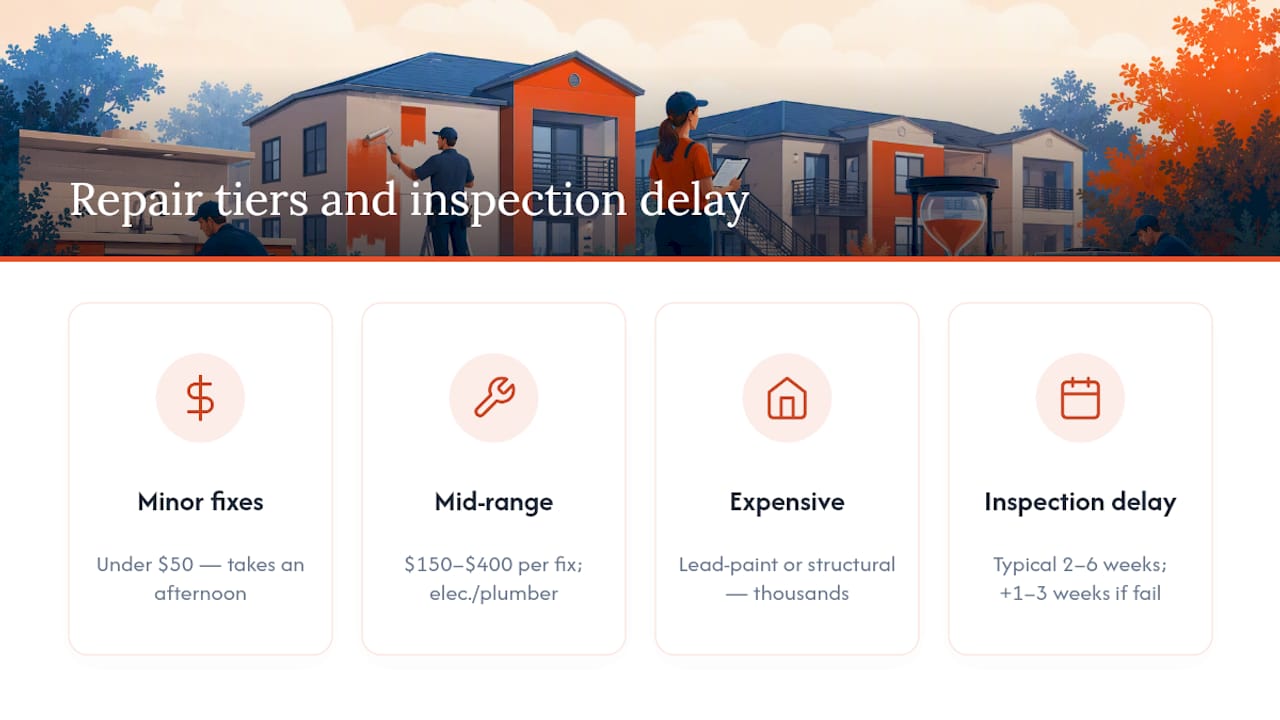
The two to six week window from RFTA to first payment assumes your unit passes inspection on the first try. When it does not, add another one to three weeks for repairs and a second inspection visit, plus whatever time your PHA takes to reschedule.

Cost depends entirely on what fails. The cheapest fixes, a missing outlet cover, a dead smoke detector battery, a loose handrail, run under $50 and take an afternoon. Mid-range fixes like GFCI outlet installation near sinks or replacing a water heater’s pressure relief valve typically run $150 to $400 per fix depending on your market and whether you hire an electrician or plumber. The expensive category is anything touching lead-based paint in pre-1978 units, where remediation can run into the thousands depending on the scope, or structural issues like a failing roof or foundation crack that NSPIRE inspectors flag as severe.

Section 8 repair costs and payment timeline

The pattern worth noting: units that pass on the first inspection almost always belong to landlords who self-inspected first. That single hour of prep against a checklist is consistently cheaper than the delay cost of a failed inspection, which can push your first HAP payment back by weeks.

Budget for ongoing maintenance too. NSPIRE inspections happen periodically throughout the lease term, not just at move-in, so a unit that passed last year still needs the same detectors working and the same GFCI outlets intact this year.

Handling Tenant Disputes and Complaints

Most Section 8 disputes fall into three categories: maintenance requests the tenant feels went unaddressed, disagreements over security deposit deductions at move-out, and confusion over who owes what portion of the rent when a HAP payment is late.

The fix for all three starts before the dispute happens. Document the unit’s condition at move-in with photos and a signed checklist, so move-out comparisons have a clear baseline. Respond to maintenance requests in writing, even a simple text confirming you received the request and when you will address it, so there is no ambiguity about response time later.

When a dispute does arise, resolve it in this order:

  • Talk to the tenant directly first. Most complaints about maintenance timing or deposit deductions resolve with a clear explanation and a reference to the lease terms.
  • Loop in the PHA if the dispute touches HAP payments or inspection compliance. The PHA has its own dispute process for HAP-related disagreements, and involving them early keeps you compliant with program rules.
  • Keep every communication in writing. Texts, emails, and portal messages create a record that protects you if the disagreement escalates to a formal complaint or legal action.
  • Know your state’s timeline requirements for responding to maintenance requests and returning security deposits, since these vary and Section 8 tenants have the same state-law protections as any other renter.

Complaints that go unresolved tend to end up either with the PHA, which can trigger a re-inspection outside your normal schedule, or with a local housing court. Both cost more time than a five-minute conversation would have.

Regulatory Changes and What They Mean for Your Property

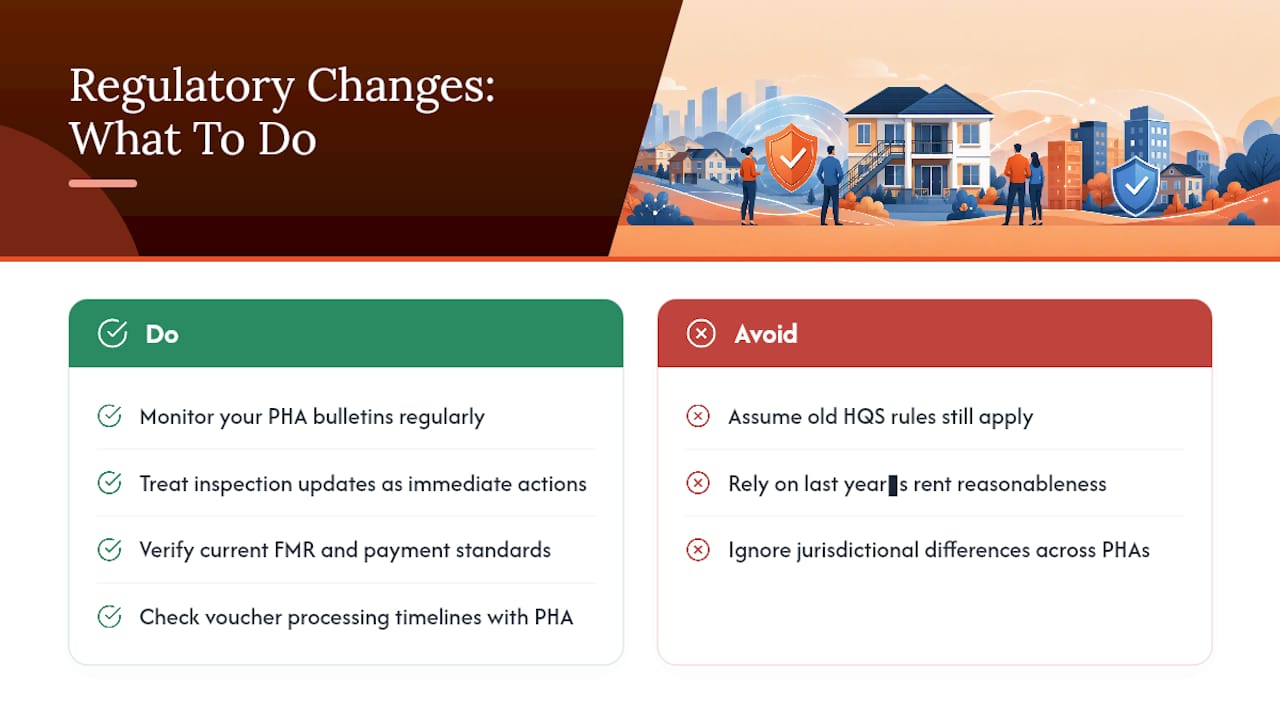
The Housing Choice Voucher program is not static. NSPIRE itself is a recent overhaul, replacing decades of HQS practice with a scored, severity-based inspection model that changed what inspectors look for and how strictly they grade it. Landlords who managed properties under the old HQS rules need to relearn the checklist, not assume the old standards still apply.

PHAs also periodically adjust their Fair Market Rent figures and payment standards, sometimes annually, which directly affects what rent the PHA will approve for your unit. A rent that cleared rent reasonableness last year is not guaranteed to clear this year if your local FMR moved or comparable market rents shifted.

Federal policy discussions about voucher funding levels and program administration surface regularly, and funding changes at the federal level can affect how quickly your PHA processes new vouchers, renews contracts, or issues payments. The GAO’s own reporting on processing delays points to administrative capacity, not just funding, as a recurring bottleneck.

The practical takeaway: do not assume the rules you learned when you first became a Section 8 landlord still apply years later. Check your PHA’s current landlord bulletin or newsletter periodically, and treat any inspection standard update as something to act on immediately rather than something to catch up on at your next scheduled inspection. A landlord managing multiple units across different PHAs faces this multiplied, since payment standards and even inspection scheduling can vary by jurisdiction even within the same state.

Regulatory Changes and What They Mean for Your Property — overview diagram

Record-Keeping That Protects You

Every HAP payment, every inspection report, every repair invoice, and every piece of correspondence with your PHA should live somewhere organized and searchable, not in a shoebox or a scattered email inbox. Time-stamped digital records resolve disputes faster and support contract renewal timelines, since a PHA processing a renewal wants to see a clean compliance history.

Keep these records at minimum:

  • Signed lease and HUD tenancy addendum for every voucher tenant
  • Move-in condition photos and signed checklists
  • Every inspection report, pass or fail, with the date and inspector’s notes
  • HAP payment history showing dates and amounts received
  • Repair invoices tied to inspection fail items, showing the fix and the date completed
  • Written correspondence with the PHA, including RFTA submissions and any dispute communications

This is not busywork. A landlord who can produce a full paper trail during a contract renewal or a payment dispute resolves the issue in days. A landlord without that trail is stuck reconstructing history from memory while payments sit on hold.

Common Challenges and Practical Fixes

The complaint heard most often from Section 8 landlords is the paperwork volume. Every unit needs an RFTA, every lease needs the tenancy addendum, every inspection needs documentation. The fix is not avoiding the paperwork. It is templating it. Build a standard packet for RFTA submissions once, and reuse it for every new voucher tenant with only the specific unit and tenant details changed.

The second recurring challenge is payment delays tied to contract renewals. Waiting until the last minute to confirm renewal status with your PHA guarantees you find out about a delay after it has already started. Calling thirty to sixty days ahead of a renewal date gives you room to fix any issue before it interrupts payment.

Inspection failures round out the top three challenges, usually from small items landlords assume are fine until an inspector flags them. The fix here is the same self-inspection habit covered earlier: walk the unit against the HUD checklist before every scheduled inspection, not just the first one.

A less discussed challenge is finding qualified applicants quickly enough to avoid vacancy stretching past what the subsidy offsets. Voucher holders often search PHA-run listing portals rather than general rental sites, so a unit only listed on a standard rental platform may sit vacant longer than necessary while eligible applicants never see it.

Marketing Your Property to Voucher Holders

List directly through your PHA’s landlord portal or listing service first. This is where most active voucher holders search, and it puts your unit in front of applicants who are already approved and ready to lease, cutting the usual back-and-forth over eligibility.

Beyond the PHA portal, standard rental listing sites still matter, since not every voucher holder limits their search to PHA channels. Write the listing the same way you would for any tenant: clear photos, accurate square footage, and an honest description of the unit’s condition. Note that the unit accepts vouchers explicitly in the listing text, since some applicants filter search results specifically for that phrase.

Pricing your listing at or near the local Fair Market Rent, rather than significantly above it, speeds up both applicant interest and PHA rent reasonableness approval. A unit priced well above comparable rents sits through a longer approval process even if you eventually find a tenant.

Landlords managing several units sometimes work with a real estate marketing service to keep listings visible across multiple channels at once, which matters more in markets with high voucher demand and fast-moving inventory. Whatever channel you use, respond to inquiries quickly. Voucher holders working against a time-limited voucher often need to secure a unit within a set window, and a slow response can lose you an otherwise qualified tenant.

An Owner’s Take on What Actually Works

The advice that circulates most about Section 8, treat every inspection like a pop quiz and hope for the best, is backwards. The landlords who do well under this program are the ones who front-load the work: self-inspect before the PHA shows up, build a relationship with a specific caseworker rather than calling a general line every time, and keep records organized before a dispute ever forces the issue.

What is overrated is the fear that voucher tenants are riskier than market-rate tenants. The data on payment reliability points the other direction. The subsidized portion of rent is not contingent on a tenant’s job status, and that alone removes a chunk of the risk that causes market-rate landlords sleepless nights. What is underrated is how much a failed first inspection costs in real time, not just repair dollars. A landlord who skips the self-inspection step and fails on the PHA’s first visit can lose three or four weeks waiting for a reinspection slot.

If you take one thing from this article, prioritize the relationship with your PHA caseworker over every other tactic. Everything else, faster payments, smoother renewals, quicker approvals, flows from that single working relationship.

— MediaBeast

Let Auben Realty Handle the PHA Side of Things

Auben Realty gives owners a full-service alternative to handling RFTA submissions, inspection prep, and PHA communication solo. Instead of learning your local PHA’s quirks through trial and error, you get a dedicated team that already knows the inspection checklist, coordinates directly with the housing authority, and reports back on payment status and repair costs without you chasing down answers.

Aubenrealty

When you request a quote, ask specifically about the manager’s experience with local PHAs, their track record on inspection pass rates, and how transparently they break down fees before work starts. Those three questions separate a manager who understands Section 8 operations from one who is guessing alongside you. Owners with units needing repair work before an inspection can also lean on Auben’s project management services to get fixes done fast and correctly the first time.

Ready to stop managing PHA paperwork on your own? Visit Auben Realty’s property management page to request a quote and see how a dedicated pod can take the inspection prep and HAP coordination off your plate.

Where to Verify These Rules Yourself

Check HUD’s PIH landlord resources and NSPIRE inspection guidance directly, review your local PHA’s landlord page (Philadelphia’s is a solid model), and read GAO’s reporting on HAP payment timeliness for the government’s own account of processing delays.

Sources

FAQ

How much does Section 8 pay landlords?

The amount varies by unit size, local Fair Market Rent, and the tenant’s income, since the PHA pays a HAP portion directly to the landlord while the tenant covers the rest, typically a portion of their adjusted income. There is no fixed nationwide amount. Check your local PHA’s current payment standard before setting your asking rent.

Who manages Section 8 properties?

Local Public Housing Authorities administer the voucher program and approve rents, inspections, and contracts, while the property owner or a hired property manager handles day-to-day leasing, maintenance, and PHA communication. Many owners work with a full-service manager like Auben Realty to handle inspection prep and PHA coordination directly.

What is happening with Section 8 housing policy right now?

Federal voucher funding and program administration are subject to periodic budget and policy debates, and changes at that level can affect how quickly PHAs process vouchers and renew contracts. Landlords should follow their specific PHA’s bulletins for the most current local rules rather than relying on general news coverage.

Which state has the most Section 8 tenants?

Voucher distribution tracks population and housing costs, with larger states generally administering more vouchers overall through their many local PHAs. Exact rankings shift as HUD funding allocations and local waiting lists change, so check HUD’s own data resources for current figures in your state.

How long does it take to get approved as a Section 8 landlord?

Most landlords see two to six weeks from submitting a Request for Tenancy Approval to receiving the first HAP payment. Failed inspections, incomplete paperwork, or PHA renewal backlogs are the most common causes of delay beyond that window.

How a Home Management Plan Gives Rental Property Owners Peace of Mind

One of the biggest advantages of owning an investment property is building long-term wealth—but that doesn’t mean every owner wants to spend their time managing maintenance requests, scheduling inspections, or worrying about the condition of their home.

For many investors, true success comes from having confidence that their property is being professionally cared for while they focus on growing their portfolio or simply enjoying more of their time.

That’s where a comprehensive home management plan can make all the difference.

Passive Investing Doesn’t Mean Ignoring Your Investment

Many investors are drawn to rental properties because they offer the opportunity to generate long-term income. However, the day-to-day responsibilities of property ownership can quickly become overwhelming without the right systems in place.

Routine maintenance, preventative care, and regular property oversight all play an important role in protecting your investment. Without a proactive approach, small maintenance issues can become costly repairs over time.

A professional home management plan helps ensure those details aren’t overlooked.

Protecting Your Property Through Preventative Maintenance

Owning a rental property involves much more than responding when something breaks.

Preventative maintenance helps preserve the condition of the home while reducing the likelihood of unexpected repairs. A proactive management approach may include:

  • Routine HVAC inspections and servicing
  • Regular air filter replacements
  • Lawn and exterior maintenance
  • Preventative property inspections
  • Ongoing monitoring of the home’s condition

These routine tasks help protect the property’s long-term value while creating a better experience for residents.

Peace of Mind for Rental Property Owners

Every property owner wants to know their investment is being properly cared for.

A professional property management team provides ongoing oversight, helping ensure maintenance schedules stay on track and issues are identified before they become larger problems. Instead of wondering whether important tasks are being completed, owners can feel confident that their property is receiving consistent attention.

That peace of mind allows investors to take a more passive approach to ownership without sacrificing the condition or performance of their investment.

Focus on Your Investment—Not the Guesswork

Managing a rental property shouldn’t require constant oversight or uncertainty. With the right systems and experienced professionals in place, investors can spend less time worrying about maintenance and more time focusing on their long-term financial goals.

Read Full Transcription

Speaker 1 Kristen Brady (00:00):

With this home management plan, it allows an investor to be very passive in the investment. And also to me, I feel like it gives them a peace of mind that their asset is being well taken care of. Let’s face it, sometimes tenants don’t necessarily maybe maintain the home the way maybe a homeowner will, but on the back end, this home management plan ensures that the filters are being changed regularly. HVAC is being looked at yearly. The yards are being maintained. Just all of those little intricacies of owning a home, like you said, all that guesswork is taken out of that.

If you’re looking for a more hands-off approach to rental property ownership, learn more about Auben Realty’s Property Management services and discover how our proactive management approach helps protect your investment while giving you greater peace of mind.

Why More Renters Are Choosing the Comfort of a Home Without the Maintenance

For many renters, the traditional apartment isn’t the only option anymore. As rental housing continues to evolve, more residents are looking for homes that offer the space, privacy, and comfort of homeownership—without the ongoing maintenance responsibilities.

Single-family rental homes are becoming an increasingly attractive option for individuals and families who want the lifestyle of owning a home while maintaining the flexibility of renting.

The Best of Both Worlds

Renting a single-family home offers many of the features people typically associate with homeownership, including:

  • A private yard
  • A driveway and garage
  • More indoor and outdoor living space
  • Greater privacy
  • A neighborhood setting

For many residents, these features create a more comfortable living experience while eliminating many of the responsibilities that come with owning a home.

Enjoy Your Home Without the Maintenance

One of the biggest advantages of professionally managed rental homes is convenience.

Instead of spending weekends mowing the lawn, scheduling repairs, or handling unexpected maintenance issues, residents can focus on enjoying their home and their community. Many professionally managed rental properties include maintenance services that help simplify everyday living and provide peace of mind.

That means more time spent with family, neighbors, and friends—and less time worrying about home maintenance.

Professional Property Management Creates a Better Rental Experience

Professional property management doesn’t just benefit property owners—it also creates a better experience for residents.

Responsive maintenance, well-maintained homes, and professional communication help ensure residents can enjoy the benefits of living in a home without the stress of managing the property themselves.

For property owners, providing this level of service often leads to happier residents, stronger retention, and better long-term investment performance.


Read Full Transcription

Speaker 1(Tyson Schuetze) (00:00): Some of those folks are coming in and saying, “Well, wait a second. I can have the benefit of a yard, a driveway, a garage, a home that feels and looks and lives like a home that I would purchase for sale, but I don’t have to deal with any of the headaches or hassles of maintaining the asset.” Or in some cases like this Willow and Sierra Vista, even maintain lawn and other parts of it. There’s entire maintenance packages that give the residents their time back to go interact with their neighbors, with their community, with the people that they live around.

If you’re looking to maximize the value of your rental property while providing an exceptional resident experience, learn more about Auben Realty’s property management services and discover how professional management can help protect your investment and support long-term success.

The Emotional Trap Many Rental Property Investors Face

When people think about successful real estate investors, they often picture someone who makes every decision based on spreadsheets, market trends, and return on investment. While that may be true for some, many rental property owners—especially those who self-manage—discover that owning an investment property is much more personal than they expected.

Over time, it’s easy to develop an emotional attachment to a property. Maybe it was your first investment, the home where you raised your family, or a property you’ve spent years renovating. Those memories can make it difficult to make objective decisions when circumstances change.

Emotional Attachments Can Impact Investment Decisions

The emotional connection doesn’t always stop with the property itself. Many landlords also build relationships with their tenants. While caring about the people living in your rental is important, those relationships can sometimes make it harder to make decisions that are in the best financial interest of the investment.

For example, owners may delay increasing rent to keep a long-term tenant happy, postpone necessary renovations, or avoid selling a property that no longer aligns with their investment goals. In some cases, emotional attachment can even make it difficult to transition ownership to family members or reposition the property for future opportunities.

Why Professional Property Management Helps

One of the biggest advantages of working with a professional property management company is having an objective partner who can evaluate every decision from an investment perspective.

Professional property managers help owners by:

  • Making recommendations based on market data rather than emotions.
  • Helping maximize rental income while remaining competitive.
  • Managing tenant relationships professionally and consistently.
  • Advising when improvements or repositioning make financial sense.
  • Keeping long-term investment goals at the center of every decision.

Having an experienced team removes much of the emotional pressure that can come with self-managing a rental property.

Focus on Long-Term Success

Successful investing isn’t about removing compassion—it’s about balancing it with sound business decisions. Viewing your rental property as an investment allows you to make choices that support stronger cash flow, long-term appreciation, and overall portfolio growth.

If you find yourself struggling with difficult decisions because you’re emotionally attached to your property or tenants, partnering with an experienced property management company can provide the objective guidance needed to protect your investment while helping you achieve your financial goals.

Read Full Transcription

Speaker (Tyson Schuetze):

“You brought up a number of things that I definitely want to talk about. I think there’s this perception that investors are very intentional, calculated, number-driven individuals.

Some of them certainly are. But I also think a lot of owners—particularly those managing residential rentals themselves—become very emotionally attached to their properties.

They can also become emotionally attached to their tenants, and that can make it really challenging to reposition the property for anybody, even their own children.

I think that’s a really interesting perspective.”


If you’re finding it difficult to separate emotion from investment decisions, professional property management can provide an objective perspective while helping protect the long-term performance of your rental property. Learn more about Auben Realty’s Property Management services today! https://www.aubenrealty.com/owners/property-management/

Cedar Creek Estates

Not ready to buy, but tired of apartment living? 🏡

Cedar Creek Estates gives you the best of both worlds: a private, single-family home with a fenced yard and attached garage without the mortgage, maintenance calls, or long-term commitment.

Check out our latest blog post from Taylor Moore to learn more about our partnership with Ellavoz Impact Capital, and how we are working to build communities, not just homes!

Learn more now at the link in our bio!

Property Management isn’t just about houses, it’s about people

At the end of the day, property management isn’t just about houses, it’s about people. 🏡

Last week our team attended the National Association of Residential Property Managers (NARPM) Southern States Conference, and we left with more than notes and ideas. We left with renewed energy, fresh perspectives, and a reminder that this industry is built on relationships.

Read more about Brandie Mejia and Jocelyn Forcht-Langfitt’s experiences in this week’s blog post at the link in our bio!

Why Trust a Property Management Company with Your Investment?

Owning rental properties can be lucrative but managing them can be time-consuming and complex. This is where a professional
property management company
comes into play. From tenant screening to property maintenance, these companies provide expertise and support that landlords can count on.

Here’s why landlords trust these professionals to handle their investments efficiently and effectively.

Expertise | Property Management Company

A professional property management company brings a wealth of knowledge and expertise to the table. Managing properties involves deeply understanding local laws, market trends, and tenant expectations. Professionals in the field offer:

Compliance with Regulations:
Staying compliant with landlord-tenant laws is critical. Property managers ensure leases, evictions, and other legal matters are handled correctly.

Market Knowledge:
They know how to set competitive rental prices and market properties effectively to attract high-quality tenants.

Efficient Processes:
Property management companies have streamlined processes that save landlords time and effort, from rent collection to scheduling repairs.

These skills ensure properties are managed professionally, leaving landlords worry-free.

Comprehensive Tenant Services

One of the key reasons landlords rely on a property management company is their ability to manage tenants effectively.

Thorough Tenant Screening:
Property managers perform background checks, verify income, and assess rental history to select trustworthy tenants.

Maintaining Positive Relationships:
They serve as a bridge between landlords and tenants, resolving disputes and ensuring tenant satisfaction.

Handling Turnover Efficiently:
When tenants move out, property managers oversee cleaning, repairs, and marketing to minimize vacancy periods.

This comprehensive approach to tenant management protects the landlord’s investment and ensures steady rental income.

Also read:
5 Practical Tenant Retention Tips to Keep Your Property Occupied | Property Management Company

Regular & Reliable Repairs | Property Management Company

Maintaining a property requires consistent attention to detail. A professional property management company has a network of reliable contractors and service providers to handle maintenance tasks efficiently.

Preventative Maintenance:
Regular inspections and upkeep ensure the property remains in good condition, preventing costly repairs.

Quick Repairs:
Property managers promptly address maintenance requests, improving tenant retention and protecting the property’s value.

Property managers give landlords peace of mind by taking care of maintenance and repairs.

Streamlined Financial Management

Landlords often trust a property management company to handle the financial aspects of their investments because of the following financial advantages:

Rent Collection:
Automated systems ensure on-time rent collection and reduce missed payments.

Expense Management:
Property managers track expenses, making it easy for landlords to monitor their profits.

Detailed Reports:
Monthly and annual financial reports give landlords a clear overview of their property’s performance.

This financial transparency builds trust and ensures landlords stay informed.

We’re the Property Management Company You Need

Landlords trust professional property management companies for their expertise and comprehensive services. These companies handle crucial responsibilities such as tenant screening, property maintenance, and financial management, simplifying the complexities of property ownership. By entrusting these tasks to experts, landlords can focus on growing their investments while ensuring their properties are well-maintained and profitable.

A property management company offers peace of mind by providing reliable support and solutions, making property ownership more efficient and stress-free.

For seamless property management tailored to your needs, contact
Auben Realty of the Midlands
today and let the experts take care of your investments.

Book an appointment today.

5 Practical Tenant Retention Tips to Keep Your Property Occupied | Property Management Company

All landlords want happy, long-term tenants. Dependable and loyal renters can make a world of difference for property owners. Not only do they provide consistent income, but they also mean fewer turnover costs and vacancy periods.

As a
property management company
, we know what it takes to keep tenants satisfied and engaged. The following are some reasons why tenant retention is necessary and tips we have learned over the years.

Importance of Tenant Retention

A key advantage of long-term tenants is that they create stability. For property owners, this means a steady stream of income and less time spent finding new renters. For tenants, it means not worrying about constantly moving and adapting to new living spaces.

Additionally, retaining tenants also leads to cost savings for property owners. With less turnover comes fewer expenses on advertising for new tenants, conducting background checks, and cleaning and repairing the unit after each tenant moves out. This can add up significantly over time and reduce the overall profitability of the rental property.

Tenant Retention Tips | Property Management Company

1.
Regular Communication

Maintain open communication with your tenants. This means responding to their calls and emails, promptly addressing any concerns or issues, and keeping them informed about any tenancy changes or updates. Proactive communication can help you stay on top of your tenants’ needs and make them feel valued.

2.
Regular Property Inspections

Periodic inspections are essential for identifying and addressing potential issues before they become significant problems. This can also help maintain the overall condition and appearance of the rental unit, increasing tenant satisfaction and the likelihood of retention. A property management company can help you set up regular inspections.

3.
Offering Incentives | Property Management Company

Incentives are another effective way to retain tenants. Consider offering rewards for timely rent payments or referrals for new tenants. You could also offer discounts on rent or upgrades to their unit for signing a longer lease. These incentives show your appreciation for your current tenants and give them a reason to stay.

4.
Maintaining the Property

No one wants to live in an unkempt or poorly maintained property. Regular maintenance and upkeep of the rental property ensure a happy and satisfied tenant. This includes promptly addressing repair requests and investing in property upgrades or improvements.

5.
Being Fair and Flexible

Being fair and flexible with your tenants can also contribute to their satisfaction and willingness to stay on as renters. This could mean understanding unexpected circumstances affecting rent payments or allowing pets with certain restrictions. Showing empathy and being willing to work with your tenants can help build a long-term relationship and increase tenant retention.

Hire a Professional Property Management Company to Increase Tenant Retention

Auben Realty of the Midlands
is a full-service property management company specializing in tenant retention strategies. Our home rental experts understand the importance of retaining tenants and can help you implement effective strategies to occupy your rental units.

Contact us if you need help with tenant retention or want to improve your current strategies. We’ll work with you to develop a custom plan that meets your unique rental needs and goals.

Best Renovations for Your Rental Property | Property Management Company

Rental properties are popular investments for many individuals. However, to maximize the return on investment and attract potential tenants, it is important to maintain and upgrade your property regularly. This is where a professional
property management company
can be beneficial.

A good property management company not only handles day-to-day tasks such as rent collection and tenant communication but also offers valuable advice on increasing the value of your rental property. One of the most effective ways to do this is through strategic renovations.

Here are some of the top renovations to enhance the value of your rental property:

1. Kitchen Renovation | Property Management Company

The kitchen is often considered the heart of a home and can significantly influence a tenant’s decision to rent your property. A well-designed and modern kitchen can increase the value of your rental property and attract high-quality tenants willing to pay more for an upgraded living space.

2. Bathroom Remodel

Like the kitchen, an updated bathroom can significantly increase the value of your rental property. To make the bathroom more functional and appealing, consider installing new fixtures, updating old tiling, and adding extra storage space.

3. Flooring Upgrades

Old, worn-out, dirty flooring can make a property look outdated and uninviting. Consider replacing carpets with hardwood or laminate flooring for a more modern and durable option. This will increase the value of your rental property and save you money on future maintenance costs.

4. Energy-Efficient Upgrades | Property Management Company

In today’s world, tenants are increasingly looking for energy-efficient properties to help reduce their utility bills. As a landlord, consider making energy-efficient upgrades such as installing LED lighting, low-flow toilets and faucets, and upgrading to energy-efficient appliances.

5. Curb Appeal Enhancements

First impressions matter when it comes to attracting potential tenants. A well-maintained exterior with attractive landscaping can make your rental property stand out and increase its value. Consider adding a fresh coat of paint, updating the front door, and incorporating some greenery to boost curb appeal.

6. Additional Amenities

Add amenities such as a washer, dryer, dishwasher, or air conditioning unit to attract higher-paying tenants. These modern conveniences are highly sought after by tenants and can significantly increase the value of your rental property.

7. Smart Technology

Installing smart home technology into your rental property can make it more convenient for tenants and increase its value. This includes keyless entry systems, smart thermostats, and security cameras that smartphones can control.

8. Regular Maintenance

Regular maintenance and upkeep keep your rental property in good condition and increase its value. This includes regular pest control, replacing old appliances, and fixing plumbing or electrical issues.

Work with an Experienced Property Management Company to Get the Most Value

Auben Realty of the Midlands
has over 15 years of experience managing rental properties and can help you get the most value out of your investment. From finding high-quality tenants to handling maintenance and upkeep, our team can handle all aspects of property management so you can maximize your profits.
Contact us today
.