Skip to content

Houston Cap Rates: Multifamily 5–6.5%, Industrial 5–6%, Auben’s Take

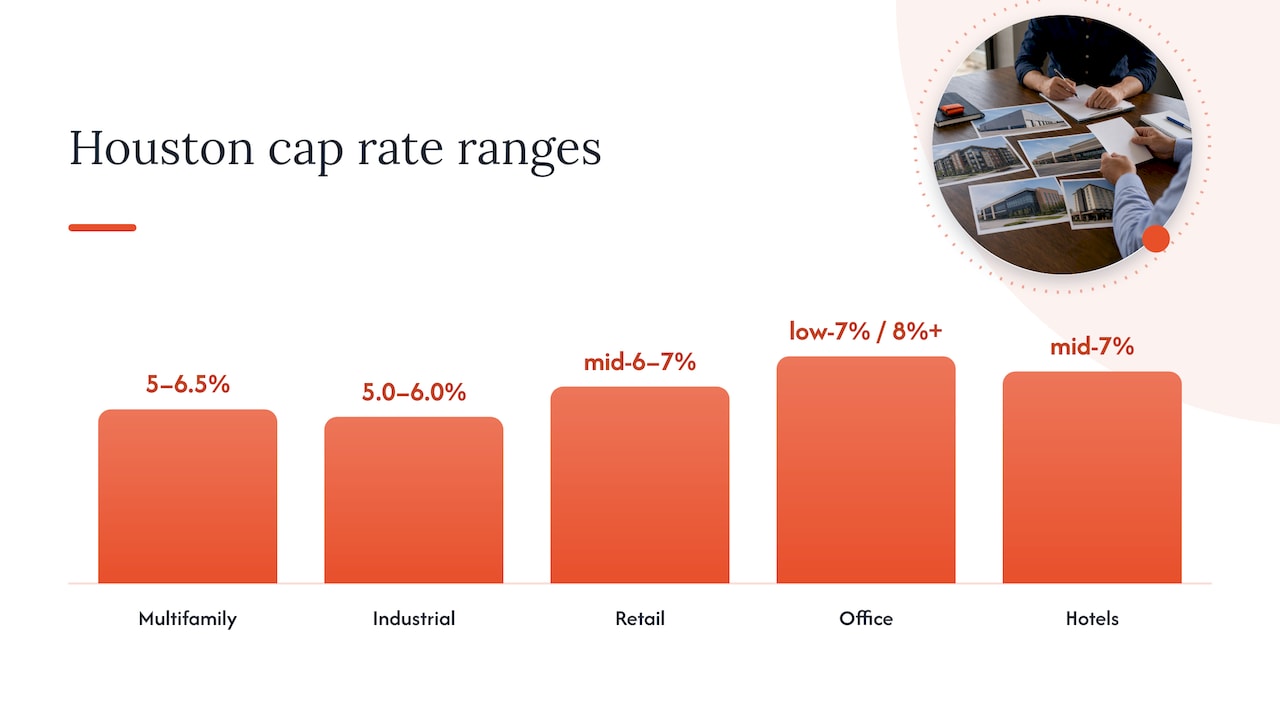
Houston cap rates currently span a wide band by sector: multifamily in a moderate range around 5 to 6.5%, industrial near 5% to 6%, retail somewhat higher, and office and hospitality generally higher still, with Class A CBD office cap rates recently exceeding 8% in some samples. Rates are drifting up on stabilized assets while compressing on well-located industrial. Before you act on any of these ranges, check your submarket and normalize the seller’s NOI with guidance on securing property insurance in Texas.


TL;DR:

  • Submarket conditions significantly impact cap rates, with industrial and retail ranges varying based on corridor-level rents and vacancy rates.
  • Class A assets typically trade at the lowest cap rates, while Class C and value-add deals often demand higher yields due to renovation and execution risks.
  • Concessions such as rent abatements and tenant improvements can overstate reported cap rates if not properly normalized in analysis.
  • A 7.5% cap rate in Houston generally indicates higher risk or value-add potential, while 5% suggests strong locations with rent growth expectations.
  • Careful due diligence, including adjusting for concessions and local fundamentals, is essential before relying on headline cap rate figures for investment decisions.

Aubenrealty
Make Your Houston Investment Work Smarter
Auben Realty combines local market expertise with investment-focused management, renovation, and tenant placement services for property owners and investors.

Visit Auben Realty

Table of Contents

1. Current cap rates by sector in Houston

Every sector in Houston is telling a different story right now, and lumping them into one “market cap rate” hides the signal you need for underwriting.

Retail has drifted into the mid-6% to 7% range as some centers face re-tenanting risk, while office is the clear outlier.

IRR’s Mid-Year 2025 Viewpoint reported Class A CBD office cap rates rising above 8% in its sample, reflecting both genuine repricing and the broader national reset in office valuations. That same report documented a regional cycle shift favoring southern markets like Houston, which helps explain why capital kept flowing into multifamily and industrial even as office struggled.

  • Multifamily: mid-5% to 6.5%, with Class A near the bottom of that band and workforce housing near the top.
  • Industrial: 5.0% to 6.0%, among the tightest spreads in the metro.
  • Retail: mid-6% to 7%, wider for centers with anchor vacancy risk.
  • Office: low 7% for well-leased suburban product, 8%+ for CBD Class A per IRR’s sample.
  • Hotels: mid-7% range, reflecting higher operational risk and slower stabilization timelines.

Industrial direct asking rents and corridor-level vacancy data from Cresa’s Q3 2025 Houston industrial report show meaningful variation by corridor, and that variation is the main reason industrial cap rates differ so much from one submarket to the next even within the same broad sector range.

The extreme cases deserve a separate mention. Opportunistic buyers chasing workforce multifamily or value-add retail are underwriting entry yields well above these headline ranges, often 7% or higher, because they are pricing in renovation risk and lease-up uncertainty rather than in-place stabilized income. Treat any cap rate quoted without a class or condition qualifier as incomplete.
1. Current cap rates by sector in Houston — overview diagram

2. Submarket variation and asset-class nuance in Houston

A citywide cap-rate range is a starting point, not an answer. Houston’s submarkets move at different speeds, and the spread between a CBD asset and a suburban one in the same sector can run well over 100 basis points.

Industrial is the clearest example. Cresa’s Q3 2025 data shows direct asking rents and vacancy rates that diverge meaningfully across corridors, and those differences flow directly into cap rates. A fully leased building in a tight corridor with low vacancy commands a lower cap rate than a comparable building in a corridor carrying excess supply, even though both sit under the same “Houston industrial” headline. Investors comparing deals across corridors should pull comps from the same corridor whenever possible rather than relying on a metro-wide average.

Class distinctions matter just as much as geography:

  • Class A stabilized assets trade at the tightest cap rates because buyers are paying for in-place income with minimal lease-up risk.
  • Class B assets usually sit 25 to 75 basis points above Class A in the same submarket, reflecting older systems and more turnover.
  • Class C and value-add deals can price well above both, since buyers demand a higher entry yield to compensate for renovation costs and execution risk.
  • CBD office and retail generally carry wider cap-rate bands than suburban product right now, a direct result of the office repricing documented in IRR’s mid-year report.

For multifamily specifically, a stabilized suburban Class B property near strong job centers can price tighter than a CBD high-rise facing elevated office-adjacent vacancy, which runs counter to the old assumption that downtown always commands a premium. That shift is worth tracking if you are comparing acquisition targets across Houston’s diverse submarkets, where corridor-level fundamentals now matter more than general location prestige.

3. What’s moving Houston cap rates now: rents, vacancy, and financing

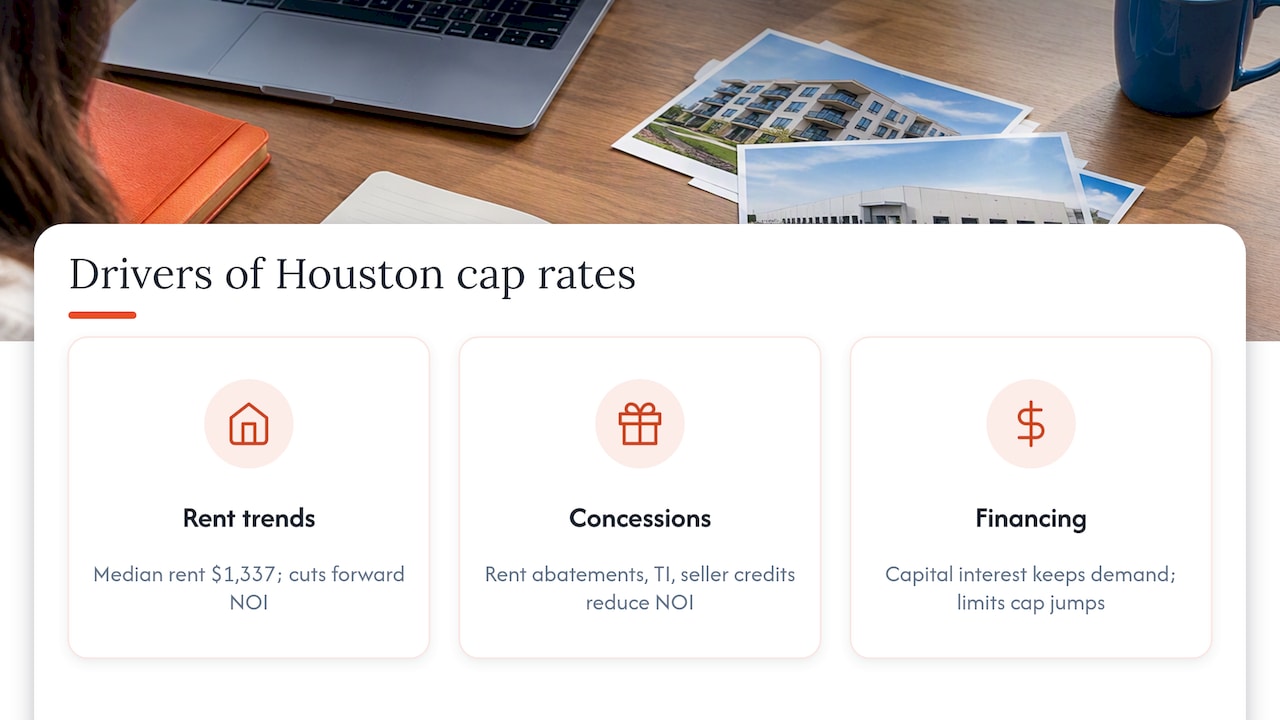
Three forces are driving the current spread in Houston cap rates, and two of them are easy to miss if you only look at a headline rate.
Three forces affecting Houston cap rates

Rent trends are the most direct driver. Realtor put the Houston metro’s median asking rent at around $1,337, down modestly year-over-year. Softer rent growth reduces forward NOI projections, which pushes buyers to demand higher cap rates on stabilized multifamily to hit the same return targets. At the same time, IRR’s mid-year report noted a regional cycle shift favoring southern markets, which has kept capital interested in Houston even as rent growth cooled.

The less obvious driver is concessions. Reporting from GlobeSt in March 2026 documented how sellers are increasingly using rent abatements, larger tenant improvement allowances, and seller-financed credits to keep a deal’s headline price and reported cap rate looking stable, even when the underlying asset has repriced. A seller offering six months of free rent on a new lease, for example, is effectively discounting the deal while keeping the face rent and the reported cap rate unchanged on paper.

This matters because a transactional cap rate built on concession-heavy leases overstates the true in-place yield. If you underwrite the headline number without adjusting for the concession package, you are paying for income that will not materialize once those concessions roll off.

Pro Tip: Convert any large TI allowance or rent abatement into an annualized expense over the lease term, then recalculate the cap rate on that adjusted NOI before you compare it to another deal.

4. How to use cap rates in underwriting: a step-by-step checklist

Treat the reported cap rate as a starting point for your own analysis, not a conclusion. Here is a practical sequence for any Houston acquisition:

  1. Verify trailing twelve-month NOI against the rent roll and expense statements rather than relying on a broker’s pro forma.
  2. Strip out and re-add concessions such as free rent, TI allowances, and seller credits as annualized adjustments, per the method GlobeSt’s reporting on concession practices points to.
  3. Compare the adjusted cap rate to submarket comps, using corridor-level or neighborhood-level data rather than a metro average.
  4. Run a sensitivity test on exit cap rate assumptions, since even a 50 to 100 basis point shift can materially change your projected return.
  5. Model at least two financing scenarios, since rate movement changes the spread between your cap rate and your cost of debt.
  6. Check vacancy and rent trend direction for the specific submarket, using current data such as Realtor, since a declining rent environment erodes forward NOI faster than most pro formas assume.

That is the kind of swing a half-point of cap-rate movement produces, and it is why exit assumptions deserve as much scrutiny as entry pricing.

Watch for these red flags in any marketing package: a cap rate calculated on a pro forma rent roll rather than trailing actuals, concessions buried in a footnote instead of the NOI line, and a cap rate that does not disclose whether it reflects a transaction price or an asking price.

6. Auben Realty’s on-the-ground perspective on effective yield

With many years managing investment properties and numerous properties served across our regional markets, we see the gap between a reported cap rate and the yield an owner actually realizes play out constantly. A property’s effective cap rate is shaped far more by execution than by the number on the offering memo.

The cap rate you underwrite and the cap rate you realize align only if nothing changes in how the property is managed.

Renovation sequencing, lease-up pacing, tenant placement quality, and expense control can all shift NOI after closing, sometimes more than the acquisition price does. Properties bought at the higher end of reported cap rates can sometimes perform better if management improves operations quickly.

Pro Tip: Budget for lease-up and renovation timelines separately from your stabilized cap rate assumption. Underwriting both at once overstates year-one returns.

7. Where the real risk sits for Houston investors right now

The biggest mistake I see is treating a headline cap rate as a finished analysis instead of a starting point that still needs adjusting for concessions, submarket fundamentals, and financing terms. Houston’s upside is real: industrial corridors remain tight and multifamily demand is resilient even with softer rent growth. The risk is paying a stabilized-asset price for a deal that is quietly discounted through concessions you did not strip out.

My direct recommendation: run the full underwriting checklist above on any letter of intent within 48 hours of receiving it, before emotional attachment to the deal sets in.

— MediaBeast

How Auben Realty supports cap-rate due diligence in Houston

Once you have a cap rate you trust, the next question is who closes the gap between projected and realized returns. That is where our Houston property management services come in: handling lease-up, tenant placement, and expense control so the NOI you underwrote has a real path to showing up on the rent roll.

Aubenrealty

For investors weighing an acquisition, our asset management services provide ongoing oversight of performance against your underwriting assumptions, and our brokerage services can help source and structure deals across our Houston market. If you are weighing a renovation-heavy value-add play, project management support keeps that work on schedule and on budget. Reach out through our Houston page to talk through a specific deal.

FAQ

What is a 7.5% cap rate?

In Houston’s current market, that level sits above typical stabilized multifamily and industrial pricing but within range for hotels and some value-add retail or workforce housing deals.

Are rents going down in Houston?

Houston metro median asking rent was $1,337 in September 2025, down about 3.0% year-over-year, according to Realtor.com’s rental report. That decline has pressured forward NOI projections on multifamily deals and is one reason buyers are demanding higher cap rates on some stabilized assets.

Is 7% a good cap rate?

Compare it to recent transaction comps in the same corridor and asset class rather than treating it as a universal benchmark.

Is 5% a good cap rate?

A 5% entry yield generally signals a premium location or asset with strong rent growth expectations baked into the price, so it warrants extra scrutiny of the underlying NOI assumptions.

Sources

The ranges in this article draw from a mix of broker market reports, an industry research firm’s mid-year local report, and metro rent data, covering roughly the second quarter of 2025 through the first quarter of 2026. Different providers calculate cap rates differently: some report transaction-based caps from closed sales, while others report caps implied by current asking prices, which tend to run softer than actual trades.

Refresh these figures quarterly, since rent and vacancy data update faster than transaction-based cap-rate surveys.


Estimate Jacksonville Property Tax in Minutes With Duval’s Estimator

There is no single Jacksonville property tax rate. Your actual bill depends on the combined millage for your specific taxing district, which stacks county, city, school, and special district rates together. The Duval County Property Appraiser and the county’s tax estimator are where you find your parcel’s real number, and your TRIM notice plus any homestead exemption or Save Our Homes cap determine what you actually owe.


TL;DR:

  • Your actual property tax depends on the combined millage rates of county, city, school, and special districts, which vary by location.
  • The property tax bill is calculated by stacking multiple mills, meaning two similar homes nearby can have different taxes.
  • Use Duval County’s tools and your TRIM notice to accurately estimate your bill, rather than relying on generalized online rates.
  • Confirm actual rates and exemptions through the Property Appraiser or Tax Collector offices rather than assumptions based on averages.
  • Homestead exemptions can reduce your tax bill significantly, especially if you qualify for the Save Our Homes cap.

Aubenrealty
Make Property Ownership More Manageable
Auben Realty combines property management, renovation, and tenant placement to help owners reduce hands-on involvement.

Explore Auben Realty

Table of Contents

Why a single Jacksonville tax rate figure can mislead you

A “mill” equals $1 of tax for every $1,000 of taxable value, and your final bill is the sum of several mills layered on top of each other rather than one flat percentage. That is why two houses a few blocks apart can carry different totals even with similar market values.

Your parcel’s millage typically combines:

  • County government: the base rate covering countywide services like public safety and general operations.
  • City of Jacksonville: municipal services for properties inside city limits.
  • Duval County Public Schools: a significant share of most bills, set separately from city and county rates.
  • Special districts (MSTUs): added charges for things like fire protection or specific improvement districts that only apply within defined boundaries.

Because these layers vary by location, the only way to know your real number is to check the current millage schedule for your specific taxing district, which the Property Appraiser publishes and updates alongside historical rates. Your annual TRIM notice lists the exact authorities taxing your parcel and the proposed rate for each one.

How to estimate your bill with Duval County’s tools and TRIM data

Running your own estimate takes a few minutes if you work through it in order.

  1. Search for the parcel on the Property Tax Estimator, either by address or by selecting the municipality if you are evaluating a hypothetical purchase.
  2. Enter the expected purchase price rather than the current assessed value, since a sale typically resets taxable value for the new owner.
  3. Indicate homestead status, and include portability information if you are transferring a Save Our Homes benefit from a prior Florida homestead.
  4. Cross-check the result against your TRIM notice or the published millage schedule for that taxing district to confirm the authorities and rates the estimator used.
  5. Treat the output as a planning number, not a guarantee, since the tool itself states its results are estimates built from the latest available tax roll rather than a final bill.

The Property Tax Estimator is built for scenario analysis, and the final certified roll along with adopted millage rates after the TRIM process are what actually bind your bill. Numbers can shift between the estimate you run today and the rate the taxing authorities formally adopt later in the year.

Pro Tip: Run the estimator twice, once with homestead assumptions and once without, so you see the full range before you commit to a purchase price.

Two property tax estimate paths compared

Where to get official rates and help in Duval County

When your estimate raises questions, Duval County has distinct offices for valuation issues versus payment issues, and knowing which one to call saves time.

  • Duval County Property Appraiser publishes millage schedules, parcel values, TRIM notices, and exemption forms, making it the first stop for valuation or exemption questions.
  • Duval County Tax Collector – Yates Branch (downtown) handles in-person payments and receipts from a central location with high foot traffic.
  • Duval County Tax Collector – Roosevelt Branch offers the same payment and receipt services for residents on that side of the county.
  • Duval County Tax Collector – Mandarin Branch covers payment processing for the Mandarin area, reducing the need to travel downtown.
  • Income Tax Office is a branch-level location providing payment assistance for residents in its immediate service area, functioning similarly to the other Tax Collector branches rather than handling valuation questions.
Office Role Google reviews
Duval County Tax Collector — Yates Branch (downtown) Payments, receipts, in-person taxpayer assistance 4.6★
Duval County Tax Collector – Roosevelt Branch Payments, receipts 4.5★
Duval County Tax Collector – Mandarin Branch Payments, receipts 4.3★
Duval County Property Appraiser Millage schedules, valuations, exemptions, TRIM notices 4.4★ (51 reviews)
Income Tax Office Local branch payment assistance 3.6★ (16 reviews)

For valuation disputes or exemption questions, contact the Property Appraiser directly. For a payment that is due or a receipt you need, any Tax Collector branch, including the Income Tax Office location, can help.

Prioritize parcel data over generalized rates

The TRIM notice and the county’s own tools beat any generalized rate you find online, because only they reflect your parcel’s actual taxing districts and proposed millage. When a number does not match what you expected, call the Property Appraiser for valuation questions or a Tax Collector branch for payment questions rather than guessing. Serious investors build this verification step into acquisition modeling before a purchase price is finalized.

— MediaBeast

Auben Realty: tax-aware support for Jacksonville investors

We help investors translate Jacksonville’s parcel-specific tax mechanics into real acquisition and ownership numbers, rather than leaving that work to a generic estimate.

Aubenrealty

Our asset management service builds tax scenarios into underwriting before you commit to a purchase price, and our property management team keeps ongoing tax obligations factored into your operating budget. For owners weighing renovation decisions that could affect assessed value, our project management service keeps that work coordinated.

  • We consider tax scenarios during underwriting.
  • We coordinate renovation and tenant placement to help keep ownership low-effort.

If you are evaluating a Jacksonville property and want help building a realistic tax picture into your numbers, start with our Multifamily & Build-to-Rent Services page or reach out through Property Management to talk through your specific parcel.

FAQ

How much is property tax in Jacksonville?

There is no flat citywide figure. Your bill depends on the combined millage for your parcel’s taxing district, which you can estimate using the Duval County Property Appraiser’s tools and confirm against your TRIM notice.

What is the property tax rate in Overland Park, KS?

Overland Park sits in Johnson County, Kansas, which uses a different assessment and mill levy system than Duval County, Florida. Residents there should check with Johnson County’s own appraiser and treasurer offices rather than applying Jacksonville figures, since the two states calculate taxable value differently.

What city has the highest property taxes in Florida?

Florida property tax totals vary by county and by the specific taxing districts layered onto each parcel, so no single city holds a fixed statewide ranking. The most reliable way to compare is checking each county property appraiser’s published millage schedule directly.

What city in Kansas has the lowest property tax?

Property tax totals in Kansas vary by county and taxing district in the same way Florida’s do, so pinpointing one city requires checking county-level mill levy data rather than relying on a statewide average. Readers researching Kansas rates should consult the relevant county appraiser’s office for parcel-specific figures.

Does homestead exemption lower my Jacksonville tax bill?

Yes. Florida’s homestead exemption can reduce taxable value significantly for qualifying owners, and the Save Our Homes provision limits how much your assessed value can increase each year once you hold the homestead.

Sources

Avoid $4,000 Turnover: 90–120 Day Lease Renewal Strategy for Landlords

Start renewals earlier and fix maintenance before offers go out. That single change raises retention more than any price cut, because tenants who feel heard and see a clean unit report tend to stop shopping around. Pair early outreach with a pre-renewal inspection and outcome-based incentives, and keep your timeline predictable. Managed programs build this sequence into every portfolio.


TL;DR:

  • Conduct renewal outreach between 90 and 120 days before lease end to gauge tenant sentiment early and avoid rushed, emotional decisions.
  • Use a structured timeline with dual deadlines at 120 days and 45 days to improve retention and ensure timely renewal or marketing.
  • Focus on outcome-based incentives, such as rent credits or policy changes, instead of blanket rent discounts to protect long-term profitability.
  • Prioritize maintenance responsiveness and document inspections thoroughly to influence renewal decisions and mitigate disputes.
  • Start renewal processes early, leverage market comps accurately, and assess tenant payment history to make informed, risk-aware renewal offers.

Aubenrealty
aubenrealty.com
Make Lease Renewals Less Hands On
Auben Realty combines property management, tenant placement, and local market expertise to help owners manage renewals and protect property value.

Visit Auben Realty

Table of Contents

A renewal timeline that keeps you ahead of move-out decisions

Two deadlines work better than one. An early soft check, placed 90 to 120 days before lease end, lets you gauge sentiment before a tenant starts browsing listings. Large operators who move renewal conversations to the 120-day mark report better retention because tenants make fewer rushed, emotional choices. A second, firmer deadline at 45 to 60 days then triggers your operational fallback: marketing the unit if the tenant has not responded.

A typical sequence looks like this:

  1. 120 to 90 days out: Pull market comps, schedule the pre-renewal inspection, and send a soft-touch message asking about renewal intent.
  2. 90 to 75 days out: Complete the inspection, open any repair work orders, and finalize the rent figure.
  3. 75 to 60 days out: Send the formal renewal offer with term options and any incentive language.
  4. 60 to 45 days out: Follow up by phone or text if there is no response; treat the 45-day mark as the hard deadline for a decision.
  5. 45 to 30 days out: Execute the signed renewal or begin listing the unit if the tenant has declined.

Assign roles so nothing stalls at a handoff: leasing staff own the outreach and offer language, maintenance owns inspection follow-through, and whoever runs your CRM owns the reminder cadence. A few checkpoints keep the process honest:

  • Leasing confirms comps and drafts the offer before day 75.
  • Maintenance closes every inspection-triggered work order before the offer goes out.
  • Marketing or CRM staff log every tenant touchpoint so a stalled renewal is visible, not forgotten.

Setting renewal rent without pricing out a good tenant

Pull comps on units with matching size, floor level, and amenity access, then adjust for any concessions those comps are currently offering. A unit with a one-month free promotion two floors down is not a clean comparison until you normalize for that discount.

Push higher when your market has clearly inverted toward landlords, or when the unit needed no repairs and the tenant has a thin payment history. Undershoot it, or hold flat, when the tenant has a strong record, the unit needs work you have not finished, or your comps show flat to falling asking rents nearby.

Offering multiple term lengths, commonly 12, 18, and 24 months, gives tenants flexibility and gives you a lever besides price. A tenant anxious about a larger jump might take an 18-month term at a smaller annual increase, which locks in occupancy longer than a standard 12-month renewal would.

Average unit turnover costs run around $4,000 per unit, according to industry estimates cited by the National Apartment Association, which is the number that should anchor every pricing decision: a modest rent concession almost always costs less than a vacancy.

Building renewal incentives that do not erode your returns

Blanket free-rent offers feel generous but they set a precedent and cost cash flow immediately. Outcome-based incentives, tied to a longer lease term or an early signature, protect net operating income while still giving tenants a reason to commit. Operators have found that value-add incentives and policy changes often outperform temporary financial concessions for long-term retention.

Strong incentive options include:

  • A rent credit applied only after the tenant signs a 24-month term, not before.
  • A pet-policy change or reduced pet deposit, which can matter more to a tenant than a small rent reduction.
  • A priority-repair guarantee, such as a 48-hour response window, written into the renewal offer.
  • A referral credit if the tenant brings in a qualified applicant for another vacant unit.

Loosening pet restrictions in particular can be a higher-impact retention lever than a short-term rent concession, since pet-owning tenants often struggle to find comparable housing and will pay to avoid moving. When you do offer a temporary financial concession, attach a condition: a credit that applies only if the tenant completes the full new term protects you from subsidizing a tenant who leaves early anyway.

Pro Tip: Offer the incentive in the same message as the rent figure, never as a separate follow-up; tenants respond better when the full picture arrives at once.

Operations that keep tenants from starting to look elsewhere

Maintenance responsiveness is the operational lever most likely to decide a renewal before pricing ever enters the conversation. Centralized, timely maintenance response is widely cited as the top factor behind non-renewal when it is absent. Close out open tickets before the renewal offer goes out, and treat any inspection-triggered repair as a priority rather than routine backlog.

A simple communication cadence supports this: a text-first outreach for routine updates, portal confirmations for anything requiring a signature, and a phone follow-up if 10 days pass with no response. Automated CRM nudges can carry a meaningful share of this load. Portfolios using renewal automation have reported roughly a 6% lift in renewal rates compared with manual outreach alone. Recurring plumbing issues are a common trigger for complaints during this window, and preventive attention to common failure points before the renewal cycle starts can head off a bad inspection.

Track a short list of operational KPIs:

  • Average repair turnaround time from ticket to close.
  • Response rate to renewal offers within the first 10 days.
  • Percentage of follow-ups completed on schedule.

Personalizing the renewal letter itself matters too: referencing a tenant’s specific maintenance history or service record increases renewal likelihood more than a generic notice does. For a deeper breakdown of maintenance categories and response planning, see this guide to the three kinds of maintenance your property will need.

Courts increasingly expect a documented trail, not a verbal agreement, when a renewal or rent increase is contested. Pre-renewal inspections, proof-of-service for rent increases, and signed tenant acknowledgments are the records most likely to matter if a dispute reaches a hearing.

  1. Schedule the pre-renewal inspection 30 to 60 days before the lease ends, using a short checklist covering five core areas: appliances, plumbing, HVAC, safety devices, and general wear.
  2. Photograph every item on the checklist, pass or fail, and attach the photos to the tenant’s file.
  3. If the inspection finds an issue, open a work order immediately and confirm completion before the renewal offer goes out.
  4. Serve any rent-increase notice as a separate document from the renewal offer itself, and keep proof of delivery, whether that is a signed receipt, a portal timestamp, or certified mail.
  5. Collect a tenant acknowledgment of the new terms, even informally, alongside the signed lease.

Keep the completed inspection record, the rent-increase notice with its proof of service, and the signed renewal in the tenant’s digital file for at least the length of the new lease term plus one year. A short, consistently completed checklist holds up better across a portfolio than a long form that staff skip under deadline pressure.

Measuring whether your renewal strategy is actually working

Four numbers tell you most of what you need: renewal rate, net effective rent change after incentives, turnover cost per unit, and average days to re-rent a vacated unit.

Run a simple comparison before approving any concession. Say a unit renting for $1,500 a month would cost $4,000 to turn, based on commonly cited industry turnover estimates, once you account for vacancy, marketing, and make-ready work. A $75-a-month concession over a 12-month renewal costs $900, far less than the turnover cost, which makes the concession the cheaper option whenever a tenant is genuinely on the fence.

  • Review renewal dashboards weekly during peak leasing season.
  • Run a cohort analysis quarterly to see how renewal rates move with pricing changes.
  • Flag any unit with declining renewal interest for an early inspection, not just an early offer.

Renewal rates have been rising across several industry datasets even as rent growth has cooled, which suggests retention is becoming a more reliable lever than chasing new tenants at market rate.

Handling tenants who go quiet or push back during renewal

A non-responsive tenant is not automatically a lost renewal, but silence past your soft-check deadline should trigger a specific sequence rather than repeated identical emails. Switch channels: if the first outreach was a portal message, follow with a text, then a phone call, spacing each attempt by a few days rather than stacking them.

Tenant renewal outreach sequence timeline

When a tenant does respond but pushes back hard on price or terms, resist matching their counter immediately. Ask what specifically is driving the objection: a competing offer, a budget change, or dissatisfaction with maintenance history. A tenant upset about slow repairs responds better to a service guarantee than to a rent discount, while a tenant citing a cheaper comp elsewhere needs a term-length or incentive conversation, not a bidding war.

Document every difficult interaction the same way you document a standard renewal: date, channel, and outcome. If a tenant remains unresponsive past your hard deadline, treat that date as final and begin marketing the unit immediately rather than holding it open indefinitely on the chance of a late reply. Holding a unit past the hard deadline without action is one of the most common ways renewal timelines quietly collapse into longer vacancies.

For tenants who are difficult but ultimately valuable, a short phone call from a manager, rather than a leasing agent, can resolve friction that email cannot. The goal is not to win every negotiation but to close the loop fast enough that you still have time to re-lease if the renewal falls through.

How market cycles should change your renewal approach

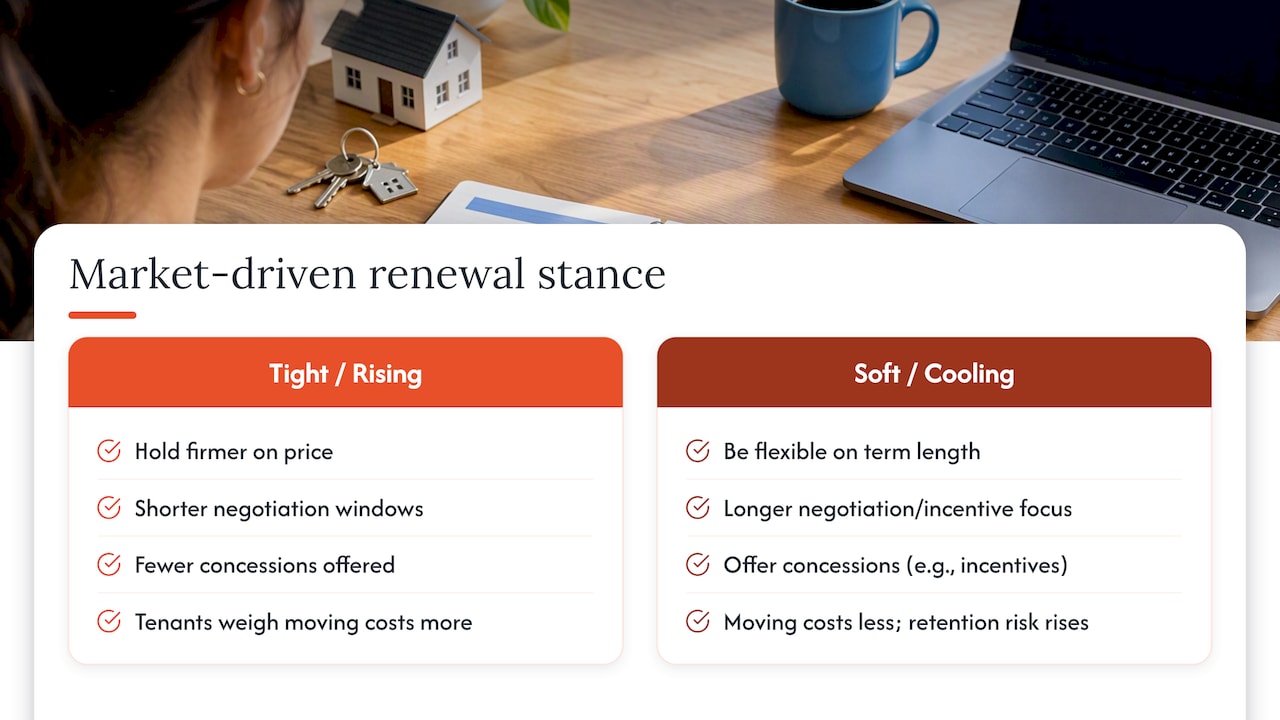
A tight rental market with falling vacancy supports firmer pricing and shorter negotiation windows, since tenants have fewer comparable options to shop against. A softer market, where comparable units are offering concessions, calls for more flexibility on term length and incentive structure before you touch the base rent.

Renewal rates have stayed resilient even as rent growth has slowed in recent data, which points to a broader shift: landlords increasingly treat renewals as the more dependable path to stable occupancy, rather than a fallback when new leasing is slow. That shift matters most in a cooling market, where the cost of chasing a new tenant at a marginally higher rent can easily exceed the cost of renewing an existing one at a smaller increase.

Watch your local comps closely during any rate or employment shift, since renewal pricing that made sense six months ago can become a retention risk quickly if nearby concessions change. In a rising-rate environment, tenants also weigh moving costs more heavily, which gives landlords slightly more room to hold firm on price, but that room shrinks fast once multiple nearby properties start offering free months or reduced deposits. The practical response is the same in either direction: price from current comps, not last quarter’s, and revisit your incentive mix every leasing season rather than setting it once a year.

How market cycles should change your renewal approach — overview diagram

Reading tenant financial stability before you commit to a renewal

A renewal decision is also a credit decision, even though it rarely gets treated that way. Payment history over the current lease term is the strongest signal you have: a tenant who paid on time for 11 of 12 months carries far less risk than one with several late payments clustered near the end of the term, even if both ultimately paid in full.

Look beyond the ledger when you can. A tenant who has mentioned a job change, a reduced work schedule, or a new dependent in maintenance requests or communications is worth a direct, low-pressure conversation before you finalize an offer. This is not about re-running a full credit check at every renewal, which is rarely necessary or practical, but about weighing the information you already have.

Where risk looks elevated, a shorter renewal term, a smaller rent increase, or a request for updated income verification can protect you without forcing a non-renewal. Where a tenant’s record is strong, that same information supports offering better terms, since retaining a reliable payer at a modest increase is almost always better than testing the market with an unknown applicant.

Auben Realty’s applied take on running renewal programs

Across managed portfolios, renewal timelines are built around early outreach, inspection-first risk review, and outcome-based incentives rather than flat concessions. A pod-based team structure keeps leasing, maintenance, and resident communication tied to the same renewal calendar, and in-house maintenance means repair work from an inspection does not wait on a third-party vendor’s schedule. Owners working with a managed renewal program should expect fewer surprise vacancies and a documented trail for every rent increase and inspection.

— MediaBeast

How Auben Realty can help with your renewal program

Running a 90-day timeline, an inspection checklist, and incentive tracking across dozens of units takes staff time most owners do not have. Auben Realty’s property management services build that calendar into day-to-day operations, while project management support handles any unit upgrades a renewal negotiation calls for, and asset management reporting shows portfolio-level renewal performance. Owners who want a managed renewal process can start with a consultation through our property management page.

Aubenrealty

FAQ

How do you negotiate a lower rent renewal?

Point to specific, verifiable comps for comparable units nearby and ask the landlord to match or adjust based on that data rather than making a general affordability argument. Offering a longer lease term in exchange for a smaller increase is also a common and effective trade for both sides.

What should you avoid saying during a renewal negotiation?

Avoid vague threats to move without a real plan, since landlords can usually tell when a tenant is bluffing and it weakens your position in future conversations. Also avoid oversharing financial hardship details that are not directly relevant to the lease terms being discussed.

What are the pros and cons of renewing a lease?

Renewing avoids the cost and disruption of moving and keeps a known, stable arrangement in place for both parties, while a new lease elsewhere might offer a lower rent or better amenities. The main downside of renewing is the risk of accepting a rent increase without fully checking whether better terms exist nearby.

What tactics work best when negotiating a lease?

Come with current market comps rather than a general request for a discount, and ask for flexibility on term length if the rent figure itself will not move. Landlords are also more likely to negotiate on non-financial terms, such as a maintenance guarantee or a pet-policy exception, than on the base rent alone.

How early should a landlord start the lease renewal process?

Most guidance points to starting 90 to 120 days before lease end, which gives tenants time to decide without feeling rushed. Large operators have found that moving renewal conversations to the 120-day mark improves retention compared with the standard 60 to 90 day window.

Sources

Protect Your Refinance Exit: BRRRR and IRS Essentials for U.S. Investors

BRRRR stands for Buy, Rehab, Rent, Refinance, Repeat, a capital-recycling strategy that lets investors convert one property into the funding for the next when rehab and refinance go to plan. It suits investors with access to renovation capital, contractor relationships, and a realistic refinance exit. The main risks are rehab overruns, refinance seasoning delays, and the temporary cash tied up between purchase and payoff.


TL;DR:

  • BRRRR deals are highly sensitive to rehab overruns, refinancing delays, and the property’s appraisal coming in lower than the projected after-repair value.
  • Successful deals require buying undervalued properties with a wide margin between purchase price and ARV, especially in stable or growing neighborhoods.
  • Proper underwriting involves a strict 70% rule based on ARV minus repair costs, along with thorough due diligence on property condition and local rental demand.
  • Refinance seasoning rules and lender requirements for lease signing and documentation are critical factors that influence timely capital recovery.
  • Running conservative stress tests that account for higher rehab costs, longer vacancy, and lower ARV helps identify deals with real profit margins.

Aubenrealty
Build A More Manageable Investment
Auben Realty helps investors manage properties, renovations, and tenant placement with local expertise and less hands-on involvement.

Explore Auben Realty

Table of Contents

How to find and underwrite BRRRR-appropriate deals

The buy phase decides whether the entire cycle works. You want distressed or undervalued properties where the gap between purchase price and after-repair value (ARV) is wide enough to cover rehab costs, financing costs, and still leave equity on the table. Neighborhood fundamentals matter as much as the house itself: stable or growing rent demand, low vacancy, and a realistic buyer or appraiser pool for comparables.

Most investors underwrite with a version of the 70% rule: offer no more than 70% of ARV minus repair costs. It is a screening tool, not a guarantee, since financing costs, closing costs, and holding costs also eat into margin. Pair it with projected post-rehab rent and cap rate to confirm the deal cash flows once it is refinanced, not just once it is rented.

Financing at purchase shapes your exit. Cash and hard-money loans give you speed and negotiating power on distressed properties, while bridge loans can fund both purchase and rehab in one draw structure. Whichever you choose, know your refinance lender’s seasoning rules before you close, since that timeline determines how long you are carrying short-term financing costs.

Before making an offer, run through a due diligence checklist:

  • Pull a title search to confirm there are no liens or ownership disputes.
  • Get a full property inspection, including roof, foundation, and major systems.
  • Verify permit history for any prior additions or conversions.
  • Check at least three to five recent comparable sales for ARV accuracy.
  • Research local rental demand through vacancy rates and comparable listings.

A free rental analysis can help confirm rent expectations and tenant demand before you commit capital to a deal.

Rehab: budgeting, contractors, and keeping scope under control

Not every renovation dollar moves ARV or rent equally. Kitchens, bathrooms, and major mechanical systems (HVAC, electrical, plumbing) tend to drive the most value per dollar spent, followed by curb appeal items like paint, landscaping, and entry doors. Cosmetic upgrades beyond that point often cost more than they return.

Build your rehab budget in four parts: hard costs (materials and labor), soft costs (permits, design, inspections), a contingency reserve, and financing or holding costs for the rehab period.

Vet contractors on past work, licensing, and insurance, then lock in a fixed-bid scope of work rather than open-ended time and materials. Structure payment as a draw schedule tied to completed milestones, and require signed lien waivers at each draw to protect your title.

  • Get at least three competing bids before awarding the rehab contract.
  • Put the scope of work in writing, including materials, brands, and finish levels.
  • Require lien waivers with every draw payment.
  • Build a punch list before the final draw releases.

Pro Tip: Walk the property with your contractor before writing the scope of work. Verbal assumptions are the most common source of change orders.

Surprises tend to hide behind walls and under floors. A short pre-rehab checklist covering sewer scope, electrical panel capacity, and moisture readings can catch expensive issues before they become mid-project change orders. Our best renovations guide breaks down which upgrades reliably pay off in rent and resale value.

Inspector checking rental home electrical panel

Rent: getting to a signed lease the refinance will accept

Stabilization is where BRRRR deals either support a strong appraisal or stall. Lenders want to see occupied, cash-flowing property with documentation to prove it, so pricing and screening speed both matter.

  1. Set rent using at least three current comparable listings in the immediate area, not citywide averages, and build in a modest vacancy assumption.
  2. Screen tenants on income, credit, rental history, and background checks, and use lease clauses lenders commonly expect, like clear term length and renewal terms.
  3. Time the lease signing with your refinance seasoning window in mind. Some lenders require a signed lease in place before underwriting will proceed.
  4. Assemble a documentation pack as you go: the signed lease, dated photos of the finished unit, and paid rehab invoices.

Having this pack ready before you apply shortens the refinance timeline considerably.

Refinance: recovering your capital without the appraisal surprise

The refinance is the step that actually returns your cash, and it is also where most BRRRR plans break down. Investors generally choose between DSCR (debt-service coverage ratio) loans, conventional investment mortgages, portfolio lender products, or paying off a hard-money bridge loan with a longer-term refinance. Each path treats seasoning and documentation differently, so the right choice depends on how fast you need capital out and how the property qualifies.

  1. DSCR loans qualify primarily on the property’s rental income rather than your personal income, and many DSCR lenders require only 3 to 6 months of seasoning, according to a refinance guide for investment property.
  2. Conventional cash-out refinances, including those following Fannie Mae’s cash-out guidelines, commonly require the existing mortgage to be at least 12 months old along with borrower-on-title requirements and maximum loan-to-value limits.
  3. Freddie Mac’s cash-out refinance guidance similarly sets LTV and debt-coverage underwriting constraints that determine how much of the appraised value a lender will actually lend against.

Seasoning windows vary by lender and product, typically running from 3 to 6 months for many DSCR programs up to 12 months for conventional cash-out refinancing, a gap that can determine whether your capital comes back in time to fund the next deal, per the refinance guide for investment property.

Appraisal risk is the other major variable. Use a conservative ARV estimate going in, request a pre-appraisal consultation when the lender offers one, and keep your comparable selections tight to similar square footage, age, and finish level in the immediate area.

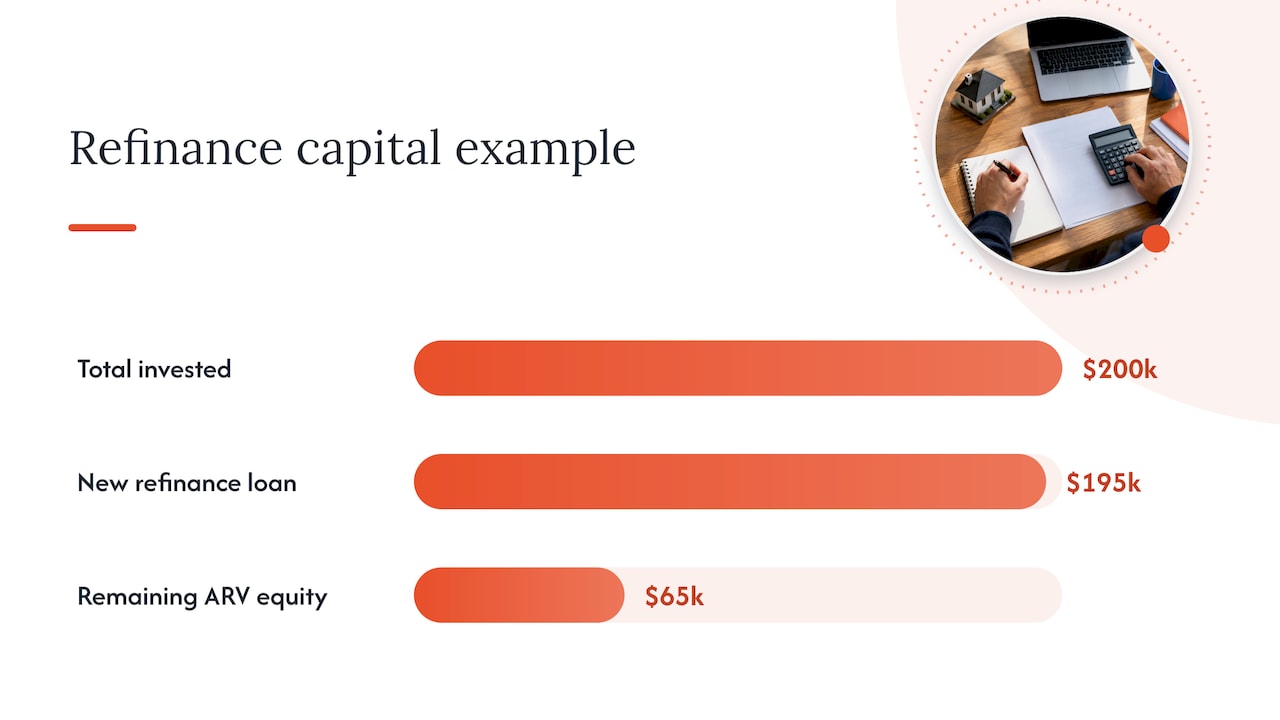
A worked example: say you buy a property for $150,000 and spend $50,000 on rehab, for $200,000 total invested. If the ARV comes in at $260,000 and your lender allows 75% LTV on the refinance, the new loan size is $195,000. After paying off the original purchase and rehab financing, you recover a meaningful share of your invested capital, though the exact amount depends on your original financing terms.

BRRRR refinance capital recovery example

Before applying, prepare the appraisal order, signed lease, paid repair invoices, and before-and-after photos. Lenders and appraisers move faster with a complete file.

Repeat and scale: turning one cycle into a portfolio

Each completed cycle frees up capital for the next purchase, so the math worth tracking is how much cash you recover per deal and how many cycles your available capital can fund in a year. That pace depends on refinance speed, rehab timelines, and how much reserve you keep on hand.

  • Keep cash reserves per property rather than deploying every dollar recovered into the next deal.
  • Set a maximum leverage rule, such as never exceeding a fixed LTV across your portfolio, to avoid overexposure if rents soften.
  • Diversify across neighborhoods and tenant types rather than concentrating risk in one submarket.
  • Decide early whether you will self-manage renovations and leasing or hand them to a project manager as your unit count grows.

Bookkeeping, a vendor panel, and a simple dashboard tracking rent, expenses, and loan balances per property become necessary once you pass a handful of units, since spreadsheets alone stop scaling.

Why some BRRRR deals fail and how to stress-test yours

The biggest misconception is that you always get your full capital back at refinance. Appraisals, lender LTV limits, and rehab overruns routinely reduce that number, sometimes leaving cash permanently in the deal.

  • Appraisal shortfalls happen when the appraiser’s comparables come in below your projected ARV.
  • Cost overruns during rehab shrink the equity cushion you were counting on.
  • Refinance denial can occur if DSCR or income qualification falls short of lender thresholds.
  • Tenant turnover or vacancy right before refinance can weaken the income documentation lenders want.

Run a quick stress test before you buy: use a conservative ARV instead of your best case, add 20% to your rehab budget, and assume 6 to 9 months of vacancy or holding costs. If the deal still works under those assumptions, it has real margin.

Tax and accounting essentials for BRRRR investors

Depreciation materially affects your return and your tax bill. The IRS requires residential rental property placed in service after 1986 to use MACRS, depreciated on a straight-line basis over 27.5 years with a mid-month convention, according to IRS Publication 527. Rehab costs that count as capital improvements add to your depreciable basis rather than deducting immediately.

Residential rental property is depreciated using the straight-line method over a multi-decade recovery period, applying the mid-month convention in the month the property is placed in service.

Rental income and expenses are reported on Form 1040 Schedule E, and most individual investors use the cash method, deducting expenses in the year paid. Keep repairs separate from improvements in your records: a patched roof section is typically deductible immediately, while a full roof replacement is capitalized and depreciated, a distinction that matters at tax time and if the IRS ever reviews your filings. Investors who plan to accelerate depreciation on qualifying rehab components sometimes look into cost segregation strategies with a tax professional.

How a full-service manager supports BRRRR investors

Auben Realty has significant experience working with property owners and investors across multiple regional markets. Renovation oversight, vendor selection, and tenant placement are the points where BRRRR cycles most often slip, and having a team handle scope control, contractor coordination, and lease-up directly addresses those failure points.

— MediaBeast

Running your BRRRR cycles with support from Auben Realty

Aubenrealty

Rehab overruns and slow lease-ups are the two things most likely to stall your refinance timeline, and that is exactly where a dedicated team pays for itself. Services offered may include project management for renovation oversight and vendor coordination, tenant placement and leasing, and asset management support for investors managing multiple properties.

If you would rather hand off renovation oversight and ongoing property management than run every cycle yourself, see Auben Realty’s property management services to get started.

This article is general information, not a substitute for advice from a qualified financial advisor. Consult a qualified financial professional about your own circumstances before acting on anything here.

Sources

FAQ

What is the 70% rule for BRRRR?

The 70% rule says investors should pay no more than 70% of the after-repair value minus estimated repair costs. It is a quick screening tool to keep enough margin for financing costs and profit, not a guarantee of returns.

What is the 3-3-3 rule in real estate?

Definitions of the 3-3-3 rule vary and there is no single, widely recognized standard behind it. Treat any version you encounter as a rough guideline rather than an industry rule, and underwrite each deal on its own numbers instead.

Does the BRRRR method really work?

BRRRR can work when rehab stays on budget, the property appraises at or near the projected ARV, and the refinance loan meets lender seasoning and LTV requirements. It fails most often when rehab overruns or the refinance appraisal comes in lower than expected, so conservative underwriting upfront matters more than optimism.

How much money do you need to BRRRR?

You need enough cash or financing to cover the purchase, the full rehab budget plus a contingency, and holding costs until the property is rented and refinanced. The exact amount depends on the deal, but the refinance is designed to return a share of that capital once the property is stabilized and appraised, per Fannie Mae’s cash-out guidelines.

60.3% Concessions Give Renters the Edge in Houston Rental Market 2026

Renters hold the leverage in Houston right now. Landlords are offering concessions at some of the highest rates in the country, median asking rent has fallen for more than three years straight, and inventory keeps climbing. The number to watch is the metro concession rate, which recently topped 60%, a clear sign owners are competing hard to keep units filled.


TL;DR:

  • Concession rates in Houston have surged past 60%, indicating landlords are heavily incentivizing tenants amid rising supply and declining asking rents.
  • Asking rents have declined for 37 consecutive months, with median rent near $1,373, while rental inventory and concessions continue to grow.
  • Variations between neighborhoods significantly impact rents, with inner areas commanding premiums and newer suburbs offering more concessions due to increased competition.
  • Effective rent and vacancy rates are more telling than posted asking prices, guiding owners on whether to offer concessions or adjust rents.

Aubenrealty
Make Houston Rentals Easier to Manage
Auben Realty helps property owners handle management, renovations, and tenant placement with local market expertise and less hands-on involvement.

Table of Contents

Latest metrics: rents, concessions, CPI, and inventory

Houston’s rental numbers tell a consistent story: more supply, more competition among landlords, and softer pricing power. Median asking rent in the metro sat around $1,373 in August 2026, down 2.7% year over year, marking the 37th straight month of annual rent declines. At the same time, the share of listings offering concessions climbed to 60.3%, a jump of 19.4 percentage points from a year earlier, according to the same Realtor.com report.

That concession spike is not unique to Houston. Realtor.com’s national analysis found concessions rising in 39 of the 50 largest metros, with Houston among the markets posting the sharpest year-over-year increases, a sign that new supply is outpacing lease-up speed across much of the country.

Meanwhile, the CPI rent index for the Houston metro, tracked by the Bureau of Labor Statistics through FRED, offers a useful contrast: it measures rent inflation across existing leases, which typically moves more slowly than asking rents on vacant units. When CPI rent inflation still shows gains while asking rents fall, it usually means the softening is concentrated in new and turnover leases rather than the broader base of renewals.

On the supply side, HAR’s mid-2026 update found single-family leased listings rising while average lease prices held roughly steady, reinforcing that renters have more options without an across-the-board price collapse.

Metric Reading Source
Median asking rent (Aug 2026) $1,373, down 2.7% YoY Realtor.com
Metro concession rate (Aug 2026) 60.3%, up 19.4 points YoY Realtor.com
National concession trend Up in 39 of 50 metros Realtor.com
Single-family listings (mid-2026) Rising, average lease price steady HAR
  • Rents have declined for 37 consecutive months on an annual basis.
  • Concessions are near record levels, giving renters room to negotiate.
  • Single-family rental supply is expanding even as average asking prices hold flat.

Why the metrics look this way: jobs, supply, and affordability

The concession surge and flat pricing trace back to a straightforward supply-demand mismatch. Houston keeps adding jobs, which supports demand, but new rental units have arrived faster than the market can absorb them.

  • The Greater Houston Partnership reports 50,300 jobs added in the 12 months ending July 2026, with construction, administrative support, and health care among the leading contributors.
  • Multifamily completions and new single-family rental listings have pushed inventory higher across most submarkets.
  • Houston’s relative affordability compared with coastal metros continues to draw new residents, which cushions demand even as supply grows.

Pro Tip: Track effective rent, not just posted rent. A unit advertised at full price with two free months and waived fees can cost less monthly than a slightly cheaper unit with no concessions.

What the next 6 to 12 months could look like

Two scenarios are plausible, and the difference will show up in the same indicators driving today’s numbers.

  1. Renter-friendly conditions persist if new supply keeps arriving faster than job growth can absorb it, keeping concessions elevated and asking rents flat or lower.
  2. The market stabilizes if job growth outpaces new completions, gradually pulling concession rates down and firming up asking rents.
  3. Watch four indicators: the metro concession rate, the CPI rent index, months of supply in HAR’s data, and local job growth reported by the Greater Houston Partnership.

A meaningful drop in the concession rate, paired with steady job additions, would be the clearest early signal that leverage is shifting back toward landlords.

What renters and owners should do next

The current data points to specific moves on both sides of the lease.

  • Renters should compare at least three listings in a target submarket and ask directly about concessions before negotiating on base rent.
  • Owners should weigh a limited-time concession against a permanent rent cut, since concessions preserve the lease’s stated rent for future comps.
  • A small capital improvement, like updated flooring or lighting, can shorten vacancy without requiring a deep price cut.

Pro Tip: A common rule of thumb is to cap concession value at around one month’s rent spread across a 12-month lease rather than offering a larger upfront discount that permanently resets tenant expectations.

If a unit sits more than 30 days without strong showing activity, that is typically the point to reassess pricing or add a concession rather than waiting longer. Auben Realty’s leasing season guidance covers timing tactics that apply directly to this kind of market.

How a local manager reads these signals

A property management firm with extensive experience across multiple markets, including Houston, can provide informed perspectives on how concessions and vacancy interact. In practice, that often means pairing a targeted concession with a modest renovation, such as fresh paint or updated fixtures, to shorten time on market while protecting net operating income rather than cutting the base rent outright. Readers weighing their own approach can review Auben’s property management and project management services for a closer look at how that balance gets managed.

Technician installing updated rental bathroom fixture

Average rental prices by neighborhood

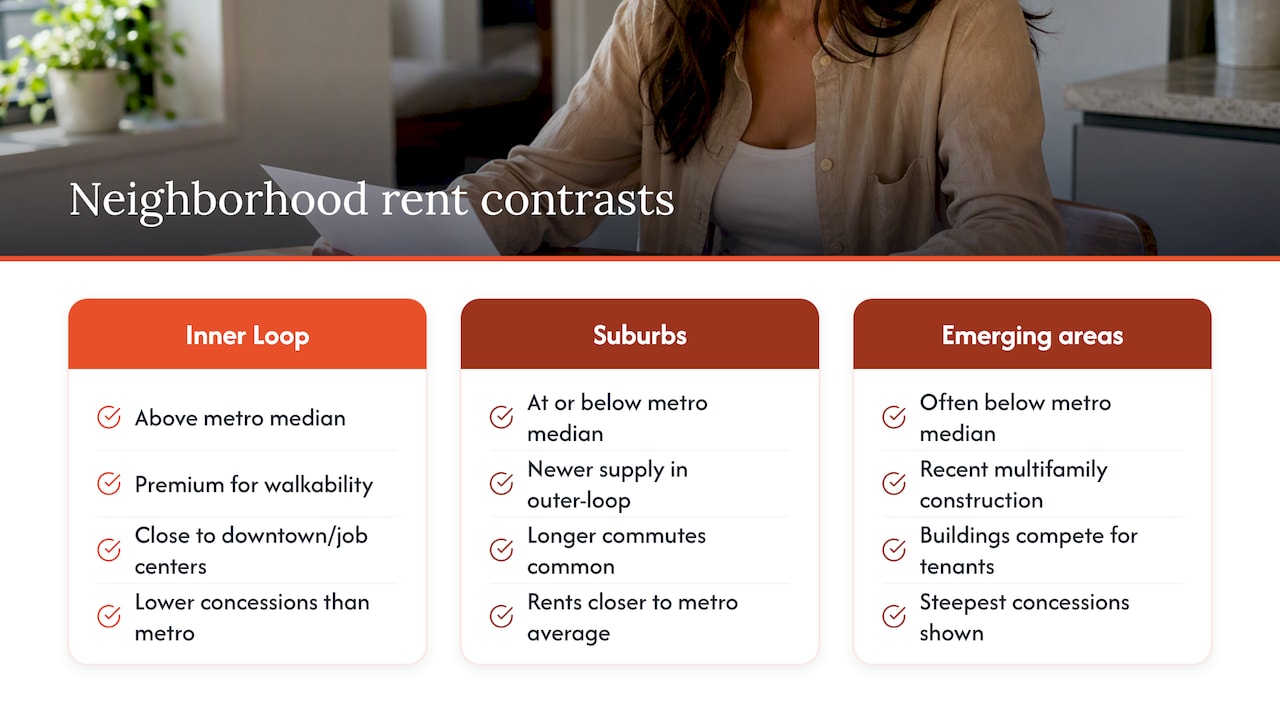
Metro-wide averages hide real differences between Houston submarkets. Inner Loop neighborhoods like Montrose, the Heights, and Midtown tend to command a premium over the metro median due to walkability and proximity to downtown and job centers. Suburban and outer-loop areas, including parts of Katy, Cypress, and Pearland, typically post rents closer to or below the metro average, reflecting newer supply and longer commutes. Energy Corridor and areas near major employers can swing with sector-specific hiring, while emerging areas with recent multifamily construction, such as parts of the East End, often show the steepest concessions because new buildings compete hardest for tenants. Because HAR and Realtor.com report metro-level figures rather than a full neighborhood breakdown, renters comparing specific submarkets should check current listings directly. Auben Realty’s rental listings page shows live examples of asking rents across the firm’s managed portfolio, which can serve as a useful reference point when comparing neighborhoods.

Average rental prices by neighborhood — overview diagram

Types of rental properties available in Houston

Houston’s rental stock spans a wide mix of property types, which is part of why metro averages can be misleading. Traditional apartment complexes, from garden-style to high-rise, make up the largest share of listings and are where most of the concession activity documented by Realtor.com is concentrated. Single-family rental homes have grown as a category, especially in suburban submarkets, and HAR’s data shows leased single-family listings rising through mid-2026. Townhomes and condos round out the market, often appealing to renters who want more space than an apartment without the maintenance of a standalone house. Build-to-rent communities, purpose-built single-family developments designed for long-term renters rather than buyers, have also expanded in the metro and add another layer of competition to the suburban rental supply.

Vacancy rates and what they mean for renters and owners

Rising inventory and elevated concessions both point to higher vacancy pressure across much of Houston’s rental stock, particularly in newer apartment communities still working through initial lease-up. When vacancy runs higher, landlords compete more aggressively on price and incentives, which is exactly what shows up in the concession data. For renters, higher vacancy translates directly into negotiating room: more available units mean more leverage to ask for a lower rate, waived fees, or a free month. For owners, sustained vacancy erodes net operating income even when posted rent stays flat, since an empty unit generates no revenue at all. That is why tracking effective rent, the actual income after concessions, matters more in a higher-vacancy environment than simply watching the asking price. Owners managing multiple units often find that a faster lease-up at a modest concession beats holding out for full price against a slower-moving pool of prospects.

Houston’s population growth continues to be driven by job opportunities in sectors like health care, construction, and administrative support, all named among the metro’s top contributors to the 50,300 jobs added in the year ending July 2026. That job growth draws a mix of new residents, from early-career workers renting their first apartment to relocating families weighing the buy-versus-rent decision. Houston’s relative affordability compared with coastal job centers continues to make renting locally attractive even as national migration patterns shift. Households priced out of homeownership by mortgage rates or home prices also add to rental demand, a dynamic explored further in Auben Realty’s comparison of renting versus buying affordability. Together, these forces keep baseline demand steady even as supply-side pressure keeps pricing power tilted toward tenants for now.

How local regulations shape the rental market

Texas does not have rent control, and Houston, like the rest of the state, cannot impose rent caps under current state law, so pricing in the metro is set entirely by supply and demand rather than regulatory limits. That absence of rent control is part of what allows landlords to respond quickly to softening demand with concessions rather than being locked into fixed pricing structures. Local regulations that do apply tend to focus on habitability standards, lease disclosure requirements, and eviction procedures rather than price controls. For owners and investors, this means Houston’s rental economics are driven by market fundamentals, like job growth, supply additions, and concession trends, more directly than in metros with rent stabilization rules. Auben Realty’s broader look at why Houston remains a strong investment market covers how this regulatory environment factors into longer-term investment decisions.

What renters and owners should watch beyond the metro numbers

Metro averages mask real variation between submarkets, so check concessions and days on market in your specific neighborhood rather than relying on citywide figures alone. Lower-income renters should weigh whether newer, concession-heavy units offer better value than older stock with lower base rent but fewer incentives. Typical market renters have more room to negotiate right now than the headline median rent suggests, so ask directly about concessions before signing.

— MediaBeast

How Auben Realty helps owners respond to these conditions

Property management firms may offer management, leasing, renovation oversight, and asset management services to owners navigating Houston’s current conditions. Experienced property management firms help owners manage vacancy and pricing decisions directly. Start with property management to see how it fits your portfolio.

Aubenrealty

Sources

FAQ

Is rent dropping in Houston?

Yes, median asking rent in Houston fell modestly year over year to roughly $1,373 in August 2026, marking 37 straight months of annual declines according to Realtor.com. Concessions have also risen sharply, adding further downward pressure on effective rent.

What is driving Houston’s high concession rates?

Rising rental supply, including new apartment completions and single-family listings, has outpaced lease-up speed, pushing landlords to offer concessions to fill units faster. Houston’s concession rate reached 60.3% in August 2026, one of the sharper increases among major U.S. metros tracked by Realtor.com’s national analysis.

Which cities have the highest rental demand?

Rental demand tends to run highest in metros with strong job growth and relative affordability, which is part of why Houston continues to attract renters despite softer pricing. Demand varies by local job market conditions, so checking metro-specific job growth and vacancy data gives a clearer picture than national rankings alone.

What is the best rental market in Texas for investors right now?

There is no single definitive answer, since the right market depends on an investor’s goals, but Houston’s combination of job growth and relative affordability makes it a market worth close consideration. Auben Realty’s analysis of Houston as an investment market covers the factors supporting that case in more detail.

How can owners tell if they should offer concessions or lower rent?

A short-term concession, like a free month or waived fees, preserves the lease’s stated rent for future comparisons, while a base rent cut resets tenant expectations permanently. Owners typically favor concessions when vacancy is temporary and tied to seasonal leasing patterns, reserving rent cuts for units that have sat unleased well beyond typical days-on-market in their submarket.

4 Days to Default: Houston Eviction Process and 2026 Rule 510 Changes

A Houston eviction must follow a fixed legal sequence: written notice to vacate, a lawsuit filed in the correct Justice Court precinct, a hearing set 10 to 21 days later, a judgment, a 5-day appeal window, and finally a writ of possession that requires 24 hours’ notice before execution. If you received a notice, your immediate move is to preserve every document and photo related to the tenancy; if you are the landlord, verify your notice and filing paperwork before you walk into court.


TL;DR:

  • Eviction filings must include correct tenant names, proper notice proof, and be made in the proper precinct to avoid delays or voided judgments.
  • The typical timeline for uncontested evictions is three to four weeks from notice to judgment, but contested cases or appeals can extend this to six weeks or more.
  • Filing costs are generally modest but can increase with contested hearings, appeals, or jury fees, and all fees should be verified before filing.
  • Self-help eviction methods, like changing locks or removing belongings without court approval, are illegal, and tenants can seek swift legal remedies like a writ of reentry.
  • Proper documentation, adherence to procedural rules, and timely proof are critical for both landlords and tenants to minimize case delays and legal risks.

Aubenrealty
Simplify Your Property Management
Auben Realty combines property management, tenant placement, and renovation services for owners seeking less hands-on involvement.

Table of Contents

The step-by-step eviction process in Harris County

Texas law sets the floor for every Houston eviction, and Harris County Justice Courts add their own filing details on top of it.

  1. Notice to vacate. Texas Property Code Chapter 24 requires a written notice before a landlord can file suit, and most leases default to 3 days unless the lease sets a different period.

  2. Petition filing. The landlord files in the Justice of the Peace precinct where the property sits, and Harris County JP guidance requires the petition to include the property description, the grounds for eviction, how notice was delivered, the rent owed, and the names of every tenant on the lease.

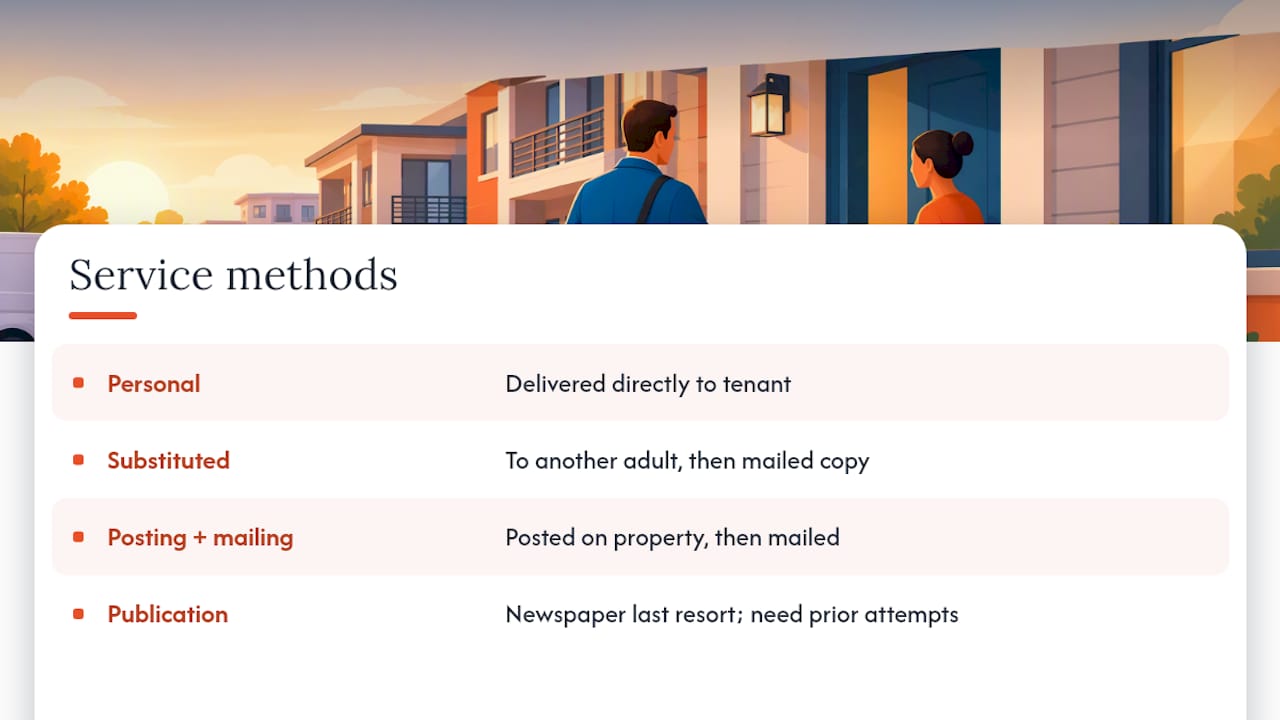
  3. Service of citation. The constable or an authorized process server delivers citation to the tenant, and the return of service becomes the landlord’s proof that notice reached the right person.

  4. Hearing. Harris County courts set the hearing no sooner than 10 days and no later than 21 days after filing, and either side can request a jury.

  5. Judgment. The judge rules for possession, rent, or both, and the losing party has a 5-day window to appeal before the judgment becomes final.

  6. Writ of possession. A writ cannot issue before the sixth day after judgment, and once issued, the constable must post a 24-hour notice at the property before removing anyone, according to the Texas State Law Library’s eviction guide.

Rule 510 changes tied to SB 38 took effect for cases filed on or after January 1, 2026, and they touch petition content, joined rent-claim caps, and the summary-disposition track used for forcible entry cases. Anyone filing this year should confirm the current Harris County packet rather than reuse an older form.

How long does a Houston eviction actually take?

Timelines vary widely depending on whether the tenant contests the case or the landlord hits a procedural snag.

  • Uncontested nonpayment case: notice period plus a hearing set near the 10-day minimum often means a judgment within roughly three to four weeks of filing.
  • Contested case with an appeal: add the 5-day appeal window, then the time it takes the appellate docket to schedule a new hearing, which can push total resolution past six weeks.
  • Summary disposition for forcible entry: this expedited track under Rule 510 gives the occupant only 4 days to respond, so a squatter case can reach judgment faster than an ordinary nonpayment suit.

Filing to hearing runs 10 to 21 days under Harris County JP rules, a window built into the court’s own docketing practice rather than left to a clerk’s discretion. Service problems, a missed constable attempt, or a crowded court calendar are the most common reasons a case runs longer than these baseline estimates.

What eviction filing costs in Harris County

Fees are modest compared to most civil suits, but they add up when a case is contested or appealed.

  • Harris County charges consolidated filing fees that cover the petition and initial court costs, listed on the county’s civil filing fee schedule.
  • Constable service fees apply separately for delivering citation to the tenant.
  • A jury trial requires a jury fee, paid several days before trial, per the Harris County fee schedule.
  • Attorney fees are recoverable only when the lease allows them or a specific statute permits it, and rent claims joined to an eviction suit are capped at $20,000 under Rule 510.

Fee amounts change periodically, so confirm current figures on the precinct’s own fee sheet before filing.

Tenant rights, defenses, and the ban on self-help eviction

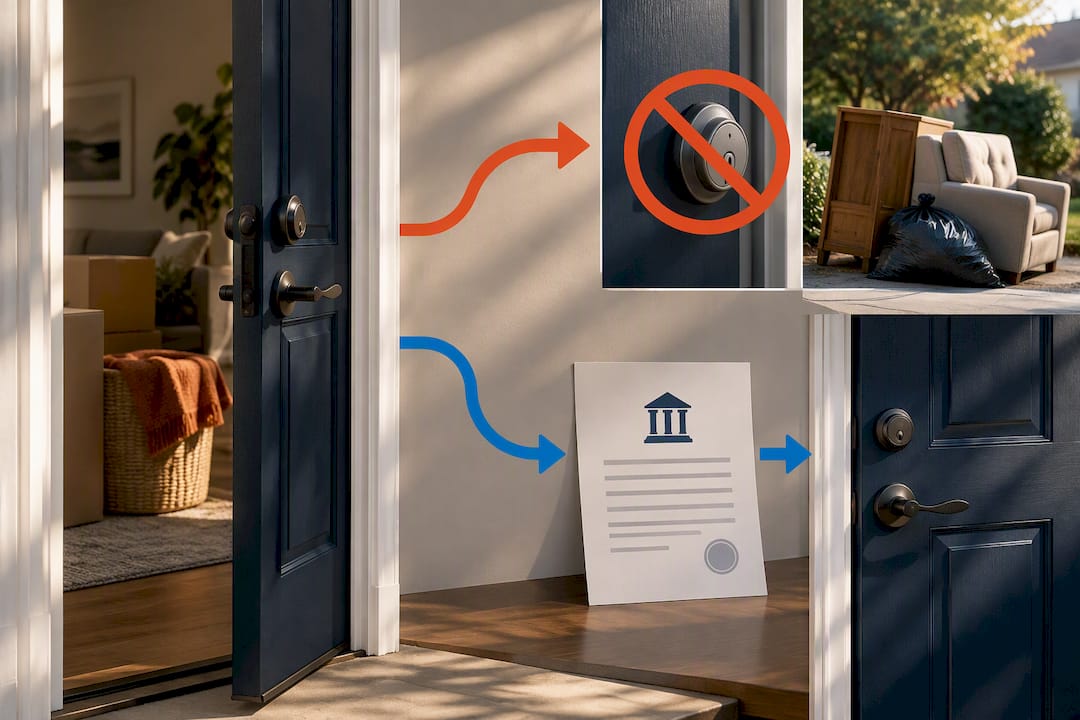
Texas law does not let a landlord change the locks, remove doors, or set belongings on the curb without a court order. That kind of self-help eviction is illegal, and a tenant locked out this way can seek a writ of reentry, which restores possession quickly when a justice reasonably believes an unlawful lockout occurred, as described in the Texas Property Code’s reentry provisions.

Illustration of lawful reentry versus lockout

Common defenses raised at a hearing include improper notice delivery, rent that was tendered and refused, retaliation for a repair complaint, and active-duty military protections. The University of Houston People’s Lawyer points out that eviction hearings decide who has the right to possess the unit, not who owns it, so documentation matters more than argument.

Pro Tip: Keep a single folder, physical or digital, with your lease, every notice you received, payment receipts, repair requests, and photos of the unit’s condition; a tenant who can hand a judge organized proof often shortens the hearing.

  • Preserve the lease, all written notices, and payment records.
  • Save repair requests and any photos showing the unit’s condition.
  • Note names and contact information for witnesses who saw notice delivery or a lockout.

If you are locked out, file a sworn complaint for reentry with the Justice Court immediately. The landlord then has a short window to request a hearing before you regain access.

First moves after a notice or citation arrives

The first 48 to 72 hours shape how the rest of the case goes, for both sides.

  1. Tenants: gather your lease, notices, and payment history, then decide whether you can pay what is owed or need a payment arrangement before the hearing.
  2. Tenants: attend the hearing in person; a default judgment against a tenant who never shows up is common and hard to reverse.
  3. Tenants: contact a legal aid clinic or tenant hotline if your notice looks incomplete or your notice period seems too short.
  4. Landlords: confirm exactly how and when notice was delivered, and keep proof (a photo, a certified mail receipt, or a signed acknowledgment).
  5. Landlords: name every adult tenant on the lease in the petition, since omitting one, a mistake practitioners in Houston see often, can void a writ against that person and force a refiling.
  6. Landlords: pull the current Rule 510 petition template from the Harris County JP eviction pages rather than reusing an older form, and file in the correct precinct.

What Auben Realty sees go wrong in eviction filings

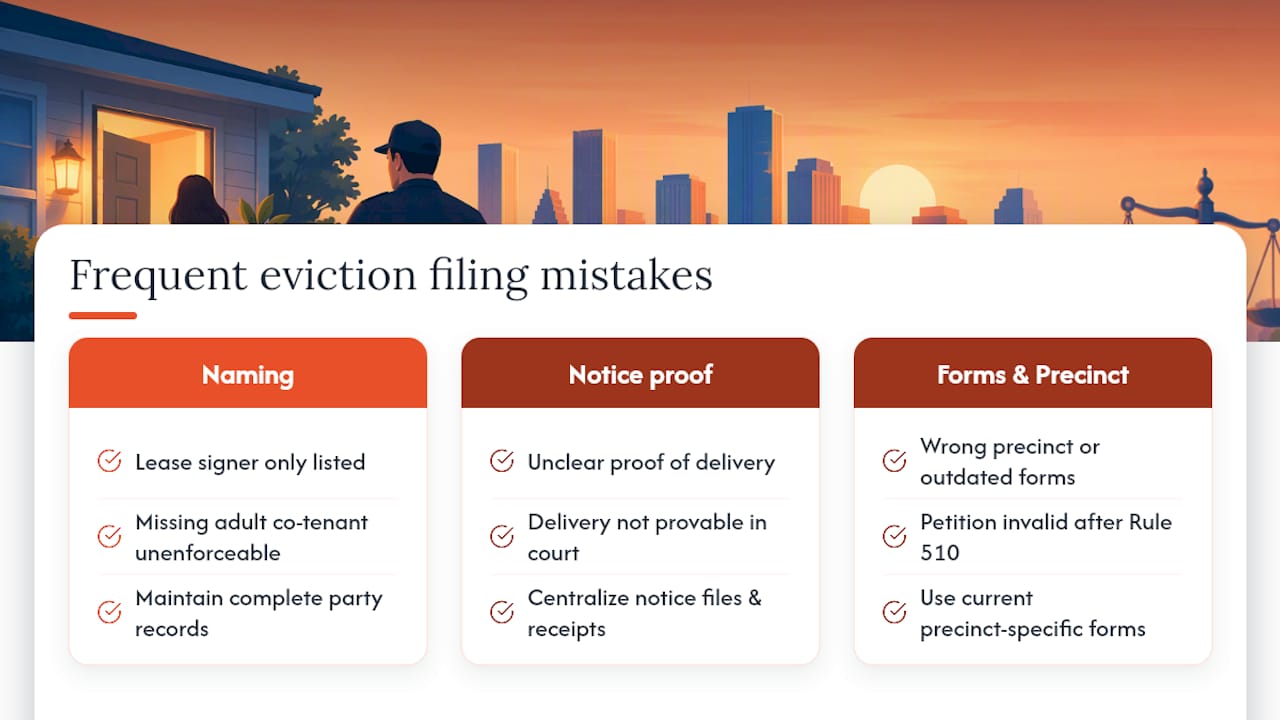
Auben Realty has managed rental properties for more than 15 years across 2,700 properties in 10 regional markets, and eviction filing mistakes tend to repeat themselves regardless of market. The most common one is incomplete party naming: a landlord lists the lease signer but skips an adult co-tenant, then discovers the writ cannot be enforced against that person.

Unclear proof of notice delivery is the second recurring problem, followed by petitions filed in the wrong precinct or built on outdated forms after the 2026 Rule 510 changes. The fix is usually operational rather than legal: lease clauses that spell out notice timelines clearly, a centralized file for every notice and delivery receipt, and property management that catches these gaps before a case ever reaches a courtroom. For more on avoiding disputes before they escalate, see our tips on handling difficult tenants.

Three eviction filing errors and operational controls

What the eviction process actually rewards

The conventional advice to “know your rights” undersells how much of a Houston eviction case turns on paperwork accuracy rather than the merits of the dispute. A tenant with a legitimate reason for nonpayment can still lose because they skipped the hearing, and a landlord with clear grounds can still lose weeks of rent because one co-tenant’s name was missing from the petition.

The 2026 Rule 510 changes make this truer, not less true. Summary disposition moves fast enough that a party who does not respond within 4 days can lose by default before ever explaining their side. Priority one, for either side, is procedural precision: correct notice, correct forms, correct precinct, and a documented paper trail. Everything else, including the strength of a defense or the sympathy of the facts, matters only after those basics are handled correctly. Property owners who avoid self-help shortcuts and follow the court’s process consistently spend less time and money than those chasing a faster, informal fix.

— MediaBeast

How Auben Realty helps Houston owners avoid eviction headaches

Most eviction problems start months before a notice ever goes out, in a lease that was vague or a maintenance request that went unanswered. Auben Realty’s property management service handles tenant screening, lease drafting, and day-to-day communication so fewer disputes reach the point of filing, and in-house maintenance through our project management services resolves repair complaints before they become legal defenses.

Aubenrealty

When an eviction is unavoidable, having accurate records already on file, correct tenant names, documented notices, and a clean payment history, shortens the process instead of stalling it.

  • Full-service property management, including tenant placement and lease terms built to avoid notice disputes.
  • In-house maintenance and renovation oversight to close repair-related defenses before they surface.
  • Asset management support for investors who want fewer vacancies and less legal exposure over time.

If you own rental property in the Houston area, visit our property management page to see how we handle eviction risk before it starts.

Official statutes, rules, and county forms to verify timelines and fees

This article is general information, not a substitute for advice from a qualified lawyer. Consult a qualified legal professional about your own circumstances before acting on anything here.

Sources

FAQ

How long is the eviction process in Houston?

A typical uncontested case runs from notice to judgment in about three to four weeks, since Harris County courts set hearings 10 to 21 days after filing. Contested cases or appeals add time, sometimes six weeks or more, while an appeal is pending.

What is the fastest a landlord can evict a tenant?

The fastest route is summary disposition for forcible entry cases under the 2026 Rule 510 changes, which gives the occupant only 4 days to respond. This track is meant for squatter situations, not ordinary nonpayment cases, which follow the standard 10 to 21 day hearing window.

Does a 3-day notice mean I have to leave in 3 days?

No. A 3-day notice to vacate is a pre-suit requirement under Texas Property Code Chapter 24, not an immediate removal order. The landlord still has to file suit, win a hearing, and obtain a writ of possession before anyone can legally be removed.

Can a landlord change my locks without a court order?

No, self-help eviction, including changing locks or removing belongings without a court order, is not legal in Texas. A tenant locked out this way can file for a writ of reentry, which can restore access quickly according to the Texas Property Code’s reentry rules.

What happens after a landlord wins an eviction judgment?

The tenant has a 5-day window to appeal before the judgment becomes final, and a writ of possession cannot issue before the sixth day after judgment. Once issued, the constable posts a 24-hour notice at the property before physically removing the tenant’s belongings, per the Texas State Law Library.

$1,240 Cost Gap Owners Can’t Ignore: Leasing vs Management Fees

Leasing fees are one-time tenant-placement charges, while management fees are recurring costs for day-to-day operations, and both affect your cash flow differently. A leasing fee typically runs 50% to 100% of one month’s rent, charged when a tenant signs. A management fee usually runs 6% to 10% of collected rent, charged every month the property is occupied. Budget for the first as a lump vacancy cost and the second as a permanent line item.


TL;DR:

  • Leasing fees typically range from 50% to 100% of one month’s rent and are paid only once per new tenant, while management fees usually run 6% to 10% of monthly rent and recur as long as the lease is active.
  • Management fees based on collected rent align incentives with occupancy, but owners should verify whether arrangements include minimum fees, vendor markups, and if they cover accounting and reports.
  • Contract language matters; landlords should watch for hidden costs like billing on scheduled rent, vague renewal terms, or uncapped vendor markups that can lead to unexpected expenses.
  • Higher management fees are often justified by faster lease times, lower vacancy rates, and fewer costly repairs, making the lowest fee not always the most profitable choice.

Aubenrealty
Simplify Your Property Management
Auben Realty combines tenant placement, management, renovation, and local market expertise for owners seeking less hands-on involvement.

Explore Auben Realty

Table of Contents

What is a leasing fee and what does it cover?

A leasing fee, sometimes called a tenant-placement fee, pays for the work of finding and installing a new resident: marketing the unit, scheduling showings, screening applicants, and preparing the lease. It is a one-time charge tied to a specific event, not a monthly obligation.

The contract language matters here. Some agreements say the fee is “earned” the moment a signed lease is in hand, while others tie it to the tenant actually moving in and paying first month’s rent. That distinction affects what happens if a tenant backs out after signing.

Owners should also watch for services that sound included but are billed separately, like professional photography, lockbox installation, or an extra fee for expedited screening. Understanding how a property management company handles tenant screening helps clarify what a placement fee is actually buying.

The owner almost always pays the leasing fee, not the tenant, though some markets have shifted certain junk fees onto renters through separate lease-signing charges. Before signing a management agreement, ask directly:

  • Is the leasing fee a flat amount or a percentage, and of what rent figure?
  • What triggers the fee: a signed lease or a move-in with rent collected?
  • Are marketing, photography, and screening costs bundled or itemized separately?
  • Does a lease renewal count as a new placement, triggering a second fee?

What is a property management fee and when does it apply?

A property management fee covers the ongoing work of running a rental: collecting rent, coordinating maintenance requests, handling accounting, and keeping the property compliant with local landlord-tenant rules. Unlike a leasing fee, it applies every month the lease is active, not just once.

Two billing models dominate. A percentage-of-collected-rent model charges a set share, often 6% to 10%, only on rent actually received, which means a vacant month costs the owner nothing in management fees. A flat monthly fee charges the same dollar amount regardless of occupancy or rent level, which can favor owners with higher-rent properties but works against owners during vacancy since some flat-fee contracts still bill during vacant months.

Minimums matter too. A company advertising 8% might apply a $100 monthly minimum that effectively raises the rate on lower-rent units. Owners should also scrutinize pass-throughs and vendor markups: a management company that marks up a $150 plumbing repair to $220 before billing the owner is quietly padding its margin beyond the stated fee.

  • Ask whether the fee is charged on collected rent or scheduled rent, since collected-rent billing aligns the manager’s incentive with actually getting the property occupied.
  • Confirm whether there’s a minimum monthly fee that changes the effective percentage on lower-rent properties.
  • Request a cap or disclosure policy on vendor markups for maintenance and repairs.
  • Clarify whether the fee includes accounting and owner statements or bills those separately.

Side-by-side comparison: timing, scope, and cash-flow impact

The two fees affect your cash flow at completely different points in the rental cycle. Treating them as interchangeable line items is where a lot of budgeting goes wrong.

  1. Scope: A leasing fee covers a single event (marketing through move-in); a management fee covers continuous operations (rent collection, maintenance, reporting) for as long as the lease runs.
  2. Timing: The leasing fee hits once, typically at lease signing or move-in; the management fee recurs monthly, drawn from collected rent.
  3. Vacancy effect: During vacancy, you pay a leasing fee to fill the unit but owe no management fee on that empty month if billing is based on collected rent.
  4. Renewal effect: Some contracts charge a reduced renewal fee (often a flat amount smaller than the original placement fee) each time an existing tenant signs a new lease term.
  5. Annual cost: A property renting for $1,800 a month with an 80% leasing fee and an 8% management fee would generate roughly $1,440 in placement cost at turnover and about $144 per occupied month in management fees, or close to $1,728 over a full year of occupancy.

Add a renewal fee, a maintenance markup, or a mid-year vacancy, and the total annual cost of professional management can swing meaningfully even when the advertised percentages look identical between two companies. That is why comparing only the headline percentage, without looking at how nominal fees compare against resident retention and profitability, tends to mislead owners shopping on price alone.

Typical fee ranges and benchmark examples owners can apply

Fee ranges vary by market, property type, and how bundled the services are, but industry surveys give owners a useful baseline. National data puts average management fees at around 8.49% of collected rent, with tenant-placement fees commonly landing between 50% and 100% of one month’s rent when billed as a standalone charge, according to the same survey.

That same benchmarking data shows real spread depending on structure:

  • Flat monthly management fees range roughly from $49 to $250 per unit depending on market and portfolio size.
  • Percentage-based fees range from about 3.75% to 14% of collected rent.
  • Renewal fees average roughly $200 to $300 or a fraction of a month’s rent when charged separately.
  • Multi-family and larger portfolios tend to see lower percentage rates than single-family homes, since per-unit overhead drops with volume.

The gap between those two scenarios, over a year with one turnover, is roughly $1,240, which is real money that a percentage comparison alone won’t reveal. Seasonal timing also affects lease-up speed and therefore how much placement cost actually delivers value, something covered in more depth in seasonal leasing strategy.

Are leasing and management fees tax deductible?

The IRS treats both fees as ordinary rental expenses in most cases. 414 on rental income and expenses](https://www.irs.gov/taxtopics/tc414), property management fees and commissions paid for tenant placement are generally deductible when they are ordinary and necessary for producing rental income. Publication 527 confirms management fees as a common deductible rental expense and offers guidance on pre-rental costs, vacant-property treatment, and recordkeeping.

Timing depends on your accounting method. Most individual landlords use cash basis, meaning a fee is deducted in the year it’s actually paid, not the year the service was performed. That distinction matters when a December leasing fee doesn’t get paid until January.

Not every fee is expensed immediately. A cost tied to a capital improvement, such as a renovation project a manager oversees, is typically capitalized and depreciated rather than deducted in full the year it’s paid.

  • Keep every management statement and leasing invoice separately labeled by property and date.
  • Reconcile monthly management statements against your bank deposits to confirm collected-rent figures match what you were billed on.
  • Track any capital-improvement-related fees separately from routine operating fees for depreciation purposes.

Pro Tip: Save every itemized management statement in a dedicated folder by tax year. It turns a stressful Schedule E filing into a ten-minute reconciliation.

How to evaluate and compare management proposals

Comparing two management proposals side by side only works if you’re comparing the same scope of service, not just two percentages.

  1. Request the fee model in writing: percentage of collected rent, flat fee, or a hybrid, along with any minimums.
  2. Ask directly how and when the leasing fee is earned, since a signed-lease trigger and a move-in trigger carry different risk for you.
  3. Ask whether billing is based on scheduled or collected rent, since collected-rent billing keeps the manager’s incentive aligned with your occupancy.
  4. Ask for the vendor markup policy on maintenance and repairs, and request a cap if none exists.
  5. Review the termination clause for notice period, early-termination penalties, and whether unearned fees are refunded.
  6. Score each proposal by weighting service scope (maintenance response time, reporting frequency, retention programs) against the nominal percentage, rather than picking the lowest number outright.

Negotiation levers worth requesting include a trial period before a long-term contract, written performance benchmarks tied to vacancy days or maintenance response time, and a cap on how much a vendor invoice can be marked up before it requires owner approval. When maintenance vendor bids are part of the conversation, a structured scoring approach like the snow removal bid evaluation rubric illustrates how owners can apply objective criteria instead of just picking the cheapest bid.

Pro Tip: Ask for the last three months of maintenance invoices from a prospective manager’s existing clients (with owner names redacted) to see real-world markup practices before you sign.

Red flags in management contracts that quietly cost you

Some contract language looks routine but ends up costing owners far more than the advertised fee suggests.

  • Billing on scheduled rent instead of collected rent charges you a management fee even when a tenant hasn’t paid, which misaligns the manager’s incentive with your actual cash flow.
  • Vague “earned” language on leasing fees can leave you owing a full placement fee even if a tenant breaks the lease within days.
  • Automatic renewal clauses with long notice windows can trap you in a contract you’re unhappy with for months after you decide to leave.
  • Uncapped vendor markups on repairs let a manager quietly inflate maintenance bills well beyond the stated management percentage.
  • Lease-break penalties charged to the owner, not just the tenant, can appear buried in boilerplate language.

Require pass-through transparency in writing, meaning every vendor invoice is shown at cost or with a disclosed, capped markup. Insist on audit rights to review statements, and get clear termination terms with a defined notice period and no penalty for cause.

What experience should you look for in a property manager?

Track record matters more than a stated percentage. A reputable property management company may have extensive experience serving many properties across multiple regional markets, combining leasing, ongoing management, and maintenance under a single contract rather than splitting them across vendors.

That integration changes the fee calculus. When maintenance, leasing, and retention programs sit inside one team instead of being outsourced piecemeal, owners avoid the markup layers that come from a management company subcontracting every repair. Investor reporting becomes more consistent when the same team handles placement and the monthly books.

Integrated versus outsourced property services

A full-service model like this tends to fit owners who want one point of contact and predictable reporting across multiple properties. Owners with a single unit and time to manage vendor relationships themselves may find an unbundled, a la carte approach more cost-efficient.

Is the cheapest fee ever the best choice?

The lowest nominal fee rarely produces the best net return. A manager charging a lower percentage but leaving units vacant longer, or missing maintenance issues that turn into bigger repairs, can cost you more than the fee difference ever saved.

Higher fees are worth paying when they come with faster lease-up, lower turnover, and fewer legal or maintenance surprises. A useful heuristic: the less time and risk tolerance you have, the more a full-service, higher-fee model tends to pay for itself.

— MediaBeast

Auben Realty: how our property management service bundles leasing and management

Some property management providers package tenant placement and ongoing management into a single agreement to avoid coordinating separate vendors for leasing, maintenance, and monthly accounting.

Aubenrealty

  • Tenant placement and screening handled by the same team responsible for ongoing occupancy.
  • In-house maintenance coordination instead of third-party vendor handoffs.
  • Investor reporting built for owners tracking performance across multiple properties.

This approach can suit owners who prefer integrated, full-service management across regional markets rather than managing separate leasing and management contracts. Visit the property management page to request a proposal.

Sources

FAQ

Is it normal to pay a leasing fee?

Yes, paying a leasing fee to cover tenant placement is standard practice among property management companies. It typically runs 50% to 100% of one month’s rent and is charged once per new tenancy, not monthly.

What is the 2% rule for rental properties?

It is a rough screening tool, not a guarantee, and doesn’t account for fees like leasing or management costs that reduce actual net return.

How much should a management fee be?

Management fees average around 8.49% of collected rent nationally, though flat-fee models and percentage rates both vary by market and property type. The right fee depends on what services are bundled in, not just the percentage itself.

Who typically pays the leasing fee?

The property owner almost always pays the leasing fee to the management company, not the tenant. Some markets have introduced separate lease-signing charges billed directly to tenants, but the placement fee itself is an owner cost tied to the management agreement.

Avoid Dismissal: 15+ Year Eviction Playbook for U.S. Landlords

Start by serving the correct written notice, documenting every step, and never attempting to remove a tenant yourself. The eviction process for landlords follows a set legal sequence: notice, court filing, hearing, judgment, and writ of possession, though exact timelines shift by state and city. Federal law under the Fair Housing Act and VAWA limits how and when you can proceed. The next section breaks the process into a checklist you can follow today.


TL;DR:

  • Serving the correct notice type, properly timed, and following the jurisdiction’s specific service methods is essential to avoid restarting the eviction process.
  • The notice periods for nonpayment or lease violations can range from 3 to 30 days depending on local laws, which must be strictly honored before filing suit.
  • Filing the eviction in the correct court and naming all adult tenants is critical, with proper proof of service required to prevent case dismissal.
  • Federal laws like the Fair Housing Act and VAWA impose limits on discrimination, retaliation, and protecting victims of domestic violence, requiring careful documentation.
  • Avoiding illegal shortcuts, such as lockouts or utility shut-offs, and properly handling tenant belongings post-eviction can prevent legal liabilities and support a smooth recovery process.

Aubenrealty
Make Property Management Less Hands On
Auben Realty combines management, renovation, and tenant placement services for owners seeking reliable returns with less day to day involvement.

Explore Auben Realty

Table of Contents

Step-by-step eviction process from notice to writ of possession

Skipping a step or filing before a notice period ends is one of the most common ways landlords lose an otherwise valid case. Following this order protects you from a forced restart.

  1. Review the lease and confirm the default. Check the signed lease for the exact violation, whether it is unpaid rent, an unauthorized occupant, or a lease breach, before you write anything.
  2. Attempt documented outreach. A dated text, e-mail, or letter noting the issue and requesting a resolution creates a paper trail that helps later if the case goes to court.
  3. Choose the right notice type. Pay-or-quit notices apply to unpaid rent, cure-or-quit notices apply to fixable lease violations, and unconditional quit notices apply to serious or repeated violations with no chance to fix them.
  4. Serve the notice properly. Deliver it according to your state’s accepted methods (personal delivery, posting and mailing, or certified mail) and keep proof of service.
  5. Wait out the full notice period. Filing even one day early can force you to restart the entire process.
  6. File the eviction lawsuit in the court that has jurisdiction over the rental property, naming every adult tenant on the lease as a defendant.
  7. Prepare for the hearing. Gather your lease, notice copies, proof of service, and rent ledger, and organize them so a judge can review them quickly.
  8. Attend the hearing and obtain judgment. Present your evidence factually; if the tenant does not appear, many courts allow a default judgment.
  9. Request the writ of possession once the judgment is final and any appeal window has closed.
  10. Coordinate with the sheriff or constable to execute the writ, since only law enforcement can physically remove a tenant.

A few habits reduce risk at every stage:

  • Keep a single, dated file (digital or paper) for every notice, communication, and receipt tied to the tenancy.
  • Never rely on a verbal notice; courts want a written, served copy.
  • Confirm your local court’s specific form requirements before filing, since a wrong form can delay the case by weeks.

Pro Tip: Call the court clerk’s office before filing and ask which eviction forms are current. Many county courts update templates yearly, and an outdated form is grounds for dismissal.

Which notice to serve and how long each timeline runs

The notice you serve depends entirely on the violation, and the number of days you must wait depends entirely on your state and sometimes your city.

A pay-or-quit notice applies when rent is late or unpaid and provides a tenant a period to pay or vacate, with the exact time depending on local law. A cure-or-quit notice applies to a fixable lease violation, such as an unauthorized pet or unregistered occupant, and gives the tenant a chance to correct the issue. An unconditional quit notice applies to serious or repeat violations, such as ongoing illegal activity, and typically does not offer a cure option.

Timelines vary widely. Some states allow a 3-day pay-or-quit notice for nonpayment, while cure-or-quit periods can range from about 7 to 30 days depending on the jurisdiction. Local court rules and even city ordinances can shorten or extend these windows, so check your specific county or state court’s published guidance before you calculate a deadline, as one representative example from New York courts shows nonpayment cases require the statutory notice before any filing can proceed.

Accepted service methods generally include:

  • Personal delivery directly to the tenant.
  • Substituted service to another adult at the residence, followed by a mailed copy.
  • Posting the notice on the door combined with mailing a copy, sometimes called “nail and mail.”
  • Certified mail with return receipt, which some states accept as a standalone method.

Proof of service, whether a signed affidavit, a certified mail receipt, or a process server’s declaration, is what the court will ask for at the hearing. Without it, a judge can dismiss the case outright.

Filing in court, the hearing, and enforcing the judgment

Once the notice period has fully run and the tenant has not complied, you file the eviction lawsuit, often called an unlawful detainer or summary possession action, in the court with jurisdiction over the property’s location, typically a justice, municipal, or county court.

  1. Name every leaseholder as a defendant. Leaving off an adult on the lease, or relying only on a generic “and all occupants” label, can invalidate the filing and force you to restart, a risk legal guidance on eviction proceedings warns landlords about directly.
  2. Serve the tenant with the court summons. This is separate from the earlier notice and follows its own state-specific rules for delivery and proof.
  3. Attend the scheduled hearing. Many courts set hearings within one to two weeks of filing, though local caseloads affect that window.
  4. Present your evidence. A rent ledger, copies of the served notice, proof of service, and written communications are the core documents judges expect to see.
  5. Address common tenant defenses. Tenants often argue improper notice, unaddressed repair requests, or retaliation, so your documentation needs to answer those points before they are raised.
  6. Receive judgment. If you win, the court issues a judgment for possession and, in many cases, unpaid rent and costs.
  7. Track the appeal window. Tenants typically have a short, defined period to appeal, during which enforcement may pause depending on local rules.
  8. Request the writ of possession once the appeal window closes without action.
  9. Have the sheriff or constable execute the writ. Only law enforcement can lawfully remove the tenant and their belongings.

Pro Tip: Bring three copies of every document to the hearing, one for the judge, one for the tenant, and one for yourself, so nothing gets left behind in the shuffle of a busy docket.

Federal limits: Fair Housing, VAWA, and anti-retaliation rules

State timelines are only half the picture. Federal law overrides local procedure in specific situations, and getting this wrong exposes you to complaints, lawsuits, and delays far longer than any notice period.

The Fair Housing Act bars evicting a tenant, or treating one differently during the eviction process, because of race, color, religion, sex, national origin, familial status, or disability. Victims of discriminatory or retaliatory eviction attempts may file complaints with HUD or bring civil action within two years of the discriminatory act, so a single inconsistent decision, like enforcing a notice period more strictly for one tenant than another, can create real exposure.

VAWA adds a separate layer of protection in HUD-covered housing. It allows a landlord to bifurcate a lease, removing an abusive household member while keeping the victim housed, rather than evicting the whole household over an incident of domestic violence. Landlords covered by these programs must provide notice of VAWA rights using HUD’s required forms, and tenants may have up to 14 business days to submit supporting documentation for emergency protections.

Practical compliance steps:

  • Apply the same written notice standards to every tenant, regardless of household composition.
  • Train any staff who serve notices or communicate with tenants on Fair Housing basics.
  • Treat a reported domestic violence incident as a request for lease bifurcation review, not an automatic ground for eviction.
  • Document every step of a sensitive case in writing to show consistent, lawful handling.

Building the evidence file that wins your hearing

Judges rule on documents, not impressions. A missing notice copy or an undated photo can cost you a case that should have been simple.

Keep and organize:

  • The signed lease and any amendments.
  • A complete rent ledger showing every payment and missed payment.
  • Copies of every written notice, along with proof of service.
  • Photos or videos of property conditions, dated and labeled.
  • Repair invoices and inspection reports tied to the unit.
  • A log of all tenant communications, including texts and e-mails.

Store records digitally with clear file names and dates, and keep a backup paper packet for court, since some clerks still prefer physical copies at filing or hearing. Affidavits summarizing your timeline can help a judge move through the case faster.

Pro Tip: Build your tenant file at move-in, not at move-out. A documented leasing process gives you a complete record before a dispute ever starts.

Illegal shortcuts that can sink your case

Self-help evictions, changing the locks, shutting off utilities, or removing a tenant’s belongings without a court order, are illegal in every state and can expose you to civil damages and, in some jurisdictions, criminal charges.

Common mistakes that force a restart or worse:

  • Locking out a tenant before a judge issues a writ of possession.
  • Harassing a tenant into leaving through repeated threats or unannounced visits, conduct explored in this breakdown of landlord harassment rules.
  • Serving a notice with the wrong dates, amount owed, or party names.
  • Filing before the notice period fully expires.
  • Applying different eviction standards to tenants in protected classes.

If you catch a mistake, stop the conduct immediately, correct the paperwork, and document the fix. When the case involves a discrimination claim, a domestic violence disclosure, or any ambiguity about proper notice, get an attorney involved before your next filing.

Handling tenant belongings after eviction

Most states require a specific process for property left behind after a lawful eviction, and skipping it can turn a clean case into a new liability. Once the writ of possession is executed, the sheriff or constable typically oversees the physical removal, and many jurisdictions require the landlord to store abandoned belongings for a set period rather than discard them immediately.

Photograph and inventory everything left in the unit before you move or store it. Keep the inventory alongside your other case documents, since a dispute over lost or damaged items can surface weeks after the eviction is technically closed.

Belongings photographed for eviction inventory

Check your state and local rules for the required storage duration and any notice you must send the former tenant about retrieving their property. Some jurisdictions require a written notice with a deadline before you can dispose of unclaimed items, and some allow you to charge reasonable storage costs. Never sell or discard belongings before that window closes, since doing so can create a separate small claims exposure even after you have legally regained possession of the unit.

Dealing with tenant stays or eviction delays

An eviction judgment does not always mean immediate possession. Tenants can file an appeal, request a stay, or, in some cases, file for bankruptcy, and each of these can pause enforcement even after you have won in court.

An appeal typically must be filed within a short, defined window after judgment, and some courts require the tenant to post a bond covering back rent or ongoing rent during the appeal to keep enforcement paused. If no bond is posted, you may be able to proceed with the writ despite the appeal being pending, though the exact rule depends on your state.

Bankruptcy filings trigger an automatic stay under federal law that halts most eviction enforcement the moment the case is filed, even if you already have a judgment. Landlords in this situation generally need to file a motion for relief from the stay in the bankruptcy court before the writ can move forward, which can add real time to an already long process.

Because both appeals and bankruptcy filings involve federal or appellate procedure outside a typical eviction docket, this is a point where consulting an attorney is worth the cost. Trying to enforce a writ during an active stay, even by mistake, can create separate legal problems on top of the delay itself.

Alternatives to eviction worth considering first

Eviction is often the most expensive and slowest way to resolve a tenant problem, so many landlords screen for cheaper, faster fixes before filing.

A short payment plan, agreed to in writing, can resolve a nonpayment case without the cost of court fees, lost rent during the process, and turnover expenses afterward. Mediation, sometimes offered free through local housing courts or community programs, can settle lease-breach disputes, like a pet violation or noise complaint, without either side needing an attorney. A cash-for-keys arrangement, where the landlord offers a modest payment in exchange for a fast, voluntary move-out, can also be cheaper than a full court process when the goal is simply getting the unit back quickly.

These options work best for a tenant who wants to comply but is short on time or money, not for one who is unresponsive or engaged in serious lease violations. Difficult-tenant situations that stop short of eviction, such as chronic late payments or property care issues, often respond well to structured conversations before legal notices are ever served, an approach covered in these tactics for handling difficult tenants. Weigh the cost of a payment plan or mediation session against weeks of lost rent and legal fees before deciding to file.

Post-eviction: cleanup, repairs, and re-renting

Once you have legal possession back, the clock on lost income starts running in the other direction, and a fast, careful turnaround protects your bottom line.

Start with a full walkthrough and photo record of the unit’s condition, which supports any security deposit deductions and documents damage for your files. Serious cases, like significant property damage left behind by a tenant, may require more extensive repair work before the unit is rentable again, a situation detailed in this account of a severely damaged rental.

Schedule cleaning, repairs, and any needed renovation promptly, since a vacant unit generates no income while it sits unrented. Update your listing with current photos and pricing based on today’s market conditions rather than reusing the previous listing, and screen new applicants carefully, since a stronger tenant screening process at this stage lowers your odds of repeating the same situation.

Finally, review the sequence: what led to this eviction, whether it was a screening gap, a lease clause issue, or a communication breakdown, and adjust your process before the next tenant moves in.

Service of process: methods and where they go wrong

Service of process, delivering the court summons and complaint after you file, is a separate legal step from serving your original notice, and it has its own strict rules that vary by state.

Common accepted methods include personal service directly to the tenant, substituted service to another adult resident followed by a mailed copy, and posting on the property combined with mailing when the tenant cannot be found. Some states also allow service by publication in a local newspaper as a last resort when a tenant is actively evading service, though courts generally require documented attempts at other methods first.

The most frequent challenges landlords run into are tenants who avoid answering the door, units with multiple adult occupants where only one gets served, and process servers who fail to file a proper affidavit of service. Any of these can give a tenant grounds to challenge the case and delay judgment. Hiring a licensed process server or using the sheriff’s office for service, where available, reduces the risk of a botched attempt, since these methods come with built-in proof of service that courts recognize without dispute. Confirm your state’s exact accepted methods before you file, since using an unapproved method can undo weeks of otherwise correct casework.

Service of process: methods and where they go wrong — overview diagram

What experienced landlords know that most guides skip

The eviction process for landlords is less about knowing the law and more about discipline: serving the right notice, on the right day, to the right person, every single time. Most cases that fall apart in court do not fail because the tenant was in the right. They fail because the landlord skipped a step, misnamed a party, or filed a day too early.

After years of managing rental properties, industry leaders have built eviction-prevention playbooks around consistent tenant screening, standardized notice templates, and documented outreach at the first sign of trouble, the same habits that keep most disputes from ever reaching a courtroom. A rigorous screening process, like the one described in this look at property manager screening practices, catches many problem tenancies before a lease is even signed.

The real cost trade-off isn’t DIY versus professional management. It’s the hours you’ll spend on paperwork and court dates versus the fee you’d pay someone else to handle it correctly the first time.

— MediaBeast

How Auben Realty helps landlords avoid and manage evictions

Aubenrealty

Auben Realty’s Property Management service is built to keep landlords out of the courtroom in the first place, and to handle the process correctly when eviction becomes unavoidable. That means rigorous tenant screening before a lease is signed, standardized lease enforcement and notice procedures that hold up in court, and in-house maintenance that resolves habitability complaints before they become legal disputes.

When professional management is in place, clients can receive consistent, documented communication with tenants from move-in through any dispute, properly drafted and served notices that meet state requirements, coordination with legal counsel when court action is necessary, and fast turnaround on cleanup and re-renting once a unit is vacant.

The result is fewer evictions overall, and less of your own time spent on the ones that do happen. If you are managing a rental yourself and want that handled correctly, check availability for Auben Realty’s property management services in your market.

This article is general information, not a substitute for advice from a qualified lawyer. Consult a qualified legal professional about your own circumstances before acting on anything here.

Sources

FAQ

What’s the fastest a landlord can evict a tenant?

The fastest timelines apply to nonpayment cases with short notice periods, some as brief as three days, but the total process still requires the full notice period plus court filing, a hearing, and a writ of possession. Even in a straightforward case, expect the full process to take several weeks once every legal step is completed properly.

How long does a landlord have to wait to evict a tenant in Illinois?

Notice periods and filing timelines in Illinois vary by the type of violation and by city, since some municipalities have their own rules on top of state law. Check the Illinois court system or your county circuit court’s published eviction guidance for the exact notice period that applies to your situation.

How much notice is required to evict a tenant in Texas?

Texas generally requires a written notice to vacate, commonly three days, before a landlord can file an eviction suit, though the lease itself may specify a different period. Local county procedures, like the one Gregg County, Texas publishes, lay out the exact notice and filing steps for that jurisdiction.

Do landlords usually win eviction cases?

Outcomes depend heavily on whether the landlord served the correct notice, waited out the full notice period, and brought complete documentation to the hearing. Cases most often fail on procedural errors, like naming the wrong parties or filing early, rather than on the underlying facts of the dispute.

What happens if a tenant’s belongings are left behind after eviction?

Most states require landlords to inventory and store abandoned property for a set period rather than dispose of it immediately, with specific notice requirements for the former tenant to reclaim items. Check your state and local rules before discarding or selling anything left in the unit.

5 Year Rental Pro Forma That Catches DSCR Shortfalls for Investors

A rental pro forma is a forward-looking income and expense projection that shows expected net operating income, cash flow, and lender or investor metrics for a rental property. Build one before you buy, refinance, or renovate. The output includes NOI, cash-on-cash return, DSCR, and often IRR. A template and worked example follow below.


TL;DR:

  • The accuracy of a rental pro forma heavily depends on precise input data, especially rent estimates, vacancy rates, and operating expenses, which vary by property and market.
  • Key metrics like DSCR, cap rate, and IRR provide different insights; DSCR is critical for loan approval, often requiring a minimum of 1.2 to 1.3, and should be stress-tested against interest rate and occupancy changes.
  • Property-specific unit-level rent rolls and explicit CapEx schedules improve model reliability, especially for larger or value-add properties, to accurately assess upside, risks, and financing feasibility.
  • Underwriters typically apply their own assumptions, such as vacancy floors and management fees, which may differ from your pro forma; aligning assumptions with lender standards speeds approval.
  • Building and maintaining a disciplined, realistic pro forma, with stress tests for downside scenarios, prevents overestimating returns and helps manage property operations effectively to stay within projected financial parameters.

Aubenrealty
Put Your Rental Plan to Work
Auben Realty combines investment expertise, property management, renovation, and tenant placement to support more hands-off ownership.

Explore Auben Realty

Table of Contents

What Goes Into a Rental Pro Forma?

A pro forma is only as good as its inputs. Get the raw numbers wrong and every formula downstream, no matter how sophisticated, produces a fiction dressed up as a spreadsheet.

Start with gross potential rent: the total rent you would collect if every unit stayed occupied all year at full market rate. From there, subtract vacancy and credit loss, which covers both empty units and tenants who stop paying. A stabilized single-family rental in a stable market might run a 5% vacancy assumption, while a Class C multifamily property in a softer submarket could realistically need 8% to 10%. Add in other income, things like pet fees, parking, laundry, storage, or short-term rental cleaning fees, and you arrive at effective gross income (EGI). This is the real revenue line, not the wishful one.

Operating expenses come next, and this is where amateur pro formas fall apart fastest. A defensible expense section breaks out:

  • Property taxes and insurance (get actual quotes, not last year’s bill)
  • Property management fees, typically 8% to 12% of collected rent
  • Repairs and maintenance, based on the property’s age and condition
  • Utilities the owner covers (common areas, vacant units)
  • Landscaping, pest control, and other recurring service contracts
  • HOA dues, if applicable

Reserves and capital expenditures deserve their own line, not a buried percentage inside “maintenance.” Roofs, HVAC systems, water heaters, and flooring wear out on predictable schedules, and treating a 1% to 2% CapEx reserve as an explicit line item rather than a rounding error keeps a multi-year model honest instead of artificially rosy.

Financing inputs, loan amount, interest rate, amortization term, and any interest-only period, determine your annual debt service. Pair that with a projection horizon. Most practitioners cap projections at 5 to 10 years, since assumption error compounds quickly beyond that window. A rent growth estimate that is off by half a percentage point barely matters in year two. By year eight, it has warped the entire cash flow picture.

One more distinction matters for anyone analyzing more than a duplex: unit-level rent rolls versus aggregate projections. A four-unit building where three units rent at $1,400 and one sits at $1,050 because of a legacy tenant tells a different story than a flat “$1,300 average” assumption. Unit-level detail catches upside from below-market leases and flags risk from a tenant who might leave the moment you raise rent to market.

What Goes Into a Rental Pro Forma? — overview diagram

NOI, Cap Rate, Cash-on-Cash, IRR, and DSCR: The Formulas That Matter

Every rental pro forma metric answers a different question, and mixing them up leads to bad decisions.

Net Operating Income (NOI) = Effective Gross Income − Operating Expenses (excluding debt service and CapEx reserves in most conventions). NOI is the property’s income-producing power independent of how you financed it, which is exactly why lenders and appraisers anchor to it.

Cap Rate = NOI ÷ Purchase Price (or current market value). Cap rate works best for stabilized properties with steady, predictable cash flow. It breaks down for a property mid-renovation or mid-lease-up, because a single year’s NOI does not reflect where the asset is headed. Freddie Mac’s own appraisal guidance warns against applying a cap rate derived from trailing-12-month income to a forward-looking pro forma NOI, since that mismatch tends to produce an inflated valuation.

Cash-on-Cash Return = Annual Pre-Tax Cash Flow ÷ Total Cash Invested. This is the metric most individual investors actually care about, because it measures return on the actual dollars out of your pocket, down payment, closing costs, and initial renovation, not the total asset value.

IRR (Internal Rate of Return) accounts for the timing and size of cash flows across the entire hold period, including a sale or refinance at the end. IRR fits non-stabilized properties far better than a single-year cap rate, because lease-up periods and renovation timelines create lumpy, irregular cash flows that a snapshot metric can’t capture.

DSCR (Debt Service Coverage Ratio) = NOI ÷ Annual Debt Service.

DSCR benchmark: A ratio of 1.0 means income exactly covers the mortgage payment with nothing left over. Lenders commonly require a minimum DSCR of 1.2 to 1.3 to build in a margin of safety against vacancy spikes or unexpected repairs.

Use cap rate to sanity-check a purchase price against the local market. Use cash-on-cash to compare deals against your own capital constraints. Use IRR when a sale, refinance, or major renovation changes the cash flow shape over time. Check DSCR every time you’re borrowing money, because your lender certainly will.

How to Build a 5-Year Rental Pro Forma Step by Step

You don’t need commercial-grade software to build a rigorous pro forma. A spreadsheet, a calculator, and a disciplined sequence of steps will get you there.

  1. Anchor your Year 1 assumptions. Pull actual comparable rents for the specific unit mix, not a citywide average. Confirm property tax based on the post-sale reassessed value where applicable, since many counties reassess on transfer. Get real insurance quotes rather than estimating.

  2. Choose your projection length. Five years suit most buy-and-hold single-family and small multifamily analysis. Ten years makes sense for larger multifamily deals where a lender or partner wants to see a longer hold thesis, but longer horizons compound assumption error, so don’t stretch past what your assumptions can actually support.

  3. Model rent growth. Apply an annual rent growth rate, commonly 2% to 4% depending on market, to gross potential rent each year. Don’t apply the same growth rate to every line item uniformly; rent, taxes, and insurance rarely move in lockstep.

  4. Model vacancy and credit loss. Keep this consistent as a percentage of gross potential rent unless you have a specific reason to change it, like a planned renovation that will take units offline temporarily.

  5. Add other income streams and apply a separate, usually more conservative, growth assumption since fee income doesn’t always track rent inflation.

  6. Calculate Effective Gross Income (EGI) for each year: gross potential rent, minus vacancy/credit loss, plus other income.

  7. Inflate operating expenses separately from rent growth. Property taxes often jump after a sale due to reassessment, then grow more slowly. Insurance has been climbing faster than general inflation in many markets. A flat 3% expense inflation assumption across the board is a common simplification, but stress-test it against your specific market.

  8. Calculate NOI each year: EGI minus operating expenses (excluding debt service and CapEx).

  9. Subtract annual debt service (fixed if you have a fixed-rate loan) to get pre-reserve cash flow.

  10. Subtract your CapEx reserve to get final annual cash flow, the number that actually lands in your account.

  11. Add an optional terminal value in Year 5 if you’re calculating IRR. Apply an exit cap rate to your projected Year 6 NOI to estimate a sale price, subtract estimated selling costs and remaining loan balance, and add that net proceeds figure to your final year’s cash flow before running the IRR function.

Pro Tip: Build your spreadsheet with assumptions in a separate input block at the top, rent growth, vacancy rate, expense inflation, exit cap rate, and reference those cells in every formula below. When a lender or partner asks “what if vacancy hits 12%,” you change one cell instead of rebuilding the model.

A Worked Example: Five Years of Numbers on a Single-Family Rental

Numbers make this concrete. Take a single-family rental purchased for $280,000 with a $224,000 loan at 7% interest, 30-year amortization, meaning annual debt service runs about $17,880.

A 2% CapEx reserve on gross rent adds $480.

Cumulative five-year cash flow lands at roughly negative $12,522, a property fighting negative leverage from a high purchase price relative to rent. This isn’t a failure of the model. It’s exactly what a pro forma is supposed to reveal before you close, not after.

Five-year rental cash flow shortfall example

Year 1 DSCR here is $14,960 ÷ $17,880 = 0.84, well below the 1.2 to 1.3 threshold most lenders want to see. That single number should stop this deal at the underwriting stage, or force a renegotiation of price, or a larger down payment to shrink the loan.

Run the sensitivity checks before you trust any of this:

  • Raise rent growth from 3% to 5% and cash flow improves modestly by Year 5, but doesn’t fix a Year 1 DSCR problem.
  • Push vacancy from 6% to 10% and Year 1 cash flow drops further, into deeper negative territory.
  • Bump expense inflation from 3% to 5% and the five-year cumulative loss widens by several hundred dollars.

Breakeven occupancy, the vacancy rate at which cash flow hits zero, sits well below what this deal’s Year 1 numbers assume, another signal that the purchase price needs to come down or the down payment needs to go up.

Choosing the Right Tool: Spreadsheets, Calculators, or Software

A basic spreadsheet handles the vast majority of single-family and small multifamily analysis just fine. If you’re evaluating one to three properties a year, templates built around property info, loan info, assumptions, and output metrics like NOI and cash-on-cash cover everything you need without a monthly subscription.

Web-based calculators speed up quick screening when you’re comparing a dozen listings and need a fast go/no-go signal, but most strip out the customization a spreadsheet allows, like unit-level rent rolls or a custom CapEx schedule tied to a property’s actual roof age.

Dedicated rental analysis software earns its cost when you’re managing a portfolio across multiple markets, need to share live models with partners or lenders, or want automated market rent comps pulled in rather than manually researched.

Before trusting any template, run this checklist:

  • Does it separate CapEx reserves from operating expenses, or bury them together?
  • Can you input unit-level rent rolls, not just an averaged monthly figure?
  • Does it calculate DSCR automatically, or only NOI and cap rate?
  • Can you adjust rent growth and expense inflation independently, year by year?
  • Does it support a terminal value calculation for IRR, if you need multi-year return analysis?

Adapting a template across property types matters too. Short-term rentals need seasonal revenue curves instead of flat monthly rent, plus a separate line for cleaning and platform fees. Single-family models are the simplest version, one unit, one rent roll. Multifamily rental analysis requires unit-by-unit rent rolls, a loss-to-lease calculation comparing current rents to market rents, and often a separate renovation-unit turn schedule if you’re executing a value-add strategy.

What Underwriters Actually Check Before Approving a Loan

Lenders rarely take your pro forma at face value, and understanding their adjustments before you apply saves time and embarrassment.

Fannie Mae defines Underwritten Net Cash Flow as underwritten effective gross income minus underwritten total expenses, a calculation that often differs meaningfully from an investor’s own pro forma. Underwriters typically apply their own vacancy floor regardless of what the seller’s rent roll shows, add a minimum management fee even if you plan to self-manage, and require a specific replacement reserve per unit per year rather than accepting a blanket percentage.

Underwriting benchmark: Most lenders set a minimum DSCR of 1.2 to 1.3, and they stress-test that number against a higher interest rate scenario or a lower rent assumption before issuing final approval.

To reconcile your pro forma with what an underwriter will actually produce:

  • Pull three to five comparable rents from the immediate submarket, not a metro-wide average.
  • Use the lender’s typical vacancy floor for the property type and market, even if actual current occupancy is higher.
  • Document management fees at market rate, even if you or a family member plans to manage the property informally.
  • Present replacement reserves as an explicit per-unit annual figure, since HUD’s own review guidance emphasizes documented, reconciled operating assumptions during underwriting.

Common Pro Forma Mistakes and How to Stress-Test Your Numbers

Most flawed pro formas share the same handful of errors, and every one of them is avoidable.

  1. Using a blanket expense ratio. Applying “50% of rent goes to expenses” across every property ignores real differences in age, taxes, and insurance costs between markets. Pull actual bills and quotes instead.
  2. Skipping the comparable-property check. Broker-supplied pro formas run optimistic more often than not; rebuild the rent and expense assumptions from your own local data rather than trusting the seller’s numbers.
  3. Underestimating CapEx and turn costs. A vacant-unit turn, paint, cleaning, minor repairs, lost rent during the vacancy, commonly runs several hundred to a few thousand dollars per unit. Model it explicitly, not as a rounding error inside maintenance.
  4. Skipping downside scenarios entirely. Sensitivity tables that flex one to three variables at a time reveal model risk faster than any other single exercise, especially for a partner or lender deciding whether to say yes.

Pro Tip: Always calculate and report your breakeven occupancy rate and your DSCR at the lender’s maximum allowable payment, not just at your projected rate. If a small rate increase or occupancy dip breaks the deal, you want to know that before closing, not after.

How Auben Realty Puts Pro Formas to Work

A pro forma on a screen is a projection. Turning it into rent collected and expenses controlled is operational work, and that’s where the numbers meet reality.

Property management teams take a pro forma’s assumptions and layer in the details a spreadsheet can’t see on its own: the actual condition of a roof that changes the CapEx timeline, a submarket’s real leasing velocity that adjusts the vacancy assumption, and the renovation sequencing that determines whether a value-add unit comes back online in month two or month five.

In practice, that means:

  • Reconciling projected management fees against actual local market rates before a client finalizes a purchase decision
  • Scheduling renovation and turn work against the pro forma’s assumed downtime, so a projected two-week vacancy doesn’t quietly become six weeks
  • Feeding real leasing and turnover data back into future projections, so year two’s assumptions get sharper instead of staying static

Across the markets where property management firms operate, this feedback loop between the model and the property is what keeps a pro forma from becoming a document nobody looks at again after closing.

The Real Value of a Pro Forma Isn’t the Model

Most guides on this topic treat the pro forma as the finish line: build the spreadsheet, hit calculate, done. That’s backwards. The spreadsheet is the easy part. The discipline is in refusing to accept optimistic inputs, especially rent and vacancy assumptions handed to you by a seller or listing agent with an obvious incentive to make the deal look good.

Where conventional advice falls short is the emphasis on precision over honesty. A pro forma with formulas accurate to the penny built on a fantasy rent roll is worse than a rough estimate built on real comps, because the false precision makes bad assumptions feel trustworthy. DSCR is the number that cuts through that fog fastest. It’s blunt, lenders check it regardless of how good your narrative sounds, and it doesn’t care how much you want the deal to work.

If you take one thing from this guide, prioritize the stress test over the base case. Run the downside scenario before you fall in love with the upside one.

— MediaBeast

Let Auben Realty Turn Your Pro Forma Into a Working Plan

Building the model is step one. Executing against it, keeping vacancy near your projection, controlling turn costs, timing renovations so they don’t blow past the schedule, is where most investors actually lose ground on their numbers. This gap can be closed by managing the property against the same assumptions modeled, not a generic playbook.

Aubenrealty

Our teams work from your pro forma’s actual line items: the management fee assumption becomes a real management agreement, the CapEx reserve becomes a scheduled renovation plan through project management, and the rent growth assumption gets tested against real local leasing data every renewal cycle. For investors building a portfolio rather than a single property, asset management turns those year-by-year projections into ongoing performance reporting you can actually act on.

If you want a second set of eyes on your numbers before you commit capital, request a free rental analysis and see how your assumptions hold up against real market data in your area.

Sources

FAQ

What Is a Rental Pro Forma?

A rental pro forma is a forward-looking projection of a property’s income and expenses, used to estimate NOI, cash flow, and metrics like DSCR and cash-on-cash return before you buy, refinance, or renovate. It differs from a historical financial statement because it models future assumptions, not just past performance.

What Is the 2% Rule for Rentals?

It’s a quick filter, not a substitute for a full pro forma, since it ignores financing costs, taxes, and actual operating expenses entirely.

What Is an Example of a Pro Forma?

A basic example projects gross rent, subtracts vacancy loss and operating expenses to reach NOI, then subtracts debt service to arrive at annual cash flow, typically laid out year by year across a 5 to 10 year horizon. The worked walkthrough above shows this full calculation with real dollar figures across five years.

What Is the 7% Rule for Rental Property?

Treat any rule-of-thumb percentage as a rough screening heuristic only, and confirm actual returns with a full pro forma using real local rent, expense, and financing figures.

Owners: Use 1%–4% and a 5 Step Plan for Property Maintenance Budgeting

The single most useful step you can take today is opening a dedicated savings account and setting an automated monthly transfer into it, even a small one. Everything else in property maintenance budgeting builds from that foundation.


TL;DR:

  • Budget at least 1% to 2% of your home’s value annually, adjusting for age, climate exposure, and whether the property is rental or owner-occupied.
  • Separate your maintenance funds into routine upkeep, large-system replacements, and emergency reserves to prevent confusion and ensure timely repairs.
  • Create a replacement schedule for major systems by tracking installation dates and estimating remaining useful life, setting aside annual reserves accordingly.
  • Automate monthly transfers into a dedicated savings account just after your mortgage or rent payment clears to avoid diverting funds from other bills.
  • Invest in preventive tasks like regular HVAC inspections, gutter cleaning, and roof checks to reduce overall repair costs and prevent costly emergency failures.

Aubenrealty
Simplify Your Property Maintenance
Auben Realty combines property management, renovation, and tenant placement to reduce hands-on ownership demands for property owners and investors.

Explore Auben Realty

Table of Contents

What Is Property Maintenance Budgeting and Which Rule of Thumb Fits Your Home?

Property maintenance budgeting means setting aside a predictable amount each year to cover both routine upkeep and eventual system replacements, rather than scrambling when a water heater fails. The most cited heuristic comes from Fannie Mae, which pegs routine maintenance spending at 1% to 4% of a home’s value per year, with 1% to 2% as a reasonable floor for a well-maintained property.

Where you land in that range depends on three factors: age, occupancy type, and climate exposure.

  • A home under 10 years old with newer systems can often budget closer to 1%.
  • A home over 25 years old, or one with an aging roof or original HVAC, should plan for 3% to 4%.
  • Rental properties tend to need the higher end because tenant turnover adds wear that owner-occupants don’t generate.
  • Homes in humid, coastal, or freeze-thaw climates need extra cushion for moisture and expansion damage.

Run the math on your own property. A $500,000 home at the same rate is $10,000 a year, or roughly $833 a month. Bump either figure up a point if the roof, HVAC, or water heater is past the halfway mark of its expected life.

How Do You Split a Maintenance Budget Into Buckets?

A single lump sum invites confusion about what the money is actually for. Splitting your annual target into three buckets solves that: routine upkeep, capital replacements, and true emergencies.

  • Routine covers predictable, recurring costs: filter changes, gutter cleaning, pest control, landscaping.
  • Capital/replacement funds big-ticket items you know are coming: roofs, water heaters, HVAC systems, appliances.
  • Emergency is a smaller cushion for the genuinely unpredictable, a burst pipe, storm damage, a sudden electrical fault.

Keeping these buckets separate matters more than it sounds. Freddie Mac’s guidance on financial preparedness warns that conflating a maintenance reserve with a personal emergency fund is a common mistake. Once you raid the roof fund to cover a medical bill, you’re back to reactive spending, and the roof still needs replacing on schedule.

How Do You Build a Replacement Timeline for Major Systems?

Every major system in your home is a ticking clock with a known lifespan. Home Depot’s guide to maintenance scheduling recommends treating each one as a tracked asset, not an afterthought you deal with when it breaks.

  1. List every major system: roof, HVAC, water heater, major appliances, plumbing, electrical panel.
  2. Record install dates, model numbers, and warranty expiration for each item, pulled from receipts, inspection reports, or the units themselves.
  3. Estimate remaining useful life using manufacturer specs or standard ranges (asphalt roofs run 20 to 25 years, water heaters 10 to 15, HVAC 15 to 20).
  4. Divide replacement cost by remaining years to get an annual reserve figure.

Here’s the math in action: a roof replacement costs $12,000 and has 15 years of life left. That’s $800 a year you need to be setting aside just for that one item. Do this for every major system and add the totals. This inventory approach, similar in spirit to the reserve studies condo associations run to fund shared capital projects, turns vague dread about “something breaking eventually” into a specific number you’re already covering.

Steps to Calculate and Automate Your Maintenance Budget

Building the budget is a five-part process, not a guess you write down once and forget.

  1. Gather your inputs. Pull your property’s assessed value, your last two to three years of actual maintenance spending if you have it, and the annual reserve total from your system inventory.
  2. Set your annual target. Take the higher of your rule-of-thumb figure (1% to 3% of value) and your inventory-derived total. If the inventory math comes out higher, trust it. It’s built on your actual systems, not an average.
  3. Open a dedicated account. Keep this separate from checking and separate from your emergency fund. Set an automatic monthly transfer so the money moves before you’re tempted to spend it elsewhere.
  4. Track spending as you go. A simple spreadsheet works fine. A property management app works better if you own more than one unit. Log every repair, date, and cost against the category it hit.
  5. Review quarterly, reforecast annually. Check actual spending against your target every three months, and rebuild the full budget once a year as systems age and costs shift.

Freddie Mac’s homeowner maintenance guidance points to the same conclusion from a different angle: owners who plan for big projects early and start saving before they need the money avoid financing repairs at high interest rates.

Pro Tip: Set your automated transfer for the day after your mortgage or rent payment clears, not the first of the month. That way the maintenance fund never competes with a bill that has a hard deadline.

Which Preventative Maintenance Tasks Actually Save Money?

The fastest way to shrink next year’s repair budget is to spend a little now preventing the failures that would otherwise force an emergency fix. The Department of Energy’s guide to home heating and cooling recommends a specific cadence: HVAC inspections every spring for cooling and every fall for heating, monthly filter checks, duct sealing, and correct insulation levels.

  • Schedule HVAC tune-ups twice a year, not just when the system stops working.
  • Clean gutters in spring and fall to prevent water intrusion at the roofline.
  • Inspect the roof after major storms and once a year at minimum.
  • Air-seal gaps around windows, doors, and utility penetrations.
  • Install programmable thermostats and ENERGY STAR lighting to cut wear on HVAC and reduce utility loads.

Scheduled maintenance can cut heating and cooling costs by roughly 5% to 10%, according to the same Department of Energy guidance, while also reducing the odds of an emergency system failure. That’s a meaningful dent in your routine bucket for the cost of a twice-yearly inspection.

How Should You Pay for a Major Repair?

The bucket the money comes from should match the type of expense. A known, scheduled replacement, like a roof at year 20, draws from your capital reserve. A sudden failure with no warning draws from the emergency fund. Neither should touch your personal savings if you’ve built the reserves correctly.

When reserves fall short, you have real options, each with tradeoffs:

  • HELOC: lower interest rates, but ties the loan to your home equity and takes time to set up.
  • Personal loan: faster to access, but higher rates than a HELOC.
  • Contractor financing: convenient for the specific job, but often the most expensive option long term.
  • Insurance claim: appropriate for sudden, covered damage, not for wear-and-tear replacements.

Whichever route you take, get at least three bids before hiring, and stagger large projects across different years when the timing allows it, so you’re never funding two major replacements in the same twelve months.

How Does a Property Manager Actually Run a Maintenance Budget?

Professional property managers don’t budget by guesswork, they run a system. Professional property managers maintain a live inventory of every major system across a property, run preventive schedules by season rather than waiting for a tenant complaint, and vet vendors ahead of time so a repair never starts with a scramble for a contractor.

Maintenance budget system connecting inventories schedules vendors

Homeowners can copy the core of this on a smaller scale: build a one-page spreadsheet listing your systems and install dates, set seasonal calendar reminders for inspections, and get two or three vendor quotes on file before you actually need one. A home management plan built around these habits turns maintenance from a source of anxiety into a routine line item.

Why Preventive Budgeting Beats Reactive Spending

Most homeowners learn this the expensive way: skip a $150 HVAC tune-up for three years running, then face a $6,000 system replacement two winters ahead of schedule. The math on prevention almost always wins, but the discipline to fund it before something breaks is where most budgets fail. Owners who track their systems and reserve for them on a planned maintenance schedule rarely face the kind of five-figure surprise that derails a household budget entirely.

— MediaBeast

Let Auben Realty Handle Your Maintenance Budget for You

If you’d rather not track inventories, chase contractor bids, or manage the quarterly review yourself, that’s exactly the gap Auben Realty’s property management service fills. Instead of building your own spreadsheet and calendar reminders, you get a team already running the inventory, vendor vetting, and preventive scheduling described above, on your property, year-round.

Aubenrealty

For owners planning a bigger renovation or system overhaul rather than routine upkeep, Auben’s project management service oversees the bids, scheduling, and staging so a capital project doesn’t blow through your reserve or drag on for months. If you own multiple properties and want the reserve math handled at a portfolio level, asset management extends the same discipline across every unit you hold.

Consider reaching out to a property management firm to talk through your property and get a maintenance program built around it instead of a spreadsheet you have to remember to update.

Sources

FAQ

What Percentage Should I Budget for Home Maintenance?

Most guidance points to 1% to 4% of your home’s value per year, with 1% to 2% as a reasonable starting point for a newer, well-maintained property. Older homes, rentals, and homes in harsh climates should budget closer to the top of that range.

Should My Maintenance Reserve and Emergency Fund Be the Same Account?

No. Freddie Mac’s guidance recommends keeping them separate because mixing the two leads to either drained repair savings or an underfunded emergency cushion. Each fund needs its own account and its own purpose.

How Do I Estimate the Useful Life of My HVAC System or Roof?

Manufacturer specs give a baseline: roofs typically last 20 to 25 years, HVAC systems 15 to 20, and water heaters 10 to 15. Documenting install dates and model numbers lets you track exactly where each system sits in that range.

Does Auben Realty Help With Maintenance Budgeting?

Yes. Auben Realty’s property management service includes inventory tracking, preventive scheduling, and vendor vetting that support a predictable maintenance budget. Current pricing details are available directly on the Auben Realty site.

How Much Can Preventative Maintenance Actually Save?

Scheduled HVAC maintenance alone can cut heating and cooling costs by roughly 5% to 10%, while also lowering the odds of a sudden, expensive system failure. Simple tasks like filter changes and duct sealing account for most of that savings.