Skip to content

2,700-Property Proof: Build-to-Rent Management That Drives Returns

A well-run build-to-rent portfolio does three things at once: it keeps units full, keeps per-unit costs down, and keeps residents renewing instead of shopping around. Some property management firms have observed this pattern across many properties in multiple markets, and it holds regardless of asset size. The levers that produce it are consistent: disciplined lease-up pricing, preventative maintenance instead of reactive repairs, and a resident experience good enough that renewal becomes the default choice, not a deliberate decision.


TL;DR:

  • Managing build-to-rent portfolios effectively relies on disciplined lease-up pricing, preventative maintenance, and fostering high renewal rates through resident experience.
  • Construction choices, such as wood framing and smaller unit sizes averaging 1,000 square feet, influence operational costs and maintenance strategies.
  • Successful operations require rapid leasing workflows, standardized turnover processes, and digital resident engagement practices to maximize occupancy and renewals.
  • Financing stages from high-interest construction loans to stable permanent debt depend on occupancy growth, lease-up speed, and conservative underwriting, especially in high-supply markets.
  • Key performance metrics like occupancy above 93 percent, net effective rent, and renewal rates above 50 percent guide ongoing portfolio health and require frequent, detailed tracking.

Aubenrealty
Simplify Build-to-Rent Operations
Auben Realty combines investment expertise, property management, renovation, and tenant placement to support owners across multiple markets.

Visit Auben Realty

Table of Contents

What Is Build-to-Rent Management and Why Does It Matter Now?

Build-to-rent (BTR) refers to purpose-built rental communities, whether detached single-family homes or low-rise multifamily units, designed and constructed specifically to be leased rather than sold. That single distinction changes almost everything about how the property gets managed. A BTR community is built with rental durability in mind: finishes chosen for turnover speed, floor plans sized for renters instead of buyers, and site layouts that support centralized maintenance and leasing operations.

The unit-size gap tells part of the story. In 2025, the median size of a multifamily unit built for rent was 1,000 square feet, compared to 1,170 square feet for units built for sale. Smaller footprints mean lower turn costs and faster unit prep, but they also mean tighter tolerances for storage and amenity space, which shapes how a management team plans community programming.

Three forces are pushing capital and renters toward this asset class:

  • Persistent housing supply shortages that keep single-family homeownership out of reach for a growing share of renters who want a house, not an apartment.
  • Demographic shifts, including remote workers and downsizing retirees who want space and privacy without the maintenance burden of ownership.
  • A preference for professionally managed communities over the patchwork quality of individually owned single-family rentals.

Construction choices reinforce the model’s economics. The overwhelming majority of multifamily buildings completed for rent, most according to Census data, used wood framing, a cost-efficient method that also demands more attentive moisture and pest management over the building’s life. That single fact should inform any BTR maintenance budget from day one. The Urban Institute’s research frames BTR as a small but fast-growing niche that genuinely requires its own management playbook, distinct from what works in traditional single-family rentals or garden-style multifamily.

Which Ownership Model Should Drive Your Management Strategy?

BTR portfolios generally get built and operated under one of four structures, and the model an investor chooses dictates staffing, maintenance strategy, and how much control they retain over design and vendor decisions.

  1. Vertically integrated operators handle development, leasing, and management under one roof. This model gives maximum control over design decisions that affect long-term operating cost, but it demands the largest capital base and the deepest bench of in-house staff.
  2. Contractor-led models bring in a builder to construct to spec, then hand off operations to a separate management team. Control over design stays with the investor, but coordination between builder warranties and the management team’s maintenance tracking becomes a critical, often underestimated task.
  3. Partnership structures pair capital partners with an operating partner who contributes local market expertise and management infrastructure. This spreads risk and reduces the capital investors need to commit, but it also means shared decision-making on everything from rent pricing to capital improvement timing.
  4. One-off or scattered-site BTR applies build-to-rent principles to individual homes rather than a cohesive community. It offers flexibility and lower entry cost, but loses the operational efficiencies of centralized maintenance and leasing that make concentrated BTR communities profitable.

The Urban Institute notes that operators typically trade off between control and capital exposure. Vertically integrated ownership buys you design control and full visibility into replacement risk, since you know exactly what’s under every roof and when it was installed. Partnership and contractor models push some of that risk onto builders or partners, which lowers capital requirements but means your management team needs airtight warranty tracking to make sure someone else’s mistakes don’t become your maintenance bill.

For most investors entering BTR for the first time, the decision boils down to three questions: How much capital can you deploy without a partner? Do you have or can you build in-house maintenance capacity? And how many markets are you trying to enter at once? Answer those honestly before choosing a structure, not after.

How Do You Run Day-to-Day BTR Operations Well?

Leasing, maintenance, and resident experience are the three operational pillars, and BTR punishes weakness in any one of them faster than scattered single-family rentals do, because residents in a shared community talk to each other.

Leasing and lease-up pricing. During initial lease-up, pricing strategy matters more than almost anything else. Freddie Mac’s 2025 multifamily outlook projects rent growth around 2.2% and vacancy near 6.2% amid elevated new supply, conditions that reward operators who prioritize occupancy over chasing top-of-market rent. A community that fills units three weeks faster than a competitor, even at a slightly lower rent, usually wins on total revenue once you account for vacancy loss. Marketing cadence should ramp before certificate of occupancy, not after, and showings should be scheduled in tight windows to create visible momentum for prospects.

Turnover and maintenance. Unit turns need a standardized workflow: inspection within 24 hours of move-out, vendor scheduling within 48 hours, and a hard cap on turn time that gets tracked per unit, not just averaged across the portfolio. Preventative maintenance schedules matter even more in wood-framed construction, where moisture intrusion and pest issues compound quietly if ignored. In-house maintenance teams tend to win on speed and cost control for routine work, while specialized vendors still make sense for HVAC, roofing, and anything requiring licensed trades.

  • Screen vendors on response time history, not just bid price.
  • Require standardized punch lists so quality doesn’t vary by technician.
  • Track maintenance cost per unit monthly, not annually, to catch cost creep early.

Resident experience. Renewal rates rise when residents have an easy way to submit requests, pay rent, and get community updates without calling an office. Digital self-service portals, group text or app-based communication for community events, and light amenity programming (a seasonal cookout, a pet meetup) build the kind of informal social pressure that keeps people renewing even when a competing community offers a few dollars less in rent.

Pro Tip: Track your “days to first showing” metric separately from “days to lease.” A gap of more than five days usually points to a marketing problem, not a pricing problem, and the fix is completely different.

Workflow automation and rent intelligence tools now handle a lot of what used to eat a leasing manager’s week: dynamic pricing recommendations, automated maintenance ticket routing, and renewal reminder sequences. None of that replaces judgment, but it does mean a smaller team can run a larger BTR footprint without dropping the details that drive renewals.
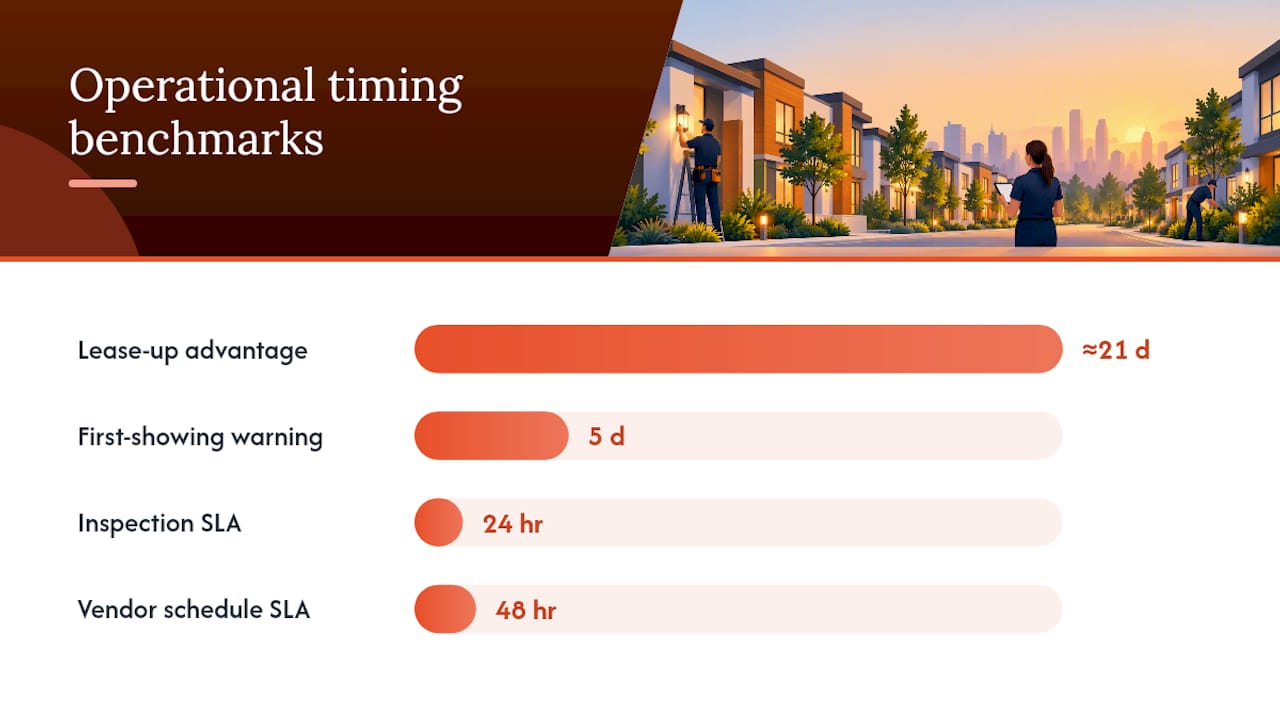
How Do You Run Day-to-Day BTR Operations Well? — overview diagram

How Should You Finance a BTR Project Through Stabilization?

BTR projects typically move through three financing stages, and the transition between them is where inexperienced investors lose the most value.

Acquisition, development, and construction (AD&C) loans fund the build itself and carry the highest rate and the shortest horizon of any financing in the project’s life. Once construction wraps, bridge or warehouse facilities often step in to cover the lease-up period, buying time for occupancy to stabilize before a lender will commit to permanent financing. Residential transition lending has become an increasingly important channel for exactly this gap, supporting builders and BTR sponsors who need capital between construction completion and stabilized cash flow.

Lease-up velocity and net effective rent are the two numbers that determine when and how favorably you can refinance into permanent debt. Lenders want to see occupancy climb predictably and rent concessions shrink over time. A community that stalls at 70% occupied for three straight months looks materially riskier to a permanent lender than one that climbed steadily from 40% to 85% over the same window, even if the final numbers land close together.

A few practical moves protect your optionality during this stretch:

  • Phase your rollout so you’re never leasing up an entire 200-unit community at once. Deliver in blocks of 40 to 60 units.
  • Keep a contingency reserve equal to at least a few months of debt service, separate from your operating account.
  • Set lease-up staging targets (25%, 50%, 75%, stabilized) tied to specific marketing and pricing adjustments, so you’re not improvising when occupancy stalls.

The Lending Gurus team, which works with small builders and investors on construction and bridge financing, points out that the biggest financing mistake sponsors make is underestimating how long lease-up will take in a high-supply market, then scrambling for bridge capital at worse terms than they could have locked in earlier.

What KPIs Actually Tell You How a BTR Portfolio Is Performing?

Six metrics cover almost everything an investor or manager needs to know, and each one should be tracked at both the lease-up stage and the stabilized stage, since the target numbers differ.

  • Occupancy rate: units occupied divided by total units. Lease-up targets typically climb in phases; stabilized portfolios should hold above 93% to 95%.
  • Net effective rent: gross rent minus concessions, averaged across the lease term. This is the number that actually predicts revenue, not the sticker rent.
  • Turnover cost per unit: total cost to prep a vacated unit for re-lease, including cleaning, repairs, and marketing. Rising turnover cost per unit without a corresponding rent increase is an early warning sign.
  • Maintenance cost per unit: monthly maintenance spend divided by total units, tracked separately from capital improvements.
  • Renewal rate: the share of expiring leases that renew. This is the single best proxy for resident satisfaction you’ll get without running a survey.
  • NOI margin: net operating income as a percentage of gross rental revenue, the number that ultimately determines asset value.

Market Snapshot: With Freddie Mac projecting vacancy near 6.2% amid high new supply, portfolios tracking occupancy weekly during lease-up and monthly once stabilized will catch softening demand months before it shows up in a quarterly P&L.

Weekly leasing reports and monthly full P&L reviews give most operators the right cadence. A dashboard that surfaces occupancy, net effective rent, and open maintenance tickets on one screen lets a regional manager spot a problem property before it drags down portfolio-wide numbers.

How Does a Real Operator Run BTR at Scale?

Some real estate companies structure their teams into pods rather than functional silos, meaning a single group handles leasing, maintenance coordination, and resident communication for its assigned properties instead of routing every request through a centralized call center. That structure shortens response time and gives residents a consistent point of contact, which matters more in BTR communities than scattered single-family portfolios because word travels fast when a community shares amenities and common areas.

Illustration of property management operational pods

In-house maintenance can be a deliberate choice, with repair crews on staff instead of routing work orders through third-party vendors to obtain tighter control over turn times and consistent quality across units, factors that directly support renewal rates. Renovation and project oversight often involve dedicated project management functions that track capital improvements from scope to completion rather than leaving that coordination to available contractors.

A practical checklist drawn from how Auben approaches BTR operations:

  • Screen and place tenants with a process built for speed without skipping the background and income verification steps that reduce eviction risk later.
  • Run pre-turn inspections before a lease term ends, not after move-out, to shorten the gap between vacancy and re-lease.
  • Track builder and appliance warranties against a shared calendar so nobody pays out of pocket for a repair still covered under warranty.
  • Run resident retention touchpoints, lease renewal outreach at 90 days out, not 30, so residents have time to plan instead of defaulting to a competitor’s move-in special.

Auben Realty has applied this model across 2,700 properties in ten regional markets, a scale that only works with the kind of standardized process this section describes.

Who Should Invest in BTR, and What Risks Should Worry You?

BTR fits investors with real staying power: enough capital to absorb a slower lease-up cycle, a long hold horizon, and genuine tolerance for development timeline risk. It’s a poor fit for anyone expecting quick turnaround or unwilling to underwrite a project that might take 18 to 24 months to stabilize.

The risks worth losing sleep over aren’t exotic. Supply cycles can flood a submarket with new units right when you’re leasing up, financing rates can shift underneath a project mid-construction, and zoning or permitting delays can push your timeline by months you didn’t budget for. Execution risk, simply failing to run leasing and maintenance well once doors open, does more damage to returns than any of the macro risks combined, because it compounds every month you’re understaffed or under-processed.

Diversifying across a few markets instead of concentrating in one metro reduces exposure to any single local supply cycle. Phasing development in blocks rather than delivering an entire community at once limits how much vacancy risk hits you at any given moment. And underwriting conservatively, assuming rent growth closer to the muted end of current projections rather than the optimistic end, protects you from the refinancing surprises that catch overleveraged sponsors off guard.

— MediaBeast

Let Auben Realty Handle the Operations While You Focus on Returns

Running BTR operations well means solving leasing, maintenance, and resident retention simultaneously, and most independent investors don’t have the staff to do all three without dropping something. Auben Realty’s Multifamily & Build-to-Rent Services exist specifically to close that gap, pairing pod-based property teams with in-house maintenance and investor-focused reporting so owners get consistent execution instead of a patchwork of vendors and part-time attention.

Aubenrealty

When you bring a BTR portfolio to Auben Realty, the scope typically includes leasing and tenant placement, preventative and responsive maintenance handled in-house, renovation oversight through dedicated project management, and regular financial reporting that tracks the same KPIs covered above, occupancy, net effective rent, turnover cost, and NOI margin, so you’re never guessing how a property is performing. If you’re weighing whether to self-manage or bring in a partner, start with a look at Auben Realty’s property management services to see how the scope lines up with what your portfolio actually needs.

Primary Sources and Further Reading

The Census Bureau’s Characteristics of New Housing (CHARS) highlights provide the construction and unit-size data behind BTR’s design economics, including framing methods and square footage comparisons between rental and for-sale product. The Urban Institute’s research on residential transition lending explains the four common BTR ownership models and the financing channels supporting them. Freddie Mac’s 2025 multifamily outlook offers the rent growth and vacancy projections that inform lease-up pricing strategy throughout this guide.

Sources

FAQ

Is Build-to-Rent Profitable?

BTR can be profitable when occupancy and maintenance costs are managed tightly, since the model’s efficiencies (standardized units, centralized management) tend to lower per-unit operating costs compared to scattered single-family rentals. Profitability depends heavily on lease-up execution, given that Freddie Mac projects rent growth around 2.2% and vacancy near 6.2% in a high-supply environment, meaning occupancy discipline matters more than aggressive rent pricing right now.

What Is the 2% Rule for Rentals?

The 2% rule is a rough screening tool suggesting a rental property’s monthly rent should equal at least 2% of its purchase price to indicate strong cash flow potential. It’s rarely achievable in most BTR markets today given current construction and land costs, and most experienced operators treat it as a rough filter rather than a real underwriting standard.

Is Rent-to-Own a Good Way to Build Credit?

Rent-to-own arrangements can help some renters build savings toward a down payment, but they don’t automatically build credit unless the specific agreement reports rent payments to credit bureaus, which many do not. This is a separate model from build-to-rent, which is standard rental housing designed for renting rather than a path to ownership.

What Are the Disadvantages of Build-to-Rent?

BTR requires more upfront development capital and carries construction and lease-up timeline risk that scattered single-family rentals don’t face. It also demands specialized operational infrastructure, in-house or contracted maintenance, centralized leasing, and community management, since a poorly run BTR community loses residents faster than a single scattered rental would.

How Much Does Property Management Cost for a BTR Community?

Property management pricing depends on portfolio size, scope, and market, and Auben Realty’s current rates are available directly through its property management page rather than published as a flat figure. Reaching out for a scope conversation is the fastest way to get an accurate number for your specific portfolio.

Six Step Tenant Screening That Meets HUD and FCRA Rules for Landlords

Tenant screening is the systematic, documented process landlords use to verify identity, income, credit, criminal history, and eviction records before handing over keys. The core steps run in order: pre-screen, collect a signed application with FCRA consent, verify identity, pull credit and background reports, confirm income, check references, then decide. Two rules govern every step: get written authorization before pulling any consumer report, and apply your written criteria the same way to every applicant.


TL;DR:

  • Most tenant screening processes, including credit, criminal, and eviction checks, are completed within two to five business days if conducted simultaneously.
  • Using a documented six-step screening process significantly reduces risks like eviction and unpaid rent, as it covers application, identity, credit, criminal, eviction, and income verification.
  • Applying consistent, written screening criteria before listing a property protects against legal claims and ensures fair treatment of all applicants.
  • Red flags such as eviction judgments and prior landlord debt are strong indicators of non-payment risk, but ambiguous records should be verified before denial.
  • Turning screening over to a professional property management service, like Auben Realty, streamlines the process, ensuring legal compliance and saving landlords time and effort.

Aubenrealty
Make Tenant Screening Easier
Auben Realty provides property management, tenant placement, and local market expertise for owners seeking less hands-on involvement.

Explore Auben Realty

Table of Contents

Why Tenant Screening Matters for Your Bottom Line

A bad placement costs far more than a screening fee. Once you factor in lost rent during an eviction filing, court costs, unit turnover, and possible property damage, a single failed tenancy can wipe out months of cash flow on that unit. Screening fees typically cost a moderate amount per applicant. That gap between screening costs and eviction costs is the entire business case for doing this consistently rather than skipping it when you’re desperate to fill a vacancy.

A documented six-step process, covering application, identity verification, credit, criminal history, eviction records, and income verification, reduces placement risk more than any single check performed alone. Landlords who only run a credit check, for example, miss prior landlord debt sitting in an eviction database that a credit bureau never touches.

Screening also functions as legal insurance. When you apply the same written criteria to every applicant, you build a paper trail that protects you if a denied applicant ever claims discrimination. When you skip that consistency, even a single subjective exception, approving one friend-of-a-friend without running the full process, can undermine your defense in a Fair Housing complaint later.

Here’s what a consistent process actually reduces:

  • Eviction filings and the legal fees that come with them
  • Chargebacks from unpaid rent and damage beyond the deposit
  • Vacancy days spent re-marketing after a failed tenancy
  • Fair Housing complaints tied to inconsistent or undocumented decisions
  • Turnover costs from cleaning, repainting, and re-listing a unit

Screening Snapshot: A comprehensive six-step screening process, covering application, identity, credit, criminal, eviction, and income verification, is considered industry best practice specifically because it closes the gaps that any single check leaves open.

Setting Written Tenant Screening Criteria Before You List

Write your criteria before your first showing, not while you’re staring at three competing applications. A written policy applied consistently is the single strongest defense you have if a denial is ever challenged, and it also speeds up your own decision making because you’re not reinventing standards for every applicant.

Income. Most landlords set a household income requirement between 2.5 and 3 times monthly rent, but decide upfront whether you’re evaluating household income or individual applicant income, since roommates and co-applicants change the math. Be careful with source-of-income rules: many jurisdictions have state-level protections for voucher holders and non-wage income, so a blanket “no vouchers” policy can create legal exposure depending on where your property sits.

Credit. Set a minimum score band, but don’t stop at the number. Look at the underlying report for collections, prior evictions reported to credit bureaus, and recent delinquencies, since two applicants with the same score can have very different risk profiles.

Rental history. Decide in writing how you’ll treat a past eviction filing versus an actual eviction judgment, and how you’ll treat prior landlord debt showing up in a screening report. A filing that was later dismissed is a different fact pattern than a judgment for unpaid rent.

Criminal history. Build your policy around HUD’s individualized assessment approach rather than a blanket “no felonies” rule, which HUD guidance flags as a likely source of disparate impact.

  • Set an income multiplier and specify household vs. individual calculation
  • Define your minimum credit score and what report details override a borderline score
  • Write out how eviction filings vs. judgments get treated differently
  • Build a case-by-case criminal history review instead of automatic exclusions
  • Publish the criteria so every applicant sees the same standard before applying

Pro Tip: Give every applicant the same one-page criteria sheet before they pay an application fee. It cuts down on unqualified applications and gives you a clean record showing the standard was public and consistent.

How Do You Run a Tenant Screening Process Step by Step?

Once your written criteria exist, the workflow itself is mechanical, which is exactly what you want. Here’s the order that keeps you compliant and efficient.

1. Pre-screen before you accept an application. A short phone or online questionnaire, asking move-in timeline, household size, income range, and pets, filters out obvious mismatches before anyone pays a fee. Sample questions: “What’s your gross monthly household income?” “Have you been evicted in the past five years?” “When do you need to move in?”

2. Collect a full application with FCRA consent. Your application should capture full legal name, date of birth, current and past addresses, employer information, income sources, and emergency contacts. Include explicit written authorization language for pulling a consumer report. The FCRA requires permissible purpose and written consent before you request any credit, criminal, or eviction report, and skipping this step exposes you to liability regardless of what the report shows.

3. Verify identity before you verify anything else. Match the applicant’s government ID to the Social Security number and name on the application. Fraud schemes involving stolen or borrowed identities are common enough that Auben Realty has written about the scam patterns property managers run into, and a mismatched name or a photo that doesn’t match the ID holder is your first red flag.

4. Pull and read the full credit report, not just the score. A tenant screening report typically bundles credit, eviction records, criminal history, and identity verification into one document. The score tells you relative risk; the report tells you why. Look for recent collections, high credit utilization, and whether debts are trending toward or away from resolution.

5. Run criminal and eviction searches, then evaluate them individually. A criminal record search shows convictions by jurisdiction, and an eviction search shows filings and judgments across the counties an applicant has lived in. Neither should trigger an automatic denial. HUD’s guidance instructs housing providers to weigh the nature, severity, and recency of a criminal record rather than apply a blanket exclusion, and the same logic applies to an old eviction filing that never became a judgment.

6. Verify income with real documents, not a stated number. For wage earners, request two to three recent pay stubs plus a prior year’s W-2. For self-employed applicants, request the two most recent tax returns and two to three months of bank statements showing consistent deposits. Acceptable documents generally include:

  • Recent pay stubs (two to three most recent)
  • W-2 forms or federal tax returns for the prior year
  • Bank statements showing deposit history
  • An offer letter for new employment
  • 1099 forms for contract or gig income

7. Call references, and use a consistent script. Ask the current landlord: “Did the tenant pay on time?” “Was proper notice given before move-out?” “Would you rent to them again?” A hesitant or vague answer to that last question is worth following up on directly.

8. Make and document your decision. Your options aren’t limited to approve or deny. A borderline applicant might qualify with a guarantor, a larger security deposit, or a shorter initial lease term. Whatever you decide, write down the specific reason tied to your published criteria.

Two federal frameworks govern almost every screening decision you make: the Fair Credit Reporting Act and the Fair Housing Act, with HUD guidance shaping how the latter applies to criminal history specifically.

FCRA obligations start before you pull a report and don’t end until after you decide. You need written authorization for permissible purpose before requesting any consumer report. If that report contributes to a denial, a higher deposit requirement, or any other unfavorable decision, you must send an adverse action notice that identifies the reporting agency, states the applicant’s right to a free copy of the report, and explains their right to dispute inaccurate information.

HUD’s guidance on criminal history is the piece landlords most often get wrong. The HUD framework instructs housing providers to run an individualized, three-factor assessment rather than a blanket policy against renting to anyone with a criminal record. The three factors are the nature and severity of the offense, the time that has passed since it occurred, and evidence of rehabilitation or changed circumstances. A blanket exclusion policy, common as it still is among small landlords, is precisely the kind of practice that creates disparate impact liability under the Fair Housing Act.

  • Get written FCRA authorization before pulling any consumer report
  • Weigh recency, severity, and relevance for any criminal record instead of applying an automatic bar
  • Apply the same income, credit, and history standards to every applicant regardless of protected class
  • Send a complete adverse action notice whenever a report contributes to a denial
  • Keep a dispute and correction process available so applicants can challenge inaccurate records

HUD’s guidance specifically flags ambiguous records, like an eviction filing with no judgment attached, as records that should carry less weight than a confirmed judgment. Treating every filing as equivalent to a judgment is one of the most common ways landlords accidentally create disparate impact without meaning to.

The practical workflow is simple even if the law behind it isn’t: review the full file against your written criteria, issue whatever notice is legally required, and keep a record of exactly what you reviewed and why you decided what you decided.

Documenting Decisions and Managing Adverse Action Notices

Every applicant file should contain the same set of documents regardless of outcome: the signed application, the FCRA consent form, the full screening report, income verification documents, reference notes, and a written record of your final decision with the specific reason. Keep these files for at least three years, longer if your state’s landlord tenant statute of limitations runs longer, since a Fair Housing complaint can surface well after the tenancy decision was made.

An adverse action notice isn’t optional paperwork; it’s a legal requirement whenever a consumer report contributes to a denial, a higher deposit, or a co-signer requirement. The notice must include the name and contact information of the screening company that produced the report, a statement that the company didn’t make the rental decision, and a clear statement of the applicant’s right to dispute the report’s accuracy and request a free copy within 60 days. HUD guidance also expects landlords to maintain a process for applicants to correct inaccurate records and to carry those corrections forward into future screenings rather than treating each application as a blank slate.

Illustrated adverse action notice process

Send every notice in writing, whether by email or mail, and keep proof of delivery. A template you reuse for every denial, with fields for the specific reason and the reporting agency’s contact information, keeps you consistent and saves you from drafting language under pressure.

Before you consider a file closed, run this checklist:

  • Signed application and FCRA consent are on file
  • Full screening report is saved, not just the summary score
  • Income verification documents match what was claimed on the application
  • Adverse action notice was sent and delivery is documented, if applicable
  • Decision reason is written down and tied directly to your published criteria

How Long Does Tenant Screening Take and What Does It Cost?

Most landlords can complete a full screening cycle within two to five business days if checks run in parallel rather than one after another. Credit reports usually come back fastest, criminal and eviction searches take longer depending on jurisdiction, and income verification speed depends entirely on how quickly the applicant supplies documents.

Check Type Typical Turnaround Notes
Credit report About 24 hours Fastest of the standard checks
Criminal history 1 to 3 days Varies by number of jurisdictions searched
Eviction search 2 to 5 days Depends on county record availability
Income verification Same day to several days Depends on applicant document turnaround

Screening fees generally run $25 to $75 per applicant, often passed through as an application fee, though several states cap what you can charge or require it to reflect actual cost. Run credit, criminal, and eviction checks simultaneously rather than sequentially, and require documents at application time rather than after approval, to keep your total timeline closer to two days than five.

Red Flags That Deserve Context, Not an Automatic Denial

Not every red flag carries the same weight, and treating them all the same is how landlords end up denying qualified applicants or missing genuinely risky ones. Prior landlord debt and a recent eviction judgment tend to be the strongest predictors of future non-payment, more predictive than a low credit score alone, since they show a documented pattern with a previous landlord specifically.

An eviction filing that never resulted in a judgment deserves far less weight than a judgment itself, since filings get dismissed, settled, or thrown out for procedural reasons unrelated to whether rent was actually owed. Bankruptcy discharges can also look scarier than they are; a Chapter 7 discharge often means the applicant is now debt-free rather than currently unstable.

Name-matching errors are more common than most landlords assume, especially with common names or generational suffixes (Jr., Sr., II, III) getting confused across county databases.

  • Verify any criminal or eviction record against a second identifier, like date of birth, before treating it as confirmed
  • Weight recency heavily: a five-year-old misdemeanor matters less than a filing from last year
  • Accept mitigating documentation, like proof of a settled debt or a letter from a prior landlord, and record it in the file
  • Apply the same tolerance for ambiguous records across every applicant, not just ones you already like

Pro Tip: When a record looks ambiguous, ask the applicant directly before denying. A short written explanation from them, kept in the file alongside your notes, gives you real documentation instead of a guess.

How a Professional Manager Runs Screening at Scale

Running screening consistently across a handful of units is manageable with a checklist. Running it consistently across hundreds of units, with different local laws and different vendor relationships in each market, is a different problem entirely, and it’s the one Auben Realty solves for owners every day.

At scale, the fix isn’t more effort; it’s more structure. That means one written criteria policy applied the same way in every regional market, centralized vendor oversight so every report comes from the same verified source instead of whatever tool a local manager happens to prefer, and pod-based teams that keep the same people accountable for a property from application through move-in rather than handing files off between departments.

What that structure looks like in practice:

  • One documented screening policy applied identically across every managed market
  • Centralized report ordering so credit, criminal, and eviction data come from consistent, vetted sources
  • Dedicated pods responsible for an applicant file end to end, reducing handoff errors
  • Standardized adverse action templates so notices go out correctly and on time every time

The tradeoff owners feel most is the one that never shows up in a screening report: the hours spent chasing pay stubs, calling references, and drafting notices correctly under FCRA. Handing that workflow to a manager who runs it daily is often the difference between screening as a chore and screening as a system that actually protects the asset.

Your Tenant Screening Checklist: What to Do Today

Screening only works if you do it before you have an applicant sitting in front of you asking for an answer. Here’s where to start:

  1. Write your income, credit, rental history, and criminal-history criteria and put them in one document
  2. Update your rental application to include full FCRA consent language
  3. Train anyone who touches an application on your criteria and on adverse action notice requirements
  4. Choose a screening vendor that pulls credit, criminal, and eviction data in one report
  5. Draft your adverse action notice template now, before you need it under time pressure
  6. Run one full applicant through the entire workflow as a test before your next real vacancy

Get these six in place and you’ll cut both your vacancy exposure and your legal exposure at the same time, which is rare: most fixes trade one risk for the other.

Screening Isn’t Paperwork. It’s How You Protect the Asset.

Consistent screening is the single biggest lever a landlord has over long-term tenancy outcomes, and it’s the one most small landlords underinvest in because it feels like friction between them and a signed lease. We see it differently. Every stable, on-time tenancy starts with the same boring, repeatable process applied the same way every time, and that consistency is what actually protects the property’s value over a ten-year hold, not the rent number on day one.

With over 15 years managing rental properties and roughly 2,700 properties served across our regional markets, we’ve watched what a documented, consistent screening policy does to a portfolio’s default rate over time. It’s not dramatic. It’s just fewer bad surprises, month after month.

If you’d rather have that consistency running in the background than build it yourself, we’re glad to talk.

— MediaBeast

How Auben Realty Handles Screening So You Don’t Have To

If you’re weighing whether to run this process yourself or hand it to someone who does it daily, the honest tradeoff is time versus control. Auben Realty’s Property Management service runs the full screening workflow, application intake, FCRA-compliant consent, credit and background checks, income verification, and adverse action handling, as a standard part of tenant placement, so you’re not the one chasing pay stubs or drafting a notice correctly at 9pm.

Aubenrealty

A consultation starts with a look at your current criteria, if you have any, and your property’s specific market. From there, we walk through what a consistent, documented process would look like for your portfolio specifically, whether that’s one unit or fifty. Owners who want a broader view of their holdings, not just placement, often pair this with Asset Management for portfolio-level oversight, including screening policy design across multiple properties.

The value isn’t just fewer bad tenants. It’s fewer hours spent on paperwork you didn’t sign up to become an expert in. Reach out to start a conversation about your property, and we’ll walk you through exactly how screening runs under our management from application to move-in.

The compliance guidance in this article draws from primary regulatory sources rather than secondhand summaries. The HUD 2024 guidance on applying the Fair Housing Act to applicant screening is the current federal framework for individualized criminal-history review. The FTC’s guidance on consumer reports covers landlord obligations under the FCRA, including adverse action notices. The CFPB’s explainer on tenant screening reports breaks down what’s actually inside a standard report. For timing benchmarks, Checkr’s turnaround data reflects typical processing windows across credit, criminal, and eviction checks.

This article is general information, not a substitute for advice from a qualified lawyer. Consult a qualified legal professional about your own circumstances before acting on anything here.

Sources

FAQ

What Is Tenant Screening?

Tenant screening is the process landlords use to verify an applicant’s identity, income, credit history, criminal record, and eviction history before approving a lease. A full screening report typically bundles credit data, eviction records, criminal history, and identity verification into a single document landlords review against written criteria.

What Counts as a Red Flag When Screening a Tenant?

The strongest red flags are a confirmed eviction judgment and prior unpaid landlord debt, both of which show a documented pattern of non-payment rather than a one-time issue. An eviction filing without a judgment, an old misdemeanor, or a discharged bankruptcy deserve individual context rather than an automatic denial, per HUD’s individualized assessment guidance.

How Long Does the Tenant Screening Process Take?

Most screenings finish within two to five business days when checks run in parallel. Credit reports often return within about 24 hours, criminal checks take 1 to 3 days, and eviction searches take 2 to 5 days depending on the jurisdiction.

Is a Tenant Credit Check a Hard Inquiry?

It depends on the screening vendor, but many tenant credit checks are structured as soft inquiries that don’t affect the applicant’s credit score. Vendors like TransUnion SmartMove specifically design their tenant screening products to pull data without a hard inquiry, though landlords should confirm this with whichever service they use.

Does Auben Realty Handle the Full Screening Process for Owners?

Yes. Auben Realty’s Property Management service manages the full workflow, from application intake through FCRA-compliant consent, credit and background checks, income verification, and adverse action notices, as part of tenant placement. Pricing details are available directly through a consultation.

Section 8 Property Management: Owner Playbook to Secure HAP

Yes, Section 8 can provide steady, government-backed rent payments for landlords who meet local Public Housing Authority requirements and keep units inspection-ready. Expect paperwork, a formal inspection before move-in, and a rent reasonableness review before your first payment lands. Landlords who treat the PHA as a working partner, rather than a bureaucratic hurdle, see fewer delays and fewer surprises once the lease is active.


TL;DR:

  • Local PHAs require thorough paperwork, inspections, and rent reasonableness reviews, which can extend the process to six weeks or more.
  • Landlords must continue screening voucher applicants equally and document policies clearly to defend against potential legal challenges.
  • Failing to self-inspect units before inspections risks delays and increased repair costs, as unresolved issues can suspend or delay payments.
  • Building a strong relationship with your PHA caseworker improves approval speed, reduces errors, and facilitates smoother renewals and payments.
  • Regular organization of records, including lease agreements, inspection reports, and communication logs, shortens dispute resolution and contract renewal timelines.

Aubenrealty
Simplify Your Property Management
Auben Realty combines property management, renovation, and tenant placement with local expertise for owners seeking less hands-on involvement.

Explore Auben Realty

Table of Contents

What Section 8 Property Management Actually Involves

Section 8, formally the Housing Choice Voucher program, is federally funded through HUD but run locally by roughly 2,200 Public Housing Authorities across the country. You never sign a contract with HUD directly. You sign a Housing Assistance Payments contract with your local PHA, and that agency becomes your point of contact for everything from rent approval to inspections.

Payment splits into two pieces: the PHA covers the Housing Assistance Payment (HAP) portion, and the tenant covers the remainder, usually a portion of their adjusted household income. Once the lease starts, the PHA pays its share directly to you, which is what makes the program attractive to owners tired of chasing rent.

Your obligations under the HAP contract include:

  • Maintaining the unit to Housing Quality Standards or NSPIRE inspection criteria for the full lease term
  • Submitting required paperwork accurately, including the lease and any addenda the PHA requests
  • Notifying the PHA of any change in tenancy, rent, or unit condition
  • Never charging the tenant more than the PHA-approved rent amount

Why Landlords Accept Vouchers, and What They Get Wrong

The biggest draw is payment certainty. A guaranteed HAP portion each month reduces the risk of a tenant paying nothing at all, since the subsidized share is not tied to whether the tenant’s job situation changes. Voucher holders also tend to stay put longer than market-rate renters, since moving means reapplying and possibly waiting months for a new inspection. Lower turnover means fewer vacancy gaps and fewer re-leasing costs.

The misconception that trips up new landlords is treating a voucher as a substitute for screening. It is not. A voucher confirms income assistance, nothing about a person’s rental history or reliability as a tenant. Smart practice looks like this:

  • Run the same credit, background, and rental history checks you would for any applicant
  • Apply identical income and screening thresholds across voucher and non-voucher applicants
  • Check state and local source-of-income protection laws before rejecting an applicant based on voucher status
  • Verify the voucher amount and bedroom size match your unit before scheduling a walkthrough

Pro Tip: Keep your screening criteria in writing and apply them the same way every time. If a rejected voucher applicant challenges the decision, a documented, consistent policy is your best defense.

Passing Inspection: From HQS to NSPIRE

HUD is in the process of replacing the old Housing Quality Standards inspection with a new system called NSPIRE, which stands for National Standards for the Physical Inspection of Real Estate. Instead of a simple pass or fail, NSPIRE scores deficiencies by severity, meaning a cracked outlet cover and an exposed wiring hazard no longer get treated the same way.

The items that trip up landlords most often:

  1. Missing or non-functioning smoke and carbon monoxide detectors
  2. Cracked or missing outlet and switch covers
  3. Active plumbing leaks under sinks or around water heaters
  4. Missing GFCI protection near water sources in kitchens and bathrooms
  5. Peeling paint in units built before 1978, which triggers lead-based paint scrutiny

Self-inspecting against the HUD landlord checklist before the official visit catches most of these issues in an afternoon. A failed inspection does not just delay your first payment. Repeated failures can suspend HAP disbursement entirely until the unit is corrected and reinspected, so a $15 outlet cover and a working smoke detector can be the difference between a payment landing on time and a payment landing weeks late.

Working With Your Local PHA: RFTA and Timeline

Your local PHA is not a passive approval office. It is the entity you will call when something goes wrong, so building a working relationship early pays off. Most PHAs have a landlord portal or listing service where you can advertise available units directly to voucher holders.

Once you have a prospective tenant, you submit a Request for Tenancy Approval (RFTA), which includes the proposed lease terms, rent amount, and unit details. The PHA then evaluates whether your rent is reasonable compared to similar unassisted units in the area, so pulling two or three comparable listings and recent lease data before you submit strengthens your case.

Expect a typical timeline of two to six weeks from RFTA submission to your first HAP payment. Common causes of delay include:

  • A failed initial inspection that requires repairs and a second visit
  • An incomplete RFTA missing signatures or lease details
  • Contract renewal backlogs at PHAs processing high volumes of existing vouchers
  • Rent reasonableness disputes when the proposed rent sits well above comparable units

Landlords who attend PHA landlord briefings and keep templates ready for RFTA submissions and inspection responses tend to move through this process faster than those handling it for the first time.

Screening, Leases, and Evictions Under Section 8

Consistency is the rule that protects you legally and operationally. Screen every applicant, voucher or not, against the same credit, criminal history, and prior landlord reference standards. The Philadelphia Housing Authority’s landlord guidance makes clear that participation is voluntary, but once you sign a lease, you cannot collect payments from the tenant above the PHA-approved amount.

Your lease must include the HUD tenancy addendum, which spells out the tenant’s and PHA’s rights and obligations alongside your standard lease terms. Document the unit’s move-in condition thoroughly with photos and a signed checklist. This record becomes critical if a dispute over damages or deposit deductions comes up later.

Eviction works under your state’s normal landlord-tenant law. A voucher does not create special protection against eviction for cause, whether that is nonpayment of the tenant’s portion, lease violations, or property damage. What is different is the paperwork trail:

  • Notify the PHA in writing when you begin an eviction action
  • Keep timestamped copies of every notice, filing, and court document
  • Continue following your state’s required notice periods exactly
  • Expect the PHA to stop HAP payments once the tenancy officially ends

The Money Side: HAP Timing, Rent Setting, and Taxes

Direct deposit is the fastest way to receive your HAP payment, and most PHAs offer it. The tenant pays their share separately, usually through the same channels as any other rent payment. When the math does not add up on time, the GAO’s review of HAP payment delays points to contract renewal backlogs and manual processing as the leading causes, not tenant nonpayment.

Mitigating those delays comes down to communication: call your PHA caseworker before a renewal date approaches, confirm your HAP is enrolled for direct deposit, and follow up in writing if a payment is more than a week late.

Setting rent starts with HUD’s Fair Market Rent data, published annually by metro area and bedroom count. Your PHA will compare your proposed rent against that figure and against unassisted comparables nearby.

A few money basics worth locking in:

  • HAP counts as rental income on your tax return, same as any other rent collected
  • Rent reasonableness reviews go faster when you bring your own comparable listings
  • Payment standards vary by PHA, so a rent that clears in one county may not clear in the next

Should You Accept Vouchers? A Quick Decision Framework

Run through this before listing a specific property to voucher holders:

  1. Check your mortgage exposure. If your loan terms or insurance require a certain rent floor, confirm the PHA’s payment standard covers it comfortably.
  2. Compare local FMR to your market rent. In some high-demand metros, market rent for a unit can outpace what the PHA will approve, cutting into your margin. In others, the FMR sits close to or above market rent.
  3. Weigh administrative capacity honestly. Inspections, RFTA submissions, and PHA communication take real time. If you self-manage a handful of units, decide whether you have the bandwidth or need help.
  4. Balance the tradeoffs. Stable subsidized income and lower vacancy risk come with inspection obligations and paperwork that market-rate leasing does not require.

None of these questions has a universally right answer. A duplex in a tight rental market with a mortgage well below the FMR is a very different calculation than a luxury unit in a market where voucher payment standards lag behind rent.

How Auben Realty Handles Section 8 Portfolios

Auben Realty structures its property management around dedicated pods, small teams responsible for a set of properties rather than a single manager juggling hundreds of units. For Section 8 owners, that means one point of contact who knows your unit’s inspection history, your PHA’s quirks, and your tenant’s lease terms without starting from scratch every call.

In practice, that looks like pre-inspection walkthroughs before the official PHA visit, in-house maintenance crews who can fix common fail items fast, and digital recordkeeping that keeps HAP payment histories and repair invoices organized for disputes or audits. Owners working with a manager should expect proactive rent reasonableness support, meaning someone pulls comparable listings before the PHA asks for them, not after.

Typical Timelines and What Repairs Actually Cost

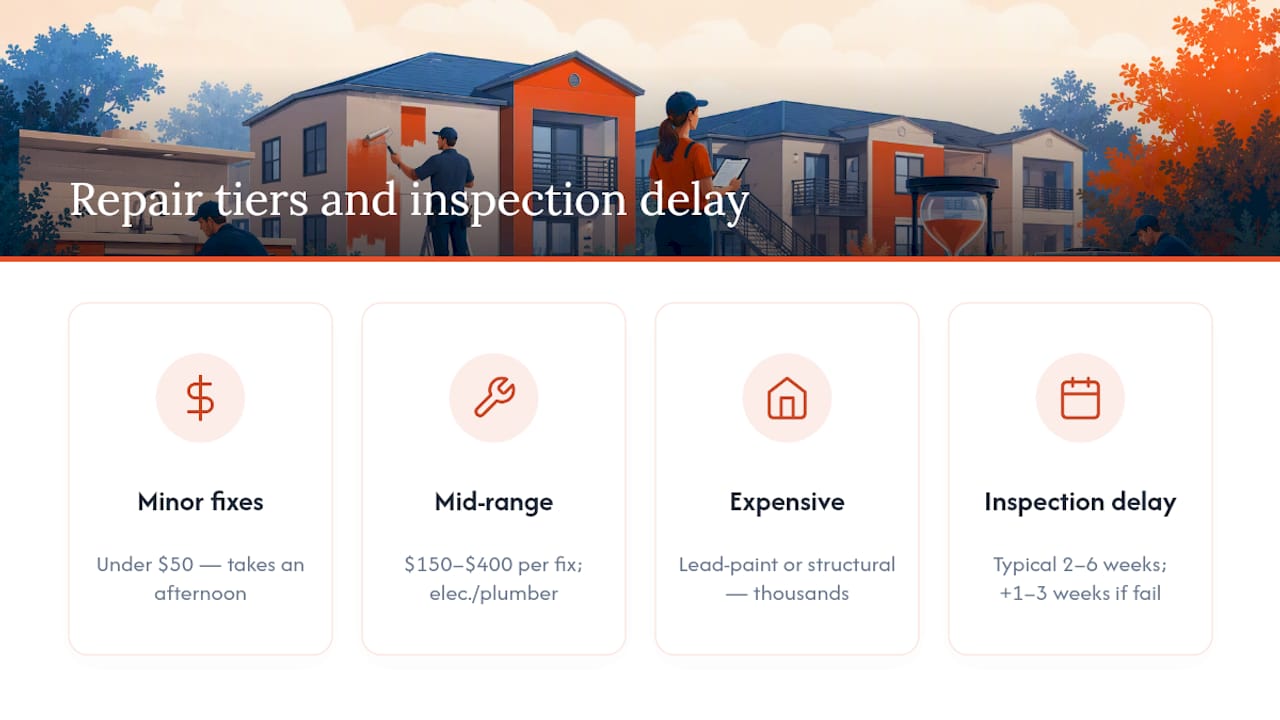
The two to six week window from RFTA to first payment assumes your unit passes inspection on the first try. When it does not, add another one to three weeks for repairs and a second inspection visit, plus whatever time your PHA takes to reschedule.

Cost depends entirely on what fails. The cheapest fixes, a missing outlet cover, a dead smoke detector battery, a loose handrail, run under $50 and take an afternoon. Mid-range fixes like GFCI outlet installation near sinks or replacing a water heater’s pressure relief valve typically run $150 to $400 per fix depending on your market and whether you hire an electrician or plumber. The expensive category is anything touching lead-based paint in pre-1978 units, where remediation can run into the thousands depending on the scope, or structural issues like a failing roof or foundation crack that NSPIRE inspectors flag as severe.

Section 8 repair costs and payment timeline

The pattern worth noting: units that pass on the first inspection almost always belong to landlords who self-inspected first. That single hour of prep against a checklist is consistently cheaper than the delay cost of a failed inspection, which can push your first HAP payment back by weeks.

Budget for ongoing maintenance too. NSPIRE inspections happen periodically throughout the lease term, not just at move-in, so a unit that passed last year still needs the same detectors working and the same GFCI outlets intact this year.

Handling Tenant Disputes and Complaints

Most Section 8 disputes fall into three categories: maintenance requests the tenant feels went unaddressed, disagreements over security deposit deductions at move-out, and confusion over who owes what portion of the rent when a HAP payment is late.

The fix for all three starts before the dispute happens. Document the unit’s condition at move-in with photos and a signed checklist, so move-out comparisons have a clear baseline. Respond to maintenance requests in writing, even a simple text confirming you received the request and when you will address it, so there is no ambiguity about response time later.

When a dispute does arise, resolve it in this order:

  • Talk to the tenant directly first. Most complaints about maintenance timing or deposit deductions resolve with a clear explanation and a reference to the lease terms.
  • Loop in the PHA if the dispute touches HAP payments or inspection compliance. The PHA has its own dispute process for HAP-related disagreements, and involving them early keeps you compliant with program rules.
  • Keep every communication in writing. Texts, emails, and portal messages create a record that protects you if the disagreement escalates to a formal complaint or legal action.
  • Know your state’s timeline requirements for responding to maintenance requests and returning security deposits, since these vary and Section 8 tenants have the same state-law protections as any other renter.

Complaints that go unresolved tend to end up either with the PHA, which can trigger a re-inspection outside your normal schedule, or with a local housing court. Both cost more time than a five-minute conversation would have.

Regulatory Changes and What They Mean for Your Property

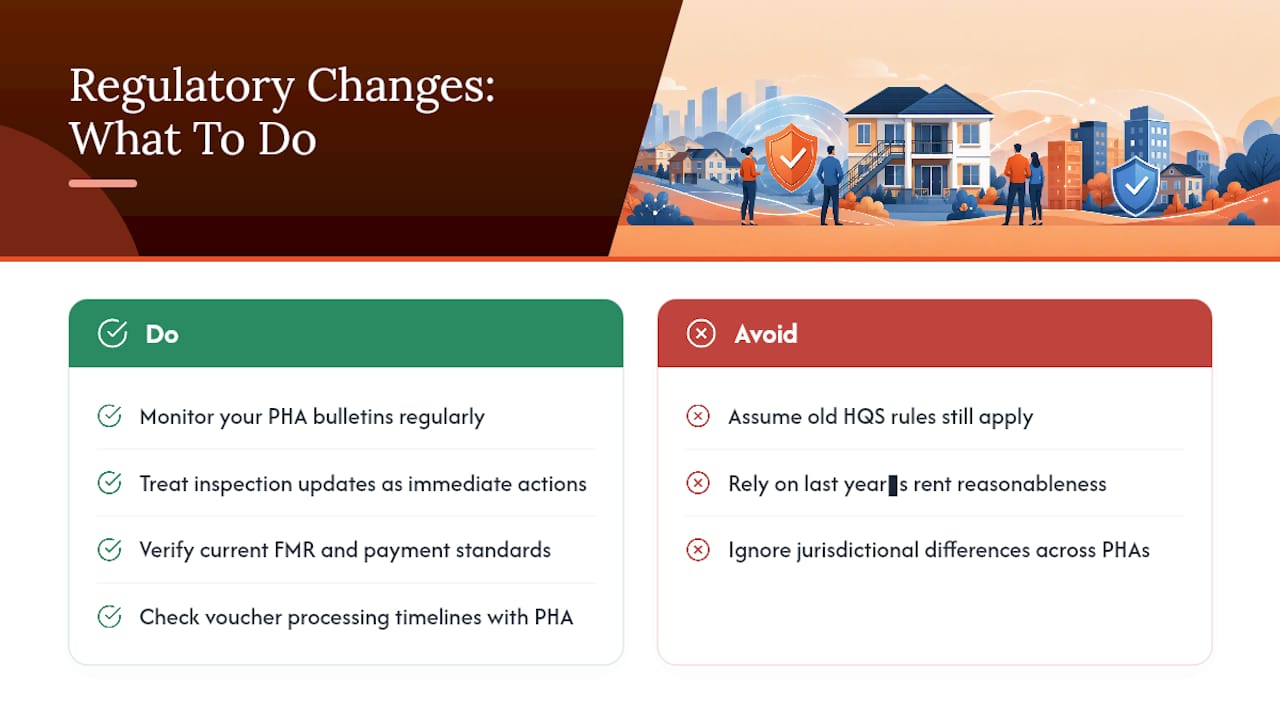
The Housing Choice Voucher program is not static. NSPIRE itself is a recent overhaul, replacing decades of HQS practice with a scored, severity-based inspection model that changed what inspectors look for and how strictly they grade it. Landlords who managed properties under the old HQS rules need to relearn the checklist, not assume the old standards still apply.

PHAs also periodically adjust their Fair Market Rent figures and payment standards, sometimes annually, which directly affects what rent the PHA will approve for your unit. A rent that cleared rent reasonableness last year is not guaranteed to clear this year if your local FMR moved or comparable market rents shifted.

Federal policy discussions about voucher funding levels and program administration surface regularly, and funding changes at the federal level can affect how quickly your PHA processes new vouchers, renews contracts, or issues payments. The GAO’s own reporting on processing delays points to administrative capacity, not just funding, as a recurring bottleneck.

The practical takeaway: do not assume the rules you learned when you first became a Section 8 landlord still apply years later. Check your PHA’s current landlord bulletin or newsletter periodically, and treat any inspection standard update as something to act on immediately rather than something to catch up on at your next scheduled inspection. A landlord managing multiple units across different PHAs faces this multiplied, since payment standards and even inspection scheduling can vary by jurisdiction even within the same state.

Regulatory Changes and What They Mean for Your Property — overview diagram

Record-Keeping That Protects You

Every HAP payment, every inspection report, every repair invoice, and every piece of correspondence with your PHA should live somewhere organized and searchable, not in a shoebox or a scattered email inbox. Time-stamped digital records resolve disputes faster and support contract renewal timelines, since a PHA processing a renewal wants to see a clean compliance history.

Keep these records at minimum:

  • Signed lease and HUD tenancy addendum for every voucher tenant
  • Move-in condition photos and signed checklists
  • Every inspection report, pass or fail, with the date and inspector’s notes
  • HAP payment history showing dates and amounts received
  • Repair invoices tied to inspection fail items, showing the fix and the date completed
  • Written correspondence with the PHA, including RFTA submissions and any dispute communications

This is not busywork. A landlord who can produce a full paper trail during a contract renewal or a payment dispute resolves the issue in days. A landlord without that trail is stuck reconstructing history from memory while payments sit on hold.

Common Challenges and Practical Fixes

The complaint heard most often from Section 8 landlords is the paperwork volume. Every unit needs an RFTA, every lease needs the tenancy addendum, every inspection needs documentation. The fix is not avoiding the paperwork. It is templating it. Build a standard packet for RFTA submissions once, and reuse it for every new voucher tenant with only the specific unit and tenant details changed.

The second recurring challenge is payment delays tied to contract renewals. Waiting until the last minute to confirm renewal status with your PHA guarantees you find out about a delay after it has already started. Calling thirty to sixty days ahead of a renewal date gives you room to fix any issue before it interrupts payment.

Inspection failures round out the top three challenges, usually from small items landlords assume are fine until an inspector flags them. The fix here is the same self-inspection habit covered earlier: walk the unit against the HUD checklist before every scheduled inspection, not just the first one.

A less discussed challenge is finding qualified applicants quickly enough to avoid vacancy stretching past what the subsidy offsets. Voucher holders often search PHA-run listing portals rather than general rental sites, so a unit only listed on a standard rental platform may sit vacant longer than necessary while eligible applicants never see it.

Marketing Your Property to Voucher Holders

List directly through your PHA’s landlord portal or listing service first. This is where most active voucher holders search, and it puts your unit in front of applicants who are already approved and ready to lease, cutting the usual back-and-forth over eligibility.

Beyond the PHA portal, standard rental listing sites still matter, since not every voucher holder limits their search to PHA channels. Write the listing the same way you would for any tenant: clear photos, accurate square footage, and an honest description of the unit’s condition. Note that the unit accepts vouchers explicitly in the listing text, since some applicants filter search results specifically for that phrase.

Pricing your listing at or near the local Fair Market Rent, rather than significantly above it, speeds up both applicant interest and PHA rent reasonableness approval. A unit priced well above comparable rents sits through a longer approval process even if you eventually find a tenant.

Landlords managing several units sometimes work with a real estate marketing service to keep listings visible across multiple channels at once, which matters more in markets with high voucher demand and fast-moving inventory. Whatever channel you use, respond to inquiries quickly. Voucher holders working against a time-limited voucher often need to secure a unit within a set window, and a slow response can lose you an otherwise qualified tenant.

An Owner’s Take on What Actually Works

The advice that circulates most about Section 8, treat every inspection like a pop quiz and hope for the best, is backwards. The landlords who do well under this program are the ones who front-load the work: self-inspect before the PHA shows up, build a relationship with a specific caseworker rather than calling a general line every time, and keep records organized before a dispute ever forces the issue.

What is overrated is the fear that voucher tenants are riskier than market-rate tenants. The data on payment reliability points the other direction. The subsidized portion of rent is not contingent on a tenant’s job status, and that alone removes a chunk of the risk that causes market-rate landlords sleepless nights. What is underrated is how much a failed first inspection costs in real time, not just repair dollars. A landlord who skips the self-inspection step and fails on the PHA’s first visit can lose three or four weeks waiting for a reinspection slot.

If you take one thing from this article, prioritize the relationship with your PHA caseworker over every other tactic. Everything else, faster payments, smoother renewals, quicker approvals, flows from that single working relationship.

— MediaBeast

Let Auben Realty Handle the PHA Side of Things

Auben Realty gives owners a full-service alternative to handling RFTA submissions, inspection prep, and PHA communication solo. Instead of learning your local PHA’s quirks through trial and error, you get a dedicated team that already knows the inspection checklist, coordinates directly with the housing authority, and reports back on payment status and repair costs without you chasing down answers.

Aubenrealty

When you request a quote, ask specifically about the manager’s experience with local PHAs, their track record on inspection pass rates, and how transparently they break down fees before work starts. Those three questions separate a manager who understands Section 8 operations from one who is guessing alongside you. Owners with units needing repair work before an inspection can also lean on Auben’s project management services to get fixes done fast and correctly the first time.

Ready to stop managing PHA paperwork on your own? Visit Auben Realty’s property management page to request a quote and see how a dedicated pod can take the inspection prep and HAP coordination off your plate.

Where to Verify These Rules Yourself

Check HUD’s PIH landlord resources and NSPIRE inspection guidance directly, review your local PHA’s landlord page (Philadelphia’s is a solid model), and read GAO’s reporting on HAP payment timeliness for the government’s own account of processing delays.

Sources

FAQ

How much does Section 8 pay landlords?

The amount varies by unit size, local Fair Market Rent, and the tenant’s income, since the PHA pays a HAP portion directly to the landlord while the tenant covers the rest, typically a portion of their adjusted income. There is no fixed nationwide amount. Check your local PHA’s current payment standard before setting your asking rent.

Who manages Section 8 properties?

Local Public Housing Authorities administer the voucher program and approve rents, inspections, and contracts, while the property owner or a hired property manager handles day-to-day leasing, maintenance, and PHA communication. Many owners work with a full-service manager like Auben Realty to handle inspection prep and PHA coordination directly.

What is happening with Section 8 housing policy right now?

Federal voucher funding and program administration are subject to periodic budget and policy debates, and changes at that level can affect how quickly PHAs process vouchers and renew contracts. Landlords should follow their specific PHA’s bulletins for the most current local rules rather than relying on general news coverage.

Which state has the most Section 8 tenants?

Voucher distribution tracks population and housing costs, with larger states generally administering more vouchers overall through their many local PHAs. Exact rankings shift as HUD funding allocations and local waiting lists change, so check HUD’s own data resources for current figures in your state.

How long does it take to get approved as a Section 8 landlord?

Most landlords see two to six weeks from submitting a Request for Tenancy Approval to receiving the first HAP payment. Failed inspections, incomplete paperwork, or PHA renewal backlogs are the most common causes of delay beyond that window.

Rental Listing Syndication: Get More Qualified Leads Fast

Yes, syndicate your listing. Post once, push it to a mix of major portals and local channels, then qualify leads fast rather than chasing every inquiry. The math is simple: one master listing that reaches renters on Zillow, Apartments.com, and a couple of hyper-local channels fills vacancies faster than any single site working alone.

Your fastest path depends on how hands-on you want to be:

  • DIY workflow: Build one clean listing, sync it through a syndication tool or your PMS, then post manually to one or two local groups for extra intent.
  • Managed syndication: Hand the listing, distribution, and lead screening to a property manager and skip the busywork entirely.

Key Takeaways

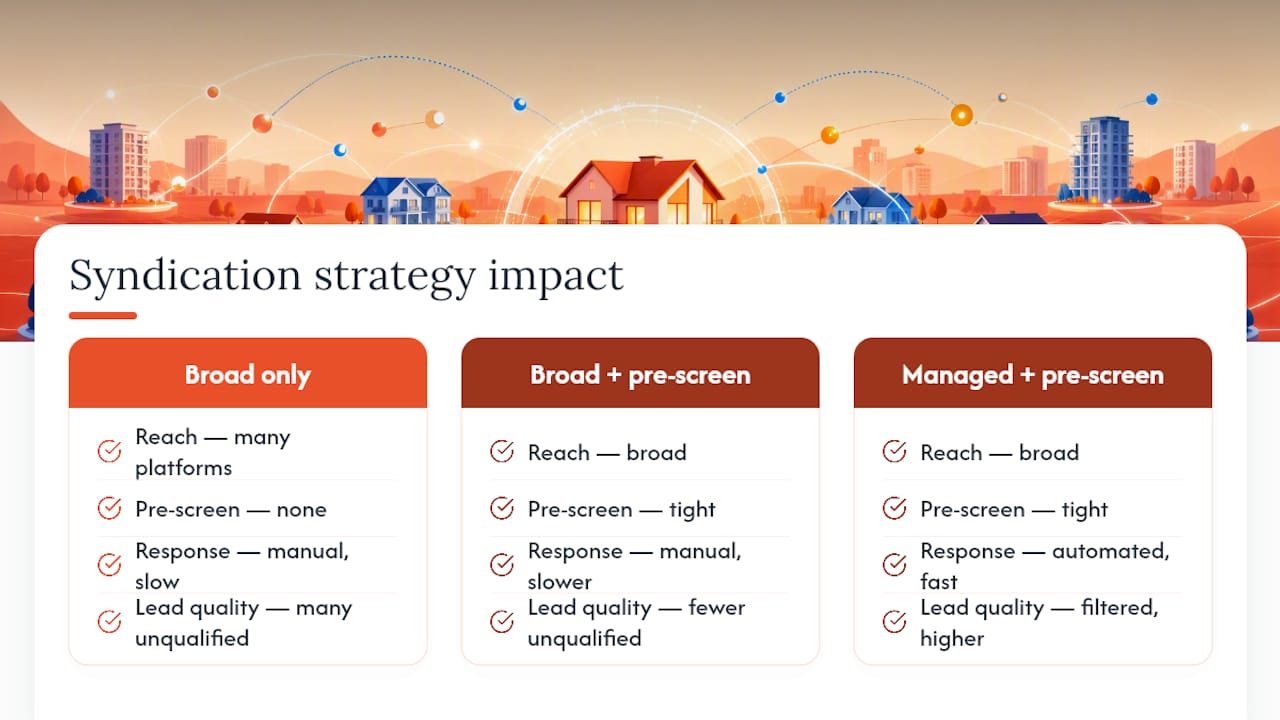
Rental listing syndication fills vacancies faster when you pair broad-reach portals with local channels and a tight pre-screen, not just more platforms.

Point Details
Build a layered stack Combine major portals like Zillow and Apartments.com with local Facebook groups and Nextdoor for higher-intent leads.
Complete every required field Missing rent, fees, or lease terms are the top cause of listings failing to sync or appearing incomplete.
Centralize your leads Route inquiries to one inbox or your PMS instead of checking each portal’s dashboard separately.
Pre-screen before showings A short form covering move-in date, income range, and pets filters out unqualified inquiries early.
Match effort to portfolio size One or two units suit DIY syndication; larger portfolios or limited time favor a managed service like Aubenrealty.

Table of Contents

What Is Rental Listing Syndication and Why Does It Matter?

Rental listing syndication is the process of creating one master listing and automatically distributing it to multiple rental websites at once instead of posting to each one by hand. Think of it as a wire service for your vacancy: write it once, and it shows up everywhere your renters are already searching.

The upside is straightforward:

  • Wider reach without repeating data entry on five different sites
  • Faster fill times because more eyes see the unit sooner
  • Consistent pricing, photos, and terms across every channel
  • One inbox for leads instead of six logins to check daily

There are trade-offs, too. You lose some platform-level control over how a listing displays, and broad-reach channels can bring in a higher share of unqualified or scam inquiries. Fair housing compliance and required disclosures also need to travel with the listing to every partner site, not just your primary one.

Syndication tools commonly distribute a single listing to dozens of marketplaces at once, and network composition (which partner tiers a service reaches) matters more than the raw count of sites. A listing that hits three high-traffic portals and two local groups usually outperforms one blasted to twenty low-traffic directories.

Which Platforms Should You Include in Your Listing Stack?

Build your stack in layers: start with the highest-volume portals, then add local and niche channels based on your unit type and market. The American Association of Landlords recommends anchoring on Zillow and Apartments.com as your core, then layering in Facebook Marketplace, local Facebook housing groups, and Nextdoor for higher-intent traffic.

Here’s how the common channels break down:

  • Zillow Rentals — the biggest audience for single-family and small multifamily units, strong for general market reach.
  • Apartments.com (CoStar network) — deep coverage of multifamily and larger communities, useful if you manage several units in one building.
  • Realtor.com Rentals — pulls in renters who are also comparing buying, a good fit for higher-end single-family homes.
  • Zumper — popular with younger renters and those searching by neighborhood filters; strong mobile traffic.
  • Craigslist — still generates volume in many metros but requires aggressive pre-screening since classified channels tend to attract more low-quality inquiries and scam attempts.
  • Apartment List — indexes millions of units nationally and is worth including for broad matching volume in metro markets.
  • Rental Beast — feeds listings into agent and MLS-adjacent networks, helpful if local agents refer tenants in your market.
  • Buildium — a property management platform with built-in syndication for owners already using it to manage leases and maintenance.
  • Reallyo — a syndication-focused service built to push listings across multiple marketplaces with a focus on complete, accurate field mapping.

Skip a channel if it doesn’t accept your listing type (some don’t support furnished or short-term units) or if past experience shows it brings mostly noise for your market.

How Does Rental Listing Syndication Actually Work?

Under the hood, syndication follows a simple chain: your master record feeds into a syndication platform, which pushes it out to partner portals, and leads flow back to one central inbox or your property management system (PMS).

Three common integration methods:

  • PMS two-way sync — your property management software and the syndication tool stay updated automatically, so a price change or a “rented” status posts everywhere at once.
  • Direct API or scheduled feed — a data feed (often CSV or XML) refreshes on a set schedule, common with tools built for PMS integrations and centralized lead capture.
  • Manual posting — used for local Facebook groups, Nextdoor, or community boards that don’t accept automated feeds.

Every partner site has its own quirks: identity verification steps, moderation delays before a listing goes live, and slightly different required fields. Missing or mismatched fields are a leading cause of listings failing to sync or appearing incomplete. Route leads to one central inbox rather than checking six portal dashboards. Centralized capture is the difference between responding in minutes and losing a renter to whoever answers first.

How Do You Set Up a Syndicated Listing Step by Step?

  1. Gather your listing data: rent, deposit, lease term, availability date, pet policy, utilities included, and parking.
  2. Shoot 10 to 15 photos, including a strong hero image for the listing thumbnail.
  3. Write your master listing description with neighborhood anchors and clear terms.
  4. Enter the listing into your syndication tool or PMS and map every required field.
  5. Push to your core portals first, then add local channels manually.
  6. Set up a central inbox or auto-responder so leads land in one place.
  7. Check each platform within 24 to 48 hours to confirm the listing actually went live.

Quick troubleshooting checklist:

  • Listing stuck in review? Check for missing required fields first.
  • Showing twice on one site? You likely have a duplicate feed pushing the same data.
  • No leads after a few days? Confirm the listing actually cleared moderation, not just submitted.

What Makes a Rental Listing Convert Better Than Average?

More views mean nothing if the leads aren’t real prospects. The fix starts with the listing itself, not the platforms it’s on.

Cover these basics every time: clear rent and fee breakdown, lease term, exact availability date, pet policy, what utilities are included, parking situation, laundry setup, and storage. Anchor the description with real neighborhood details, a specific grocery store, a school district name, a commute time to downtown, not vague phrases like “close to everything.” Use a strong primary photo and 10 to 15 total images with captions that call out features and nearby landmarks.

Cozy and modern apartment interior

Add a short pre-screen form before you hand out a showing time. Ask move-in date, household income range, credit range, and whether the applicant has pets. This alone filters out a large share of unqualified inquiries before they hit your calendar.

Pro Tip: Run your major portals for volume, but hand-post to one or two local Facebook groups or a university housing board. That hybrid approach consistently pulls in higher-intent, lower-scam applicants than automated syndication alone.

Why Do Some Syndicated Listings Stop Working?

Most syndication problems trace back to a handful of repeat offenders:

  • Listing not appearing on a partner site — usually a missing required field or a feed that hasn’t refreshed yet.
  • Duplicate listings on the same platform — often caused by re-submitting manually while an automated feed is still active.
  • Slow updates after a price or status change — check whether that partner uses a scheduled feed instead of real-time sync.
  • Verification holds — some portals require identity or ownership verification before a listing goes live, which can take a day or two.
  • Low-quality leads flooding your inbox — tighten your pre-screen questions rather than abandoning that channel.

Audit your feed mapping when the same error repeats across listings. Re-post manually only when a single listing is affected. If troubleshooting eats more hours than it saves, that’s the signal to hand syndication to a managed service instead of chasing partner support tickets.

What Fair Housing and Disclosure Rules Apply to Syndicated Listings?

Every syndicated copy of your listing carries the same legal weight as your original post. Federal fair housing law prohibits discrimination based on race, color, religion, sex, national origin, familial status, or disability in any advertisement, and that rule doesn’t loosen just because a partner site rewrote your description or auto-generated a summary.

Review language before it goes live. Phrases like “perfect for young professionals,” “no kids,” or “ideal for a single tenant” can violate fair housing rules even when the intent seems harmless. Photos matter too: avoid captions or descriptions that suggest a preference for or against any protected class.

Disclosures vary by state and sometimes by city, covering things like lead paint notices for older buildings, security deposit handling rules, or required move-in condition statements. When you syndicate to multiple partners, confirm each one displays your full listing text rather than truncating it in a way that drops a required disclosure. A shortened auto-summary that cuts your pet policy or lease term isn’t just confusing, it can create liability if a renter claims they weren’t informed.

Keep one master version of your compliant listing language and treat every partner site as a copy of it, not a place to write something new. If you manage several units across different states, the disclosure requirements can differ property by property, so don’t assume one boilerplate works everywhere.

Rental Listing Syndication for Landlords: What Actually Moves the Needle

The industry loves to sell syndication as a numbers game: more platforms, more eyeballs, more leads. That’s not wrong, but it’s incomplete. The landlords who actually fill units faster aren’t the ones blasting listings to the most sites. They’re the ones pairing broad reach with a tight pre-screen and a fast response time.

Conventional advice tends to stop at “syndicate everywhere.” The gap is what happens after the listing goes live. A flood of unqualified messages from a wide-net platform wastes more time than it saves if there’s no filter catching them before they hit your calendar. Response speed matters just as much as reach: automated lead capture and fast initial responses noticeably improve conversion compared to manual follow-up, and that advantage compounds across every channel you’re syndicated to.

Diagram comparing syndication strategies on lead quality

If you take one thing from this, prioritize the pre-screen and the inbox setup before you worry about adding a tenth platform to your stack. Reach without filtering just means more noise to sort through.

Should You DIY Syndication or Hire a Manager?

There’s a real DIY path here, and plenty of landlords run it well: a syndication tool, a clean master listing, and a Saturday morning to check partner sites. But if you’re managing more than a unit or two, or you’ve ever spent an evening chasing down why a listing vanished from one portal, you know the hours add up fast.

Aubenrealty handles the entire syndication process for owners who’d rather not manage six logins and a screening queue themselves. That includes building the master listing, pushing it across the major portals and local channels covered above, routing every lead into one screened pipeline, coordinating showings, and handling the lease paperwork once a qualified applicant is ready to sign. With more than 15 years managing rental properties and 2,700 properties served across ten regional markets, Aubenrealty has already worked through the partner-specific quirks that trip up DIY syndication, from verification holds to fair housing language review.

The decision usually comes down to inventory and time. One unit with some flexibility on your schedule? DIY is reasonable. Several units, a full-time job, or a track record of slow fills? The math tips toward managed syndication fast. Browse current rental listings to see how Aubenrealty presents properties across its markets, or reach out about property management services to get your next vacancy syndicated and screened without doing it yourself.

Frequently Asked Questions

What is rental listing syndication?
It’s the process of creating one master rental listing and distributing it automatically to multiple websites, like Zillow, Apartments.com, and Zumper, instead of posting to each site by hand.

Is Zillow or Apartments.com better for syndication?
They serve slightly different audiences. Zillow tends to draw broader single-family and small multifamily traffic, while Apartments.com’s CoStar network has deeper coverage of larger multifamily communities. Most landlords benefit from including both.

Should I use Zillow Rental Manager or a tool like Avail?
Zillow Rental Manager syndicates directly to Zillow’s own network and a few partners, while broader tools or a managed service can push your listing to a wider mix of major portals and local channels at once. Choose based on how many channels you actually want covered.

How long does it take for a syndicated listing to appear on partner sites?
It varies by platform. Some update within hours, others take a day or two due to moderation or identity verification holds.

Do I still need to post manually to local channels if I use syndication software?
Yes, for best results. Automated syndication covers the major portals, but manual posts to local Facebook groups or community boards tend to bring in higher-intent, lower-scam leads.

What’s the biggest reason syndicated listings stop showing up correctly?
Incomplete or mismatched required fields, followed by duplicate feeds pushing the same listing twice on one platform.

Sources

Made with BabyLoveGrowth to reach ChatGPT users

What Should a Property Manager’s Maintenance Invoice Show? | Property Management Company in Fort Worth, TX

A useful maintenance invoice should show what failed, what work was authorized, who completed it, how labor and materials were charged, and what condition remained afterward. If your monthly statement says only ‘plumbing repair—$475’, you can’t see the scope, time, parts, photographs, or approval history. That transparency matters when you’re evaluating a property management company in Fort Worth, TX.

The amount due is only the endpoint. Before paying, trace the repair description, authorization trail, vendor compensation, and records that should support your property file after payment clears.

The Invoice Should Reconstruct the Repair | Property Management Company in Fort Worth, TX

An owner-facing invoice should identify:

  • Property address and work-order number 
  • Dates reported, scheduled, and completed 
  • Original problem or resident complaint 
  • Diagnosis and repair performed 
  • Technician or vendor 
  • Labor time and billing increment 
  • Parts, materials, and quantities 
  • Trip, diagnostic, or after-hours fees 
  • Taxes, markups, discounts, and total 
  • Photographs or supporting notes, when appropriate 
  • Warranty terms or recommended follow-up 

Itemization lets you understand the expense without chasing a manager, technician, and vendor for missing context. Brevity isn’t the same as vagueness. 

Replacing a part may require less documentation than repairing an HVAC system, but every charge should connect to a reported problem, completed action, and accountable provider.

Also Read: Rent or Buy: Identifying the Best Course of Action

Approval and Emergency Authority Need a Paper Trail | Property Management Company in Fort Worth, TX

The invoice should match the authority granted in your management agreement:

  • Below the threshold: The manager may proceed within the agreed spending limit. 
  • Above the threshold: You may expect an estimate and approval request before work begins. 
  • Urgent or safety-related: Immediate action may be permitted to protect a resident or the property. 

Resident-caused damage is a separate accounting question. The lease and evidence determine whether an owner or resident may be responsible.

Invoices, estimates, work orders, approvals, and emergency notes should tell one story, not reveal a changed scope only after the final charge arrives.

Vendor Incentives Can Influence the Final Charge

Ask a property management company in Fort Worth, TX, how its maintenance model works:

  • Are repairs completed in-house, by independent vendors, or both? 
  • Does the company receive vendor referral payments? 
  • Are administrative fees and markups disclosed? 
  • How are labor increments calculated? 
  • Can partial-hour work receive partial-hour billing? 
  • Who confirms that the proposed repair fits the reported problem? 

A markup isn’t improper when disclosed and tied to real coordination or oversight. Compensation shouldn’t reward unnecessary dispatches, inflated scopes, or vendor selection based on payments rather than service quality and owner value.

Today’s Invoice Should Improve Tomorrow’s Repair Decision

Organized maintenance records turn separate invoices into a useful property history. They help you and your manager:

  • Identify repeated failures in the same system 
  • Separate a callback from a new repair 
  • Track labor and parts warranties 
  • Compare recurring repair costs with replacement 
  • Support bookkeeping and year-end reporting 
  • Add context during inspections, refinancing, or sale 

Together, related invoices may reveal aging equipment, incomplete work, resident misuse, or an overdue replacement decision.

Ask to See the Paper Trail Before Handing Over the Keys

Backed by 15-plus years’ experience and over $500 million under management, Auben Realty is an investor-focused property management company in Fort Worth, TX, serving Dallas–Fort Worth. 

Our local agents, managers, and in-house maintenance team offer leasing, resident support, reporting, partial-hour billing, and no-pay-to-play vendors. 

Get a Free Rental Analysis or schedule a discovery call about repair approval, billing, documentation, and oversight.

The Value We Found in Dallas-Fort Worth

Market momentum is creating an opportunity to strengthen our presence, grow the Auben brand and build the team for what comes next.

A recent GlobeSt article examined how technology talent is expanding beyond the markets that have traditionally dominated the sector. Dallas-Fort Worth stands out in that shift.

CBRE now ranks Dallas-Fort Worth No. 8 among North America’s tech talent markets. GlobeSt also reports that the region added 37,230 tech workers between 2022 and 2025, an 18.7% increase and the largest gain among U.S. markets included in the report.

Those numbers are about technology, but the signal is broader. Companies are investing in Dallas-Fort Worth, skilled workers are choosing the region and the market is gaining depth.

That matters to Auben because Dallas-Fort Worth is not a future market for us. It is our primary operational market and Regional Operating Center. Charleston remains our Corporate Headquarters.

Building more than a presence

Auben has always believed that real estate investors should benefit from local market expertise without giving up the advantages of a broader operating platform. Our integrated approach brings property management, project management, investment sales and an asset management mindset together around the owner and the performance of the property.

Dallas-Fort Worth gives us an opportunity to put that model to work at a greater scale. Being close to the market helps our teams understand what owners are experiencing, see changes as they happen and build stronger relationships with investors, developers, brokers and industry partners.

Presence alone does not build a brand. Performance does.

From a marketing perspective, our responsibility is to make the value of that performance clear. We need to show what Auben does differently, share useful local insight and make sure the right people understand how our teams help owners operate and grow their portfolios. We also need to be active in the relationships and conversations shaping the Dallas-Fort Worth real estate market.

The goal is not awareness for its own sake. It is trust, relevance and business growth supported by a reputation Auben has earned.

Building the team to support the opportunity

None of this happens without the right people.

Our recruiting approach is intentional because the work demands it. We do not want to hire our way out of a crisis or fill a seat simply because it is open. We want to build ahead of the work and bring in people who can contribute to Auben’s long-term success.

Experience matters, but it is not enough on its own. We look for people who reflect Auben’s six core characteristics:

  • Team Oriented: They work toward shared success and support the people around them.
  • Direct and Communicative: They communicate clearly, respectfully and early.
  • Solution Oriented: They bring answers, not just problems.
  • Always Accountable: They take ownership of their work and its outcome.
  • Sense of Urgency: They understand what needs to move and act on it.
  • Underdog DNA: They are resourceful, resilient and willing to earn the result.

These are not recruiting slogans. They are operating expectations. They help us identify people who can accept

feedback, solve problems, follow through and continue learning as the company grows.

Dallas-Fort Worth’s expanding talent base gives Auben access to people with a wide range of experience and perspective. Our job is to identify those who can succeed within our culture, serve our clients well and help strengthen the organization over time. We want to build real estate careers, not simply staff positions.

What comes next

Dallas-Fort Worth offers Auben a meaningful opportunity, but taking advantage of it will require discipline. We need strong local operations, integrated services, a clear and credible brand, productive industry relationships and people who know how to execute.

When those pieces work together, growth can create better outcomes for owners, residents, employees and the communities we serve. Locally, our Dallas property management team is a big part of how we deliver on that promise for investors every day.


This week’s blog comes to us from our Director of Marketing and Training, Lakyn Samaniego, and our Corporate Recruiter, Holly Moncibaiz!

Breaking Down Cost Segregation & Bonus Depreciation

Powerful Tax Strategies for Real Estate Investors

As real estate investors look for ways to maximize returns and improve cash flow, cost segregation and bonus depreciation have become two of the most valuable tax planning tools available. When used strategically, these techniques can significantly reduce taxable income and help investors keep more capital working in their portfolios. 

What Is Cost Segregation? 

Cost segregation is a tax strategy that allows real estate owners to accelerate depreciation deductions on certain components of a property. Rather than depreciating an entire building over the standard 27.5 years for residential property or 39 years for commercial property, a cost segregation study identifies assets that can be depreciated over shorter periods, typically 5, 7, or 15 years. 

Examples may include: 

  • Flooring and carpeting 
  • Appliances and fixtures 
  • Decorative lighting 
  • Landscaping and site improvements 
  • Parking lots and sidewalks 

By separating these components from the building structure, investors can recognize a larger portion of depreciation expenses earlier in the property’s life cycle. 

What Is Bonus Depreciation? 

Bonus depreciation allows investors to immediately deduct a significant percentage of qualifying assets identified through a cost segregation study. Instead of spreading these deductions over several years, investors can take advantage of accelerated write-offs in the year the property is placed into service or the cost segregation study is completed. 

When combined with cost segregation, bonus depreciation can create substantial upfront tax savings that improve liquidity and preserve capital for future investments. 

How These Strategies Benefit Real Estate Investors 

For many investors, the primary advantage is increased cash flow. Lower taxable income can result in reduced tax liability, allowing owners to retain more of their investment capital. 

Potential benefits include: 

  • Increased after-tax cash flow 
  • Enhanced return on investment 
  • Greater capital available for acquisitions and improvements 
  • Improved portfolio growth opportunities 
  • Tax-efficient wealth preservation strategies 

These benefits can be especially impactful for investors with larger portfolios, high-income earners, and those actively acquiring rental properties. 

Who Should Consider Cost Segregation? 

Cost segregation is often most beneficial for investors who: 

  • Own rental properties with substantial building value 
  • Have recently purchased or constructed real estate 
  • Expect significant taxable income from real estate or other investments 
  • Plan to hold properties long enough to realize the tax advantages 

Because every investment situation is unique, investors should work closely with qualified tax professionals to determine whether a cost segregation study aligns with their financial goals and tax strategy. 

A Strategic Tool for Long-Term Wealth Building 

Real estate investing offers numerous opportunities to build wealth, but understanding the tax advantages available can be just as important as selecting the right property. Cost segregation and bonus depreciation provide investors with powerful tools to accelerate deductions, increase cash flow, and create greater flexibility for future growth. 

At Auben, we believe successful investing starts with understanding every tool available to maximize returns. For investors focused on scaling their portfolios and preserving capital, cost segregation and bonus depreciation remain two of the most effective strategies in today’s real estate market! 


This week’s blog comes to us from our Houston Market Sales Manager, Kristen Brady!

Tune in to the latest episode of Real Estate Rewind on Thursday, August 27th, and be sure to leave a review, subscribe, and share it with your friends!

How Property Managers Negotiate Better Vendor Deals for Landlords | Dallas Property Management

Owning rental properties involves more than collecting rent. Repairs, maintenance, inspections, and property improvements all require reliable vendors. The cost of these services can quickly affect profitability.

This is where professional Dallas property management services create real value. We work with vendors regularly and build long-term relationships that benefit our clients. Because we manage multiple properties, we can often secure better pricing, faster service, and higher quality work than individual landlords can obtain on their own.

For property owners, those savings add up over time and help protect investment returns.

How Volume Creates Negotiating Power | Dallas Property Management

Access to Better Pricing

One of the biggest advantages of working with a property management company is purchasing power.

Because we coordinate maintenance and repair work across many properties, vendors receive consistent business from us. In return, they are often willing to offer discounted rates.

These savings may apply to:

  • Plumbing services
  • Electrical repairs
  • Landscaping
  • Cleaning services
  • HVAC maintenance
  • General contracting work

A single landlord may not generate enough work to negotiate lower rates. We can often secure pricing that reduces operating expenses across the portfolio.

Choosing Vendors Based on Value, Not Just Cost | Dallas Property Management

Evaluating Quality and Reliability

The lowest bid is not always the best option. Poor workmanship often leads to repeat repairs and higher expenses later.

When managing a property, we evaluate vendors using several criteria. We look at their experience, response times, quality of work, insurance coverage, and reputation.

Our goal is to find professionals who deliver consistent results at a fair price. This approach helps landlords avoid costly mistakes while keeping properties in excellent condition.

Creating Long-Term Partnerships

Building Trust with Service Providers

Successful negotiations are rarely one-time events. They develop through strong professional relationships.

We communicate clearly with vendors and provide a steady stream of work. In return, many vendors prioritize our requests and offer favorable pricing structures.

This relationship becomes especially valuable during emergencies. When urgent repairs are needed, trusted vendors are more likely to respond quickly and help minimize disruptions for tenants.

That advantage makes managing a property far less stressful for owners.

Negotiating Beyond Price | Dallas Property Management

Securing Additional Benefits

A strong vendor agreement goes beyond a lower invoice.

As part of our Dallas property management services, we often negotiate additional benefits that improve value for landlords. These may include:

  • Faster response times
  • Extended service warranties
  • Priority scheduling
  • Preventive maintenance programs
  • Reduced fees for recurring work

These advantages help protect properties while improving efficiency and tenant satisfaction.

Monitoring Performance and Accountability | Dallas Property Management

Ensuring Vendors Meet Expectations

Negotiation does not end when a contract is signed. We continually monitor vendor performance to ensure they deliver on their commitments.

We track work quality, completion times, and tenant feedback. If a vendor fails to meet expectations, we address concerns promptly or seek better alternatives.

This ongoing oversight helps maintain service standards and ensures property owners receive the value they expect. It also supports smoother long-term property management.

Maximize Returns with Expert Vendor Management

Vendor negotiations play an important role in controlling costs and protecting rental investments. Better pricing, dependable service, faster response times, and stronger accountability all contribute to improved property performance.

Through professional Dallas property management, we help landlords benefit from established vendor relationships and proven negotiation strategies. At Auben, we work to reduce unnecessary expenses while maintaining high standards across all the properties we manage. Contact our team today to learn how our expertise can help your investment perform more efficiently and profitably.

What Student-Town Rental Cycles Teach Local Landlords | Property Management Company in Columbia

Student rental timing doesn’t wait for owners to catch up. Once keys, move-out condition, deposit questions, and next-lease expectations collide, the clock starts moving fast. Late summer can bring repair surprises, parent questions, cleaning needs, and new applicant pressure all at once.

Our property management company in Columbia helps turn that turnover window into a plan, because the next lease often depends on what gets handled right after the last tenant leaves.

Lesson One: Move-Out Day Starts the Next Lease

Move-out day isn’t just a closing date. It sets the pace for the next rental window. If keys are late, access is unclear, or inspection timing slips, the repair and cleaning window can shrink fast.

Owners need a clear move-out process before pressure builds. Tenant communication, access instructions, inspection scheduling, and next-step planning all affect how quickly the property can be ready for the next lease.

The Walkthrough Should Catch More Than Obvious Damage | Property Management Company in Columbia

A student rental walkthrough should look past the visible mess. Trash, dust, or leftover items may be easy to spot, but the bigger clues can hide in how the home was used.

Check appliances, doors, flooring, fixtures, walls, windows, and exterior areas. Note cleanliness concerns, missing items, and signs of misuse. Separating normal wear from possible tenant damage helps owners set repair priorities before the next applicant or tenant steps inside.

Also Read: How Property Management Companies Handle Difficult Tenants 

Parent and Applicant Questions Need Clear Answers

In a student-town market, the applicant may not be the only person asking questions. Parents can be part of the decision too, especially around:

  • Lease terms and deposit expectations
  • Move-in dates and access details
  • Repair status before occupancy
  • Safety, communication, and response times
  • How questions or concerns should be handled

Our property management company in Columbia helps keep answers consistent and professional, so the rental feels organized instead of confusing before the lease begins.

The Repair Window Is Shorter Than It Looks

The time between move-out and the next move-in can disappear quickly. Inspection notes, cleaning needs, vendor schedules, and touch-ups all compete for the same narrow window.

Before the next lease begins, owners may need to line up:

  • Cleaning and trash removal
  • Wall, flooring, and fixture repairs
  • Appliance checks
  • Exterior touch-ups
  • Photo updates before relisting or confirming move-in

Even one delayed repair can push everything else back, especially when applicants or incoming tenants are already asking for updates. A clear order keeps the property from sliding into last-minute panic.

Documentation Can Calm the Deposit Conversation | Property Management Company in Columbia

Deposit questions can turn emotional fast, especially when students, parents, and owners remember the property differently. Damage disputes need proof, not guesswork.

Photos, inspection notes, repair records, invoices, and communication history can help explain what happened and why certain repair decisions were made. Clear documentation protects owner confidence during deposit conversations.

It also gives you a better record for future maintenance planning, turnover timing, and lease-cycle decisions.

Keep the Next Rental Cycle From Getting Messy

Student-town rentals move quickly, but turnover doesn’t have to turn into a guessing game. Scott Properties of Charleston brings Lowcountry-rooted rental management experience with tenant screening, maintenance coordination, rent collection, reporting, property evaluations, and clear owner communication. Our property management company in Columbia helps owners stay ahead of the next lease cycle. Talk with us about management support.

The Garage Premium in Build-to-Rent Townhomes

Walk through almost any American neighborhood and you’ll notice something interesting: Many garages aren’t filled with cars—they’re filled with everything else that makes up our daily lives. Whether it’s because we’re collectors, hobbyists, or simply like having extra storage, one thing is clear: 

Americans love their stuff. 

For build-to-rent developers and investors, that’s more than an interesting observation—it’s a business opportunity. 

A recent study from Yardi Matrix and Hunter Housing Economics analyzed more than 1,500 rental townhome communities representing over 238,000 units to answer a question many developers have only loosely considered: 

What is a garage really worth? 

The answer surprised even seasoned industry professionals. 

More Than a Place to Park 

According to the research, a one-car garage generated approximately $1,680–$2,580 in additional annual rent, while a two-car garage produced $2,940–$4,440 per year in additional rental income. At a 6% exit cap rate, that translates to approximately $37,850 in additional implied value per unit—often exceeding the additional construction cost.  

As the authors conclude, ”The headline findings are unambiguous.” Garages are proving to be much more than an amenity. They’re a measurable value driver for modern build-to-rent communities.  

If you’d like to dive deeper into the research, you can read Brad Hunter’s full white paper and article here.

You can also watch Brad Hunter discuss the findings in this video:

The Hidden Value Isn’t Just Rent 

Here’s where the research becomes even more compelling. 

Communities with garages don’t simply collect higher rents—they tend to perform better operationally. Residents with garages move less frequently, resulting in lower turnover, reduced make-ready expenses, fewer leasing commissions, and less vacancy loss. The study estimates these operational advantages contribute an additional $350–$650 per unit annually in effective NOI. 

In other words, the garage continues producing value long after the lease is signed. 

Auben Sees It Every Day 

The national research aligns with what our leasing teams experience across our portfolio. 

Prospective residents regularly ask one of the first questions before scheduling a tour: 

“Does it have a garage?” 

Storage has become one of today’s most desired amenities. Whether it’s seasonal decorations, lawn equipment, bicycles, strollers, or simply a place to keep life’s extras, residents consistently place a premium on having additional enclosed space. 

“We’ve found that garages do more than provide parking—they give residents the extra storage they’re looking for. The added space is something people are willing to pay for.” -Auben Team Member 

These conversations reinforce something the data confirms: garages aren’t just appreciated—they influence leasing decisions. 

Cedar Creek Put the Theory Into Practice 

At Auben Realty, we’ve had the opportunity to see these findings play out in real time. 

During the lease-up of Cedar Creek, homes with attached garages consistently outperformed nearby comparable communities by supporting stronger rental rates while maintaining excellent leasing momentum. 

Cedar Creek Results 

  • Average Rent: $2150 
  • Comparable Communities: $1950 
  • Monthly Rent Premium: $250 
  • Lease-Up Timeline:8 months 
  • Occupancy: 100% 

Those results mirror the national research and reinforce what we’ve experienced firsthand: residents recognize the value of garages and are willing to pay for them. 

A Down Side… The downsides point to dense urban markets and legacy stock-heavy markets where transit and urban density limit the need for garages or “no garage” is often well-established.  These markets have the smallest garage premium (4%-7%) as compared to markets where car dependency is great, demand for enclosed parking, or markets accustomed to garage living have garage premiums of (8-18%). 

A Different Way to Think About Garages 

Developers have traditionally viewed garages as another line item in the construction budget. 

But perhaps that’s the wrong way to look at them. 

National research, combined with our own experience leasing build-to-rent communities, suggests that garages do far more than provide a place to park a vehicle. They create additional storage, support today’s renter lifestyle, differentiate communities from nearby competition, and contribute to stronger financial performance. 

That doesn’t mean every market is the same. 

In dense urban environments and legacy markets where public transit is widely available—or where older housing stock has historically been built without garages—the premium tends to be much smaller. In these locations, the value of enclosed parking is often outweighed by walkability and established housing patterns, resulting in garage premiums of approximately 4%–7%. By contrast, suburban markets where residents rely heavily on personal vehicles and have come to expect attached garages routinely see premiums ranging from 8%–18%.  

For Auben’s markets across the Southeast, that distinction is especially meaningful. Many of the communities we serve are suburban, vehicle-dependent, and attract residents who value both convenience and additional storage. Our leasing teams hear it every day, and our experience at Cedar Creek reinforces what the national research demonstrates: garages consistently help homes stand out in the marketplace. 

The garage isn’t simply another amenity to list in a marketing brochure. It’s becoming a structural driver of rental income, resident retention, and long-term asset value. Developers who evaluate garages solely as a construction expense may be overlooking one of the most impactful investments they can make in a build-to-rent community. 

Sometimes the highest return on investment isn’t found inside the home. 

It’s waiting just beyond the garage door. 


This week’s blog post comes to us from Ivan Jenkins!